
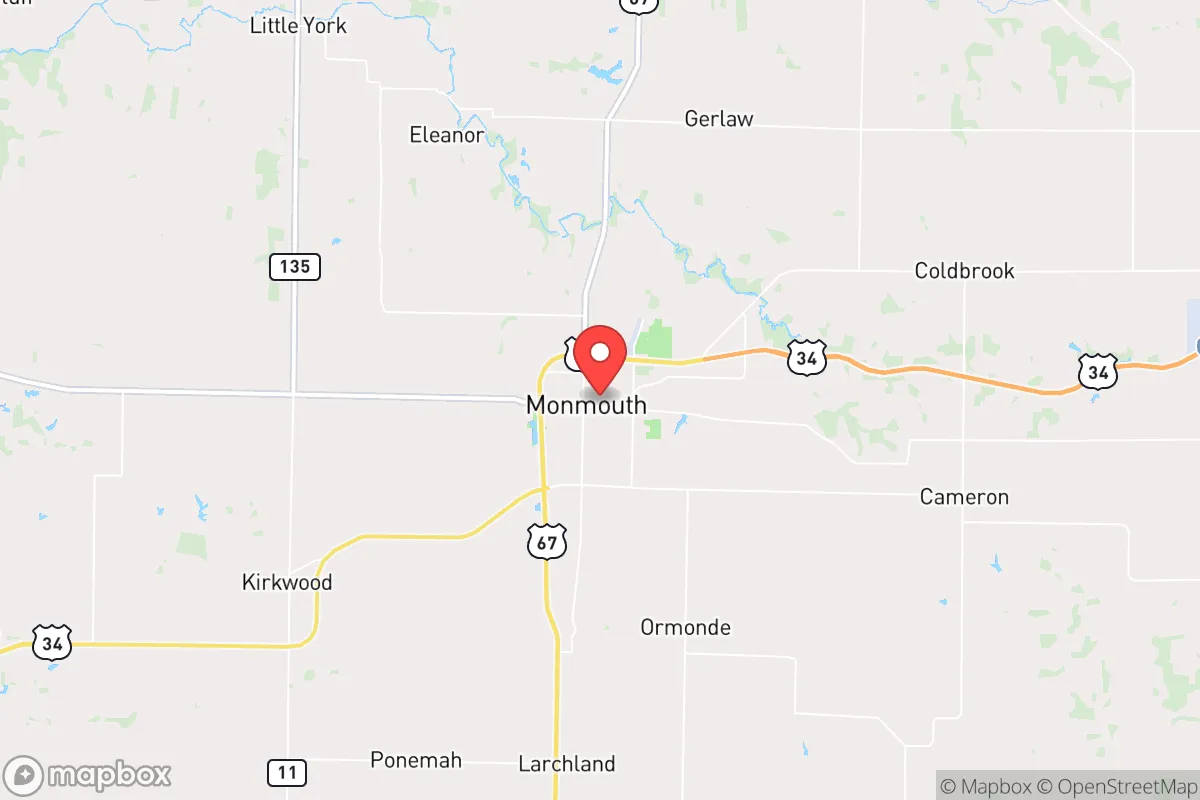
Photo: Wikipedia
Personal Sovereignty in Monmouth, IL
Viable for self-reliance. Generally workable, though some barriers may limit total independence.
What does Personal Sovereignty tell us?
Personal Sovereignty measures your capacity for self-reliance and independence with minimal government friction. Higher scores mean fewer barriers between you and the way you want to live... but it assumes you have the space you need and good neighbors.
What does this tell us?
Personal Sovereignty measures your capacity for self-reliance and independence with minimal government friction. Higher scores mean fewer barriers between you and the way you want to live... but it assumes you have the space you need and good neighbors.
State Policy
Energy independence: Importer (63% of energy produced in-state)
Personal Liberty
Homesteading

Personal Liberty Analysis
Monmouth, Illinois offers a notably high degree of personal sovereignty relative to many other Midwestern communities, particularly for those who value self-reliance and minimal government intrusion. The city’s small-town character, combined with Illinois’s generally permissive self-defense laws and a light-touch local regulatory environment, creates a setting where individuals and families can exercise significant control over their daily lives. While the state-level tax burden is a genuine consideration, Monmouth’s local governance and cultural norms lean heavily toward personal autonomy, making it a compelling option for relocation-minded readers who prioritize independence over convenience.
Tax burden and regulatory posture in Monmouth and Warren County
Illinois carries a reputation for high taxes, and Monmouth residents do face a state income tax rate of 4.95% and a statewide property tax burden that ranks among the highest in the nation. However, the local picture is more nuanced. Warren County’s property tax rates are moderate for Illinois, and Monmouth’s municipal government maintains a relatively hands-off approach to business and property regulation. There is no local income tax, and the city’s zoning code is straightforward, with no overlay districts or excessive permitting requirements for common residential improvements like sheds, fences, or home-based businesses. The regulatory posture is best described as light-touch but not absent: building permits are required for major structural work, but the process is typically quick and inexpensive. For a family or individual looking to minimize bureaucratic friction, Monmouth’s local governance is a clear advantage over larger Illinois cities like Chicago or even Peoria, where permitting and compliance can be more burdensome.
Self-defense and gun law specifics in Illinois and Monmouth
Illinois is a shall-issue state for concealed carry, meaning that any law-abiding adult who completes a 16-hour training course and passes a background check can obtain a Concealed Carry License (CCL). Monmouth itself has no additional local gun ordinances beyond state law, so residents enjoy the full scope of Illinois’s self-defense framework. This includes stand-your-ground protections in the home and vehicle, though Illinois does not have a broad stand-your-ground law for public spaces—a nuance that matters for those who carry daily. The state also prohibits firearms in certain “gun-free zones” like schools and government buildings, but these restrictions are standard nationwide. For the self-defense-minded reader, Monmouth offers a practical balance: the legal right to carry and defend oneself is clearly established, but the training requirement and limited public carry zones mean it is not a “constitutional carry” state. The local sheriff’s office is known for efficient processing of Firearm Owner’s Identification (FOID) cards and CCL applications, with wait times typically under 90 days.
Self-reliance and homesteading viability: lot sizes, zoning, and off-grid feasibility
Monmouth’s residential zoning is notably permissive for a city of its size. Standard residential lots range from one-quarter to one-half acre within city limits, and many properties in the older neighborhoods offer larger lots of up to one acre. This space is sufficient for substantial vegetable gardens, small orchards, and even a few chickens—backyard poultry is explicitly allowed with a simple permit. The city’s zoning code does not prohibit rainwater collection, composting, or clotheslines, all of which are common sights in Monmouth’s older neighborhoods. For those seeking true off-grid living, the rural areas immediately outside city limits in Warren County offer even more flexibility: no building permits are required for agricultural structures, and properties of 5 to 40 acres are available at prices well below the national median. Solar panels are permitted without special review, and several local contractors install grid-tied systems. The main limitation for full off-grid living is Illinois’s net metering policy, which is favorable but requires connection to the grid—completely disconnecting from the power company is technically possible but would require a battery system and backup generator, as the local climate offers only moderate solar insolation. Overall, Monmouth provides a strong environment for self-reliance, especially for those willing to live just outside city limits.
Personal liberties: parental rights, medical autonomy, speech, and property
Monmouth’s cultural and legal environment strongly supports parental rights in education and healthcare. The local school district, Monmouth-Roseville Community Unit School District 238, has a transparent curriculum policy and does not enforce any controversial health or sex education programs without parental opt-in. Medical autonomy is generally respected: Illinois law does not mandate COVID-19 or other routine vaccinations for adults, and the state’s medical freedom protections are among the stronger in the Midwest. Informed consent requirements for medical procedures are robust, and no local ordinances restrict access to alternative or complementary medicine. Free speech is fully protected under the First Amendment, and Monmouth’s public forums—including the city council meetings and the downtown square—see active, uncensored debate on local issues. Property rights are well-defined: the city has no rent control, no short-term rental bans, and no historic preservation overlay that would restrict what owners can do with their homes. Eminent domain is rarely used, and the local government has a reputation for respecting private property boundaries. For the reader who values personal liberty across multiple domains, Monmouth presents a consistently freedom-respecting environment with few local overrides of individual choice.
In the broader context of the Midwest, Monmouth ranks as a strong choice for personal sovereignty, especially when compared to larger Illinois cities or neighboring states like Iowa and Missouri. While the state-level tax burden is higher than in some surrounding areas, the local regulatory climate, self-defense laws, and homesteading viability are all favorable. The city’s small size and engaged citizenry mean that residents can often influence local policy directly, and the absence of heavy-handed municipal codes preserves a sense of autonomy that is increasingly rare in suburban and urban settings. For the relocation-minded individual or family who prioritizes freedom and self-reliance, Monmouth offers a practical, livable balance of rights and responsibilities without the extremes of either overregulation or lawlessness.

* Values derived from national, state, county, city and local statistics and may differ in a specific area. Last updated: 2026-11-21T08:43:05.000Z
Narrative content on this page is AI-generated and may contain mistakes. Verify any details that matter before acting on them.
ReloMaps may earn a commission from affiliate links at no extra cost to you.

