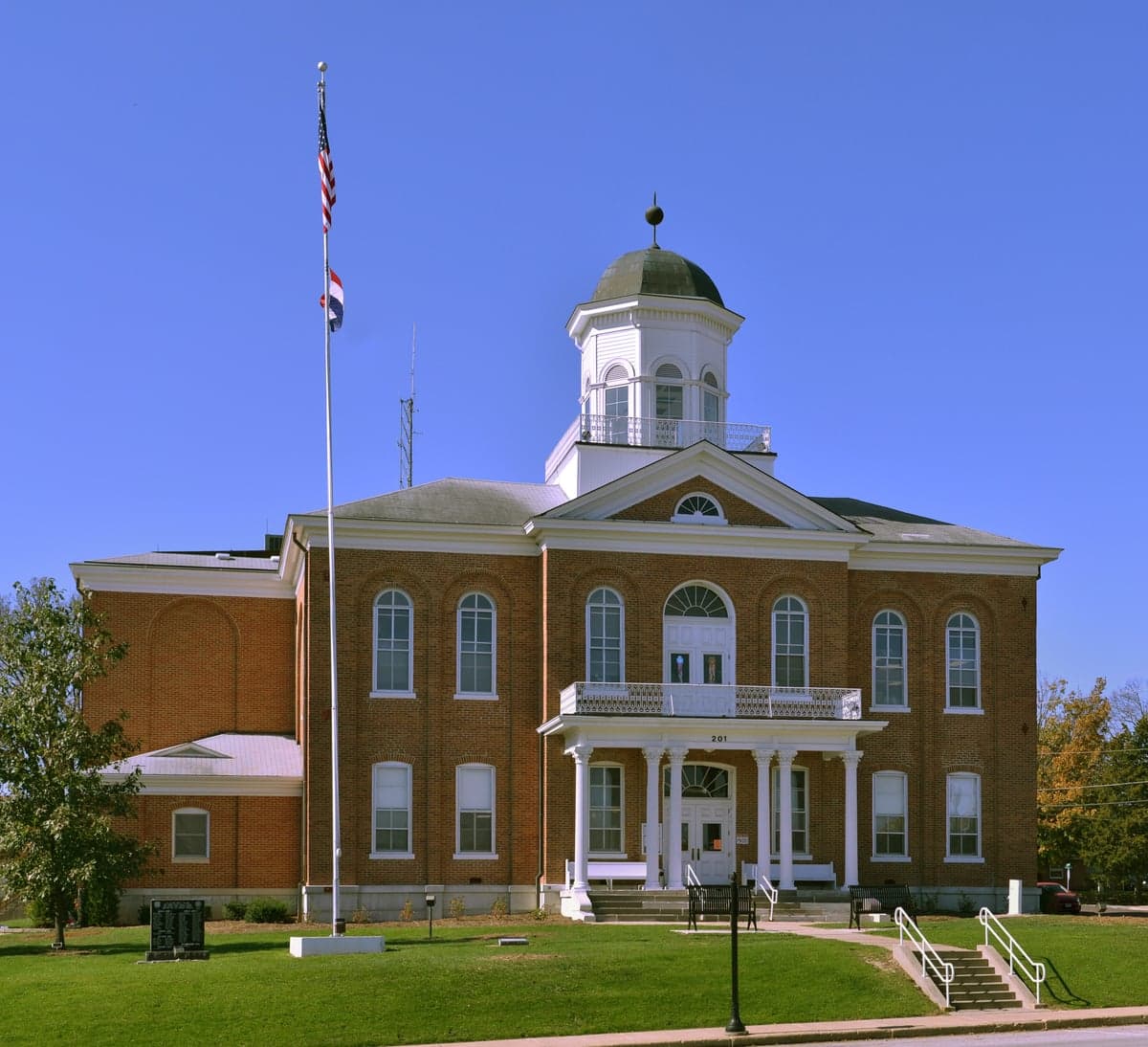
Photo: Wikipedia
Political ClimatePolitical Climate in Lincoln County
Showing county-level results — no local-only data available.
Lean and PVI are calculated from this county’s 2020 and 2024 presidential results, Cook-style.
Political rankings in Missouri
- Most Conservative Cities in Missouri
- Most Liberal Cities in Missouri
- Best Liberal-Leaning Towns in the Midwest
- Safest Liberal-Leaning Towns in the Midwest
- Safest Conservative-Leaning Towns in the Midwest
- Affordable Small Towns for Conservatives
- Most Affordable Liberal-Leaning Small Towns in the U.S.
- Safest Conservative-Leaning Cities in the U.S.
- Most Conservative Counties in Missouri
- Most Liberal Counties in Missouri
Local Political AnalysisPolitical Analysis of Lincoln County
Lincoln County, Missouri, is one of the most reliably Republican areas in the state, with a Cook Partisan Voting Index (PVI) of R+28—a full 20 points more conservative than Missouri as a whole, which sits at R+8. That gap isn't just a number; it reflects a deep, consistent red tilt that has only intensified over the last decade. The county hasn't voted for a Democratic presidential candidate since 1996, and in 2024, Donald Trump carried it by roughly 40 points. The real story, though, is the internal variation: the county's politics aren't monolithic, and the differences between towns like Troy, Moscow Mills, and Elsberry tell you a lot about where things are headed.
How it compares
Missouri's R+8 PVI already makes it a solidly red state, but Lincoln County is in a different league. To put it in perspective, the county is roughly as conservative as Wyoming (R+25) or Idaho (R+18), while the state as a whole is closer to Indiana (R+11) or South Carolina (R+8). The gap comes from a few key factors. First, Lincoln County is part of the St. Louis exurbs, but it's far enough out that it hasn't absorbed the suburban moderation you see in St. Charles County (R+14). Instead, it's a mix of rural farming communities and small towns where cultural conservatism runs deep. Troy, the county seat, is the most reliably red town—precincts there regularly deliver 75-80% of the vote to Republican candidates. Moscow Mills, just south of Troy, is slightly more competitive, with GOP margins closer to 65-70%, partly because it's a bedroom community for workers commuting to St. Louis. Elsberry, in the northern part of the county, is the most conservative pocket, often hitting 85% Republican, driven by its older, more rural population. The only real blue-leaning precincts are in the far southern edge near the St. Charles County line, where newer subdivisions have drawn in a handful of moderate Democrats and independents, but even those areas still vote Republican by double digits.
What this means for residents
For conservative residents, Lincoln County is about as comfortable as it gets. Local elected offices—county commission, sheriff, school boards—are almost entirely held by Republicans, and policy debates tend to focus on tax cuts, Second Amendment rights, and limiting government regulation. The county government has been vocal in opposing state-level mask mandates and vaccine requirements, and it's a common sight to see "Let's Go Brandon" flags flying alongside Trump banners in rural yards. For liberal residents, the reality is more isolating. There's no organized Democratic party presence to speak of, and progressive candidates rarely bother to campaign here. Socially, being openly liberal can be a liability in small-town settings like Troy or Elsberry, where political conversations at the local diner or hardware store can quickly turn confrontational. That said, the growing exurban population—especially around Moscow Mills and along Highway 61—is slowly diversifying the county's politics. Younger families moving out from St. Louis for cheaper housing tend to be more moderate, and if that trend continues, the county's R+28 lean could soften to something closer to R+20 over the next decade. But don't expect a flip: the rural core is deeply entrenched, and the county's political culture is built around a suspicion of big government that isn't going anywhere.
One cultural distinction worth noting: Lincoln County is part of the "Missouri Bootheel" of the St. Louis metro, but it feels more like a slice of the Ozarks than a suburb. Gun culture is pervasive—open carry is common, and the county has a "Second Amendment Sanctuary" resolution on the books. Evangelical Christianity dominates the social landscape, with churches like Troy First Baptist and Elsberry Assembly of God serving as community hubs. There's also a strong strain of libertarian-leaning independence: residents here don't like being told what to do by Jefferson City or Washington, and that sentiment cuts across party lines. For a conservative, it's a haven. For a liberal, it's a place where you'll need thick skin and a willingness to keep your politics to yourself in public. Either way, the county's trajectory is clear: it's getting redder, not bluer, and the R+28 PVI is likely to hold steady for the foreseeable future.

State Political ClimatePolitical Climate in Missouri
State Political AnalysisPolitical Environment in the State
Missouri is a solidly Republican state at the federal level, carrying a Cook PVI of R+8, but its political reality is far more nuanced than that number suggests. Over the past 20 years, the state has shifted decisively rightward in statewide and presidential races, driven by the rapid depopulation of its historically Democratic rural areas and the simultaneous exodus of moderate voters from the increasingly blue urban cores. The result is a state where Republicans hold supermajorities in both legislative chambers and control every statewide office, yet the two major metros—St. Louis and Kansas City—remain deeply Democratic strongholds that produce the bulk of the state’s population and economic output.
Urban vs. rural divide
The political map of Missouri is a textbook case of the urban-rural chasm. St. Louis City and County, along with Kansas City (Jackson County), vote reliably Democratic by margins of 30 to 50 points in most elections. Columbia (Boone County), home to the University of Missouri, and the St. Louis suburb of St. Charles County have become competitive but lean Republican, while the vast rural expanse—from the Bootheel to the northern plains—votes Republican by 60 to 80 points. The key swing counties that once decided close races, like Jefferson County south of St. Louis and Platte County north of Kansas City, have moved sharply right since 2016. In 2024, Donald Trump won Missouri by 18 points, but St. Louis City voted for Kamala Harris by a 4-to-1 margin. This divide means a new resident in a suburb like Chesterfield or Lee’s Summit will experience a very different political environment than someone in Springfield or Cape Girardeau.
Policy environment
Missouri’s policy environment is defined by low taxes and a light regulatory touch, but with notable exceptions. The state has a flat income tax of 4.95% (set to drop to 4.8% in 2025), a low corporate tax rate, and no estate tax. Property taxes are among the lowest in the nation, averaging about 0.9% of home value. The state is a right-to-work state (though the law was repealed by referendum in 2018, the legislature has since passed a new version), and it has some of the weakest worker protections in the country. Education policy is a flashpoint: Missouri has a robust charter school system in St. Louis and Kansas City, but rural districts are struggling with consolidation and underfunding. The state’s school choice movement is strong, with a growing number of voucher-like programs. Healthcare is a mixed bag—Missouri did not expand Medicaid until 2021, via a ballot initiative, and the legislature has since tried to impose work requirements. Election laws are restrictive: the state has a strict voter ID law, limited early voting (no-excuse absentee voting was only introduced in 2022), and a ban on ballot drop boxes. Abortion is effectively banned after eight weeks, with no exceptions for rape or incest, following the trigger law that took effect after Dobbs.
Recent policy direction
The last five years have seen Missouri’s legislature push aggressively on cultural and liberty issues. In 2021, the Second Amendment Preservation Act (SAPA) was signed, which purports to nullify federal gun laws—a move that has led to a standoff with the Biden administration and caused some law enforcement agencies to refuse to cooperate with federal authorities. In 2023, the state banned gender-affirming care for minors and restricted transgender athletes’ participation in school sports. Parental rights bills have expanded, including a law requiring schools to notify parents of any curriculum changes related to sexuality. On the privacy front, the state passed a biometric data privacy law in 2023, but it lacks a private right of action. Property rights are strong, with no statewide zoning and a robust “right to farm” constitutional amendment. Tax policy has been trending downward: the income tax rate was cut from 5.3% to 4.95% in 2022, with further cuts tied to revenue triggers. Voting access has tightened: the 2022 law eliminated no-excuse absentee voting (though it was later restored by court order) and banned private funding of election administration. The overall direction is toward more individual liberty on guns and property, less on reproductive and transgender rights, and a shrinking government footprint on taxes and regulation.
Civil unrest & political movements
Missouri has a history of high-profile civil unrest, most notably the 2014 Ferguson protests after the shooting of Michael Brown, which sparked the Black Lives Matter movement nationally. Since then, protests have been less frequent but still occur, particularly in St. Louis over police brutality and in Columbia over campus issues. On the right, the state has a strong Second Amendment movement, with open-carry rallies at the state capitol and a vocal “constitutional sheriff” movement in rural counties. Immigration politics are less heated than in border states, but there have been flashpoints: in 2023, the legislature considered a bill to allow local law enforcement to enforce federal immigration law, and some counties have declared themselves “sanctuary counties” for gun rights, not immigrants. Election integrity controversies have been persistent, with the 2020 election leading to a GOP-led audit of St. Louis County’s results (which found no widespread fraud). Nullification rhetoric is common among conservative activists, particularly around federal gun laws and vaccine mandates. A new resident in a suburb like Wentzville or a rural county like Texas County will see “Don’t Tread on Me” flags and local GOP meetings, while a resident of Kansas City’s Crossroads district will see BLM murals and progressive activist groups. The divide is visible and real.
Projection
Over the next 5-10 years, Missouri’s political trajectory is likely to continue its rightward drift, but with a ceiling. The urban cores of St. Louis and Kansas City are growing slowly and diversifying, but the rural and exurban areas are growing even faster, particularly in the southwest (Springfield, Branson) and along the I-70 corridor. In-migration is largely from other Midwestern states and is slightly more conservative than the national average. The state’s Republican supermajority is unlikely to be threatened, but internal divisions between the more pragmatic, business-friendly wing (centered in St. Charles County) and the more populist, culture-war-focused wing (centered in the Ozarks) will intensify. Expect further tax cuts, continued restrictions on abortion and transgender rights, and a push for school choice expansion. The Second Amendment Preservation Act will likely face more court challenges, and the state may see a showdown with the federal government over marijuana enforcement (recreational use was legalized in 2022). A new resident moving in now should expect a state that is politically stable but polarized, where your experience depends heavily on which county you choose.
For a new resident, the bottom line is this: Missouri offers a low-tax, low-regulation environment with strong property and gun rights, but at the cost of limited reproductive and LGBTQ+ protections, a fraying public education system in rural areas, and a political climate that can feel like a cold civil war between the two metros and the rest of the state. If you’re a conservative, you’ll find a welcoming state government and like-minded neighbors in most places outside the urban cores. If you’re a liberal, you’ll find vibrant communities in St. Louis, Kansas City, and Columbia, but you’ll be living under a state government that is actively hostile to many of your values. Choose your county carefully—it will define your daily political reality more than the state as a whole.
* Values derived from national, state, county, city and local statistics and may differ in a specific area. Last updated: 2026-11-15T07:14:52.000Z
Narrative content on this page is AI-generated and may contain mistakes. Verify any details that matter before acting on them.
ReloMaps may earn a commission from affiliate links at no extra cost to you.

