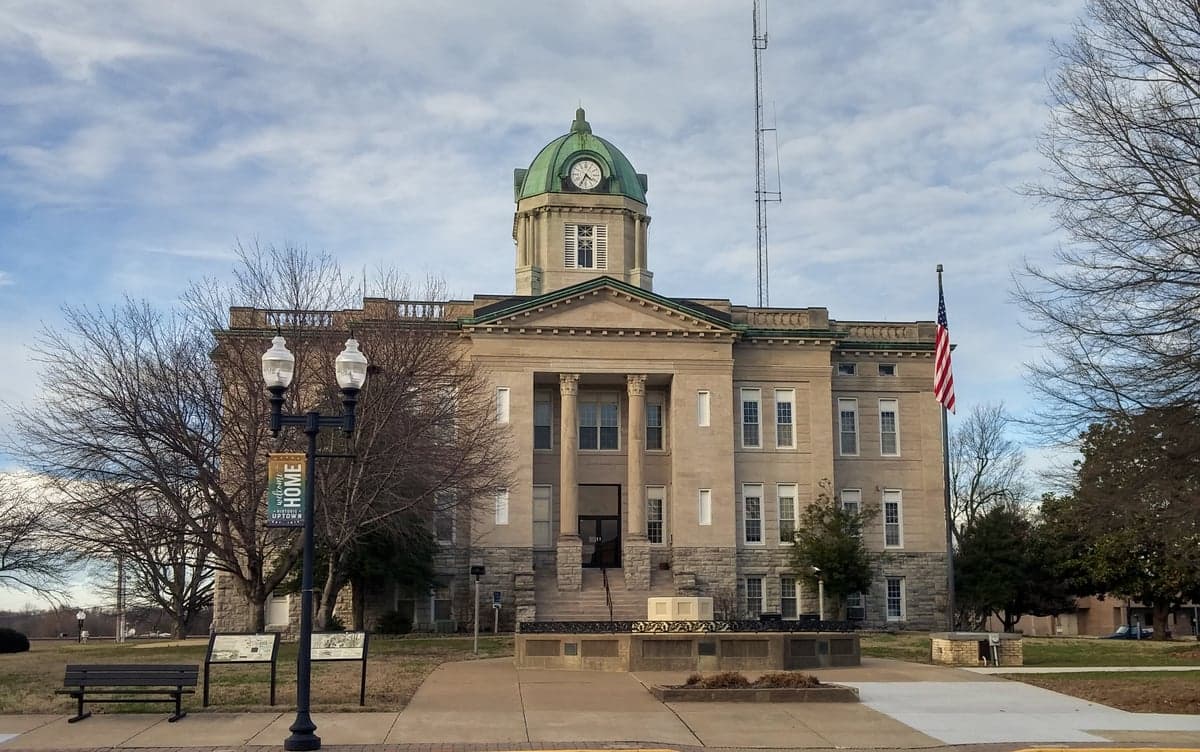
Photo: Wikipedia
Political ClimatePolitical Climate in Cape Girardeau County
Showing district-level results — no local-only data available.
Local Political AnalysisPolitical Analysis of Cape Girardeau County
Cape Girardeau County is one of the most reliably Republican strongholds in Missouri, with a Cook Partisan Voting Index (PVI) of R+27 — meaning the county votes about 27 points more Republican than the national average. That’s a full 19 points redder than the state of Missouri as a whole, which sits at R+8. The county hasn’t voted for a Democratic presidential candidate since 1964, and in 2024, Donald Trump carried it by roughly 40 points. But the political reality isn’t a monolith: the city of Cape Girardeau itself, home to Southeast Missouri State University and a growing professional class, shows more nuance, while the rural towns and unincorporated areas lean heavily conservative.
How it compares
Missouri’s R+8 PVI already marks it as a solidly red state, but Cape Girardeau County is in a different league. The county’s R+27 rating places it among the most conservative counties in the state, comparable to Christian County (R+30) or Stone County (R+32). The gap is driven by the rural precincts outside the city limits. For example, the towns of Jackson and Scott City consistently vote 70-80% Republican in federal races, while the unincorporated areas around Burfordville and Dutchtown are even redder. In contrast, the city of Cape Girardeau’s precincts near the university — particularly around Broadway and the downtown core — occasionally tip 55-60% Democratic in local races, though they still lean Republican in presidential years. The swing precincts are in the newer subdivisions on the city’s north side, where growth from St. Louis transplants and young families has created a more competitive mix. Statewide, Missouri’s R+8 reflects a balance between deep-red rural areas and blue-leaning urban centers like St. Louis and Kansas City; Cape Girardeau County lacks that urban counterweight, so its politics are more uniformly conservative.
What this means for residents
For conservative residents, the county’s lean means their values are reflected in nearly every level of local government. The county commission, school boards, and city councils in Jackson and Scott City are overwhelmingly Republican, and policy debates tend to focus on tax cuts, Second Amendment rights, and limited regulation. For liberal residents, the reality is more isolating. While the city of Cape Girardeau offers some blue-friendly spaces — the university campus, the arts district, and a handful of progressive-leaning churches — there’s little chance of electing a Democrat to countywide office. That said, the county’s politics are not as confrontational as in some deep-red areas. Local elections often hinge on personality and competence rather than party loyalty, and many residents describe the atmosphere as “live and let live” outside of election season. The biggest practical impact is on policy: the county has opted out of certain state-level programs like Medicaid expansion implementation, and local zoning laws remain minimal, which keeps property taxes low but limits public transit and affordable housing initiatives.
Culturally, the county’s political identity is tied to its history as a German-settled, agricultural region with a strong military presence (the 139th Airlift Wing at Rosecrans Air National Guard Base is a major employer). You’ll see more “Don’t Tread on Me” flags than rainbow flags, but the university town vibe in Cape Girardeau proper means there’s a quiet tolerance for diversity — just not much public advocacy. The biggest shift I’ve seen in the last decade is the growth of the city’s tech and healthcare sectors, which has brought in younger, more moderate voters. I’d expect the county to stay R+20 or higher for the foreseeable future, but the city’s precincts could become more competitive as the population grows. For now, if you’re conservative, you’ll feel right at home; if you’re liberal, you’ll find your people in the university district or the coffee shops on Broadway, but you’ll need to drive to St. Louis for a Democratic rally.

State Political ClimatePolitical Climate in Missouri
State Political AnalysisPolitical Environment in the State
Missouri has been a reliably Republican state for most of the past two decades, with a Cook Partisan Voting Index of R+8, meaning it votes about eight points more Republican than the nation as a whole. The state has shifted rightward since the early 2000s, when it was still a classic bellwether—it voted for the winner in every presidential election from 1904 to 2004 except 1956. That changed after 2008, when Missouri backed John McCain by a slim margin and then Mitt Romney by nearly 10 points in 2012. By 2024, Donald Trump carried the state by roughly 18 points, reflecting a deep consolidation of rural and exurban voters into the GOP column while the two major metro areas—St. Louis and Kansas City—remain Democratic strongholds. The dominant coalition today is a mix of rural conservatives, suburban moderates who have shifted right on cultural issues, and a growing number of working-class voters in small industrial towns who have abandoned the Democratic Party over trade and social policy.
Urban vs. rural divide
The political map of Missouri is a textbook case of the urban-rural split. The state’s two largest metros—St. Louis and Kansas City—anchor the Democratic vote. St. Louis City and County together cast about 40% of the state’s Democratic ballots, with the city itself voting over 80% Democratic in recent presidential elections. Kansas City and its inner-ring suburbs like Independence and Raytown are similarly blue, though the outer suburbs in Clay and Platte counties have become more competitive. The rest of the state is overwhelmingly Republican. The rural Ozarks, including counties like Christian, Taney, and Stone near Branson, routinely vote 75-80% Republican. The Bootheel region in the southeast, once a Democratic stronghold due to its agricultural and union roots, has flipped hard—counties like Dunklin and Pemiscot went from reliably blue to +30 Republican or more by 2024. The I-70 corridor between St. Louis and Kansas City, including Columbia (home to the University of Missouri) and Jefferson City, is a mixed bag: Columbia leans Democratic, while the state capital and surrounding Boone County are more purple. The most notable suburban shift has been in St. Charles County, just west of St. Louis, which was a swing area in the 1990s but now votes about 60% Republican, driven by families moving out of the city for schools and lower taxes.
Policy environment
Missouri’s policy environment is broadly conservative, with a low-tax, low-regulation posture that has been consistent for decades. The state has a flat income tax rate of 4.95% as of 2025, down from 5.4% in 2022, with a scheduled phase-down to 4.5% by 2027 if revenue triggers are met. Sales taxes are relatively high—around 8-9% in most areas—but property taxes are among the lowest in the country, averaging about 0.8% of home value. The state is a right-to-work state (though voters repealed the law in a 2018 referendum, the legislature has since passed other union-restricting measures), and it has no state-level minimum wage above the federal $7.25, though several cities like St. Louis and Kansas City have set their own higher floors. Education policy is a flashpoint: Missouri has a robust charter school sector in St. Louis and Kansas City, and a school choice program (the Missouri Empowerment Scholarship Accounts) that provides tax credits for private school tuition. The state has also passed laws restricting how race and gender can be taught in public schools, including a 2021 law banning critical race theory in K-12 classrooms. On healthcare, Missouri did not expand Medicaid until 2021, when voters approved it via ballot initiative—the last state in the country to do so. Abortion is heavily restricted: after the 2022 Dobbs decision, a trigger law banned nearly all abortions, with exceptions only for medical emergencies. A 2024 ballot initiative to restore abortion access up to fetal viability passed with 52% of the vote, but the legislature has since moved to limit its implementation through additional regulations. Election laws have tightened: Missouri now requires a government-issued photo ID to vote, limits absentee voting to those with an excuse, and banned ballot drop boxes except in limited circumstances.
Recent policy direction
The last five years have seen Missouri’s legislature push aggressively on cultural and liberty-related issues, often overriding vetoes from Governor Mike Parson (a Republican) or his successor. On gun rights, Missouri became a Second Amendment Sanctuary state in 2021, passing a law that nullifies federal gun regulations—a move that has led to legal battles with the Biden administration. The state also passed permitless carry in 2017 and has no red-flag law. On parental rights, a 2022 law requires schools to notify parents of any changes to a student’s health or well-being, effectively targeting transgender students. A 2023 law banned gender-affirming care for minors, with no exceptions for those already receiving treatment. On speech and privacy, Missouri passed a law in 2023 restricting social media platforms from deplatforming users based on political viewpoints, though it was blocked by a federal court. Property rights are generally strong: Missouri has no state-level rent control, and eminent domain is limited by a 2006 constitutional amendment passed after the Kelo decision. On taxation, the trend is toward lower rates: the flat income tax is being phased down, and the state eliminated its corporate franchise tax in 2023. Voting access has tightened, as noted, but Missouri also allows same-day voter registration during early voting, and no-excuse absentee voting was expanded temporarily during the pandemic but then rolled back. The overall direction is toward more conservative cultural policy and lower taxes, with a strong emphasis on local control and resistance to federal mandates.
Civil unrest & political movements
Missouri has a history of high-profile civil unrest, most notably the 2014 Ferguson protests after the shooting of Michael Brown, which sparked a national movement and led to federal investigations of the St. Louis County police. That event still shapes local politics: Ferguson and nearby municipalities like Jennings and Dellwood remain heavily Democratic and predominantly Black, while the surrounding county has seen a white exodus to St. Charles and Jefferson counties. More recently, the 2020 protests in Kansas City and St. Louis over George Floyd’s death were large but largely peaceful, though St. Louis saw some property damage. On the right, the Missouri Freedom Caucus, a group of hardline state legislators, has pushed for further restrictions on abortion, immigration enforcement, and election integrity. Immigration politics are less visible than in border states, but Missouri passed a law in 2023 requiring local law enforcement to cooperate with federal immigration authorities and banning sanctuary city policies. There is no serious secession or nullification movement, though the Second Amendment Sanctuary law is a form of nullification. Election integrity controversies have been muted compared to states like Arizona or Georgia, but the 2020 election saw Trump’s legal team challenge results in St. Louis City, and the legislature has since passed multiple bills tightening voting rules. A new resident would notice the political divide most in the suburbs: a drive from St. Louis County to St. Charles County feels like crossing into a different political universe, with yard signs, church billboards, and local news coverage all reflecting the split.
Projection
Over the next 5-10 years, Missouri is likely to remain solidly Republican at the state level, but the margin may narrow slightly as the St. Louis and Kansas City suburbs continue to diversify and attract younger, more educated residents. The state’s population growth is concentrated in the outer suburbs of both metros—places like Wentzville in St. Charles County and Lee’s Summit in Jackson County—which are trending more moderate on economic issues but remain culturally conservative. The rural areas will continue to lose population, which could reduce the GOP’s raw vote share but not its geographic dominance. The biggest wildcard is the abortion ballot initiative: if the 2024 measure is fully implemented, it could mobilize Democratic voters in future elections, but the legislature is likely to keep fighting it through regulations. In-migration is modest—Missouri gains about 10,000-15,000 net new residents per year, mostly from Illinois and Kansas—and these newcomers tend to be retirees or remote workers drawn to low taxes and housing costs, which reinforces the conservative tilt. A new resident moving in now should expect a state where Republican control of the governorship and legislature is the baseline, but where ballot initiatives can occasionally override the legislature on specific issues like Medicaid and abortion. The practical takeaway: if you’re conservative, you’ll find a friendly policy environment with low taxes and strong gun rights; if you’re liberal, you’ll have to live in one of the two metro areas to find like-minded neighbors and local policies that align with your values.
For someone choosing Missouri, the bottom line is that the state offers a predictable, low-cost, and culturally conservative environment outside of its two major cities. The political climate is stable but polarized, with little chance of a dramatic shift in either direction over the next decade. If you value low taxes, strong Second Amendment protections, and a government that generally stays out of your business, you’ll feel at home in most of the state. If you prioritize progressive social policies or robust public transit, you’ll want to stick to St. Louis or Kansas City, where local governments often push back against state-level conservatism. Either way, the state’s politics are transparent and consistent—what you see is what you get, and that’s a rare thing in today’s America.
* Values derived from national, state, county, city and local statistics and may differ in a specific area. Last updated: 2026-06-15T10:44:05.000Z
Narrative content on this page is AI-generated and may contain mistakes. Verify any details that matter before acting on them.
ReloMaps may earn a commission from affiliate links at no extra cost to you.

