
Photo: Wikipedia
Personal Sovereignty in Lafayette County
Viable for self-reliance. Generally workable, though some barriers may limit total independence.
What does Personal Sovereignty tell us?
Personal Sovereignty measures your capacity for self-reliance and independence with minimal government friction. Higher scores mean fewer barriers between you and the way you want to live... but it assumes you have the space you need and good neighbors.
What does this tell us?
Personal Sovereignty measures your capacity for self-reliance and independence with minimal government friction. Higher scores mean fewer barriers between you and the way you want to live... but it assumes you have the space you need and good neighbors.
State Policy
Energy independence: Importer (50% of energy produced in-state)
Personal Liberty
Homesteading

Personal Liberty Analysis
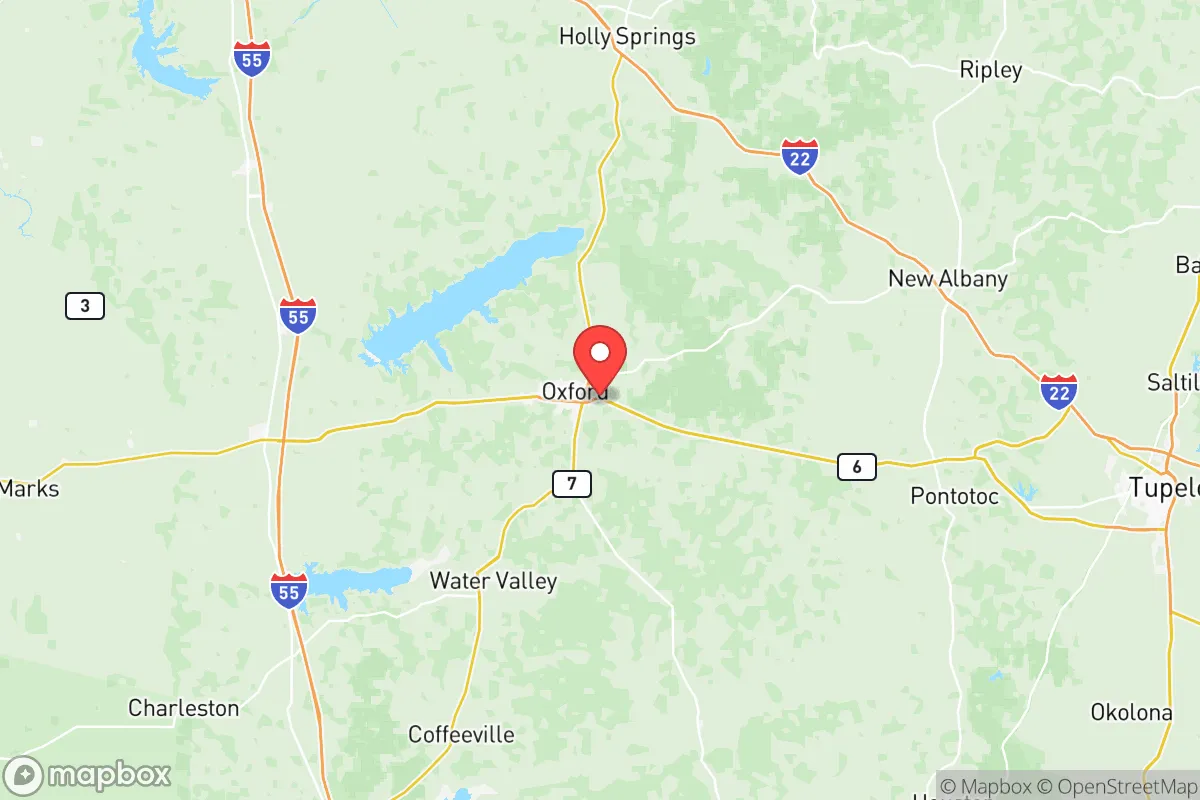
Lafayette County, Mississippi, anchored by the city of Oxford, presents a nuanced personal sovereignty environment where state-level protections for gun rights and parental authority coexist with a moderately active local regulatory presence, particularly within the Oxford city limits. The county offers a distinctly different autonomy profile for residents depending on whether they choose the denser, more regulated Oxford or the unincorporated areas and smaller communities like Taylor, Abbeville, and Tula, where a lighter touch from local government prevails. For individuals and families weighing personal freedom, the key distinction lies in navigating the balance between Mississippi's broadly permissive state laws and the more structured municipal codes found in the county's primary population center.
Tax burden and regulatory posture across Lafayette County
Mississippi's overall tax burden is among the lowest in the nation, and Lafayette County residents benefit from this directly. There is no state income tax on Social Security benefits, and the state's flat income tax rate is a competitive 4.0% as of 2026, with a phase-out to 0% by 2028 already legislated. Property taxes in Lafayette County are moderate, with the county's millage rate typically falling below the state average. However, the regulatory posture diverges sharply between Oxford and the rest of the county. Oxford enforces a city zoning code, building permits, and a rental inspection program that adds layers of compliance for property owners and landlords. In contrast, unincorporated areas of the county—such as the rural stretches near Paris or Yocona—operate under minimal county-level zoning, allowing for greater flexibility in land use without the need for city permits. The county's approach to business regulation is similarly bifurcated: opening a home-based business in Oxford requires a city business license and adherence to specific home occupation rules, while the same activity in the county outside city limits typically requires only a simple county privilege license, if any. For a reader prioritizing low regulatory overhead, the unincorporated areas of Lafayette County offer a significantly lighter touch than Oxford's municipal code.
Self-defense and gun law specifics for residents
Mississippi is a constitutional carry state, meaning that as of 2016, any adult who can legally possess a firearm may carry it openly or concealed without a permit. Lafayette County fully reflects this state-level posture. The Oxford Police Department and the Lafayette County Sheriff's Office both operate under state preemption laws that prevent local governments from enacting their own gun control ordinances, so the rules are uniform across the entire county. This means that whether a resident lives in the heart of Oxford, in the historic community of Taylor, or on a rural property near Abbeville, the same carry laws apply. Stand-your-ground laws are in effect, with no duty to retreat in any place where a person has a legal right to be. The Castle Doctrine extends to vehicles and occupied structures. For those interested in firearms training, the Mississippi Department of Public Safety still issues enhanced carry permits for reciprocity with other states, but no permit is required for daily carry within Mississippi. The gun culture in Lafayette County is robust, with multiple shooting ranges and gun shops in and around Oxford, and the local sheriff's office is known for a pro-Second Amendment stance in its public communications.
Self-reliance and homesteading viability across the county
Homesteading and self-reliance are highly viable in Lafayette County, but the feasibility depends heavily on location. In unincorporated areas, lot sizes can be as large as a landowner desires, with many parcels in the 5- to 40-acre range available near Tula and Yocona. There are no county-level zoning restrictions on keeping chickens, goats, or even larger livestock on these properties, and the county does not impose building codes on agricultural structures or owner-built homes in rural areas. Off-grid living is legally feasible: Mississippi has no state law requiring grid connection, and rainwater collection is unrestricted. However, the county health department does require a permitted septic system for any dwelling with plumbing, and a well permit is needed for private water. Within the Oxford city limits, homesteading is far more constrained. The city's zoning code limits livestock to small fowl (hens only, no roosters) on lots of at least one acre, and all residential structures must meet the International Residential Code. For a family seeking true self-reliance, the rural areas of Lafayette County—particularly the southeastern quadrant near Paris—offer an environment where off-grid living, large gardens, and animal husbandry are practical and legally straightforward, while Oxford itself is better suited to those who want a walkable town with farmers' markets rather than full homesteading.
Personal liberties: parental rights, medical autonomy, speech, and property
Mississippi law provides strong protections for parental rights, including a statutory requirement that schools obtain parental consent before administering any medical or mental health screening, and a Parents' Bill of Rights that affirms the fundamental right of parents to direct their children's upbringing, education, and healthcare. The Lafayette County School District and the Oxford School District both operate under these state mandates, though Oxford's more progressive school board has occasionally drawn scrutiny from conservative parents on curriculum transparency issues. Medical autonomy is more limited: Mississippi has not expanded Medicaid, and the state's restrictive abortion laws are among the most stringent in the nation. For those who prioritize medical freedom, the state's vaccine choice laws are relatively strong, with broad exemption options for school attendance. Free speech is protected under the First Amendment, and Lafayette County has a generally tolerant environment for political expression, though Oxford's university culture (home to the University of Mississippi) creates a more liberal social atmosphere than the surrounding rural areas. Property rights are well-protected under Mississippi law, with strong protections against eminent domain abuse and no statewide rent control. The county's approach to property use is permissive outside city limits, where landowners have wide latitude to build, harvest timber, or operate businesses without excessive bureaucratic hurdles.
Overall, Lafayette County offers a split sovereignty environment that is among the most freedom-friendly in the South for those who choose the unincorporated areas, while Oxford itself provides a more regulated but still relatively light-touch municipal experience compared to cities of similar size in states like California or New York. For the reader who values personal autonomy—especially in self-defense, homeschooling, property use, and low taxation—the rural stretches of the county near Abbeville and Tula represent a strong option. The trade-off is access to the cultural and economic amenities of Oxford, which come with a modest increase in regulatory oversight. Compared to neighboring counties like Pontotoc or Union, Lafayette County's regulatory posture is slightly more active due to Oxford's influence, but it remains far less restrictive than urban centers in the Northeast or West Coast, making it a solid choice for families and individuals seeking a high degree of personal sovereignty within a community that still offers modern conveniences.

* Values derived from national, state, county, city and local statistics and may differ in a specific area. Last updated: 2026-07-10T09:51:24.000Z
Narrative content on this page is AI-generated and may contain mistakes. Verify any details that matter before acting on them.
ReloMaps may earn a commission from affiliate links at no extra cost to you.

