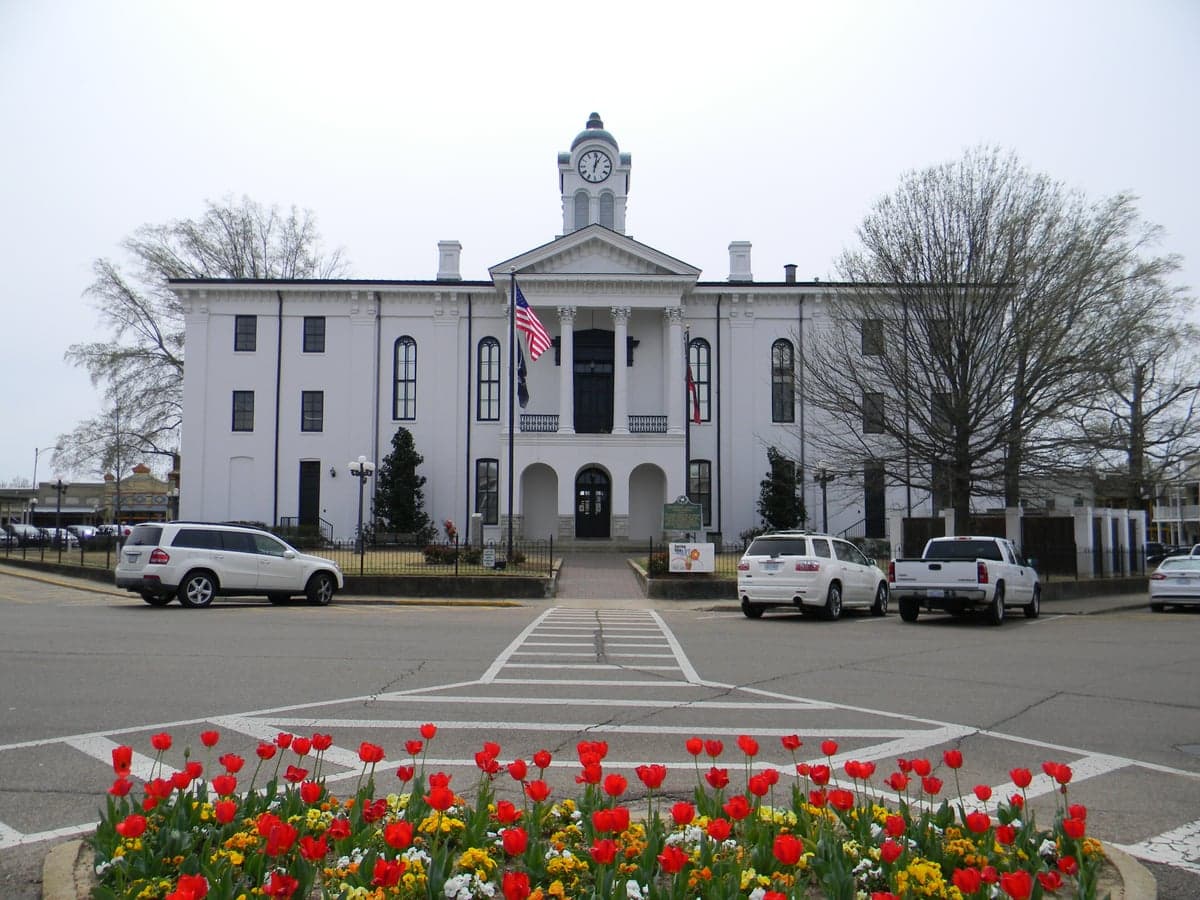
Photo: Wikipedia
Demographics of Lafayette County
Affluence Level in Lafayette County
A middle-class area roughly in line with national averages across income, home values, education, and employment.
People of Lafayette County
Lafayette County, Mississippi, is home to 56,920 residents, a population defined by the presence of the University of Mississippi in Oxford, which gives the county a distinctly youthful, educated, and transient character alongside deep-rooted family lines. The county is 68.7% White and 23.0% Black, with a small but growing Hispanic community at 3.6% and an Asian population of 1.4%, while only 2.5% of residents are foreign-born, reflecting a region shaped more by domestic migration than international immigration. The population is notably well-educated, with 44.3% holding a college degree, a figure driven by the university and the professional and medical sectors it supports. This blend of a historic Southern small-town identity with a modern, university-anchored economy creates a distinctive social landscape where old families and new arrivals coexist.
Settlement & growth (pre-1960)
Long before European settlement, the land that is now Lafayette County was part of the historic territory of the Chickasaw Nation, who controlled much of northern Mississippi and Alabama. The Chickasaw were forcibly removed in the 1830s under the Indian Removal Act, opening the region to White settlers from the Upper South, primarily Virginia, North Carolina, and Tennessee. These early Anglo-American settlers, mostly of Scots-Irish and English descent, arrived in the 1830s and 1840s, drawn by the promise of fertile cotton land distributed through state land grants and federal land sales. They established small farms and plantations, and the county seat, Oxford, was founded in 1837, quickly becoming the commercial and political hub. The town of Taylor, founded in the 1840s, grew as a railroad stop and service center for surrounding plantations.
The antebellum economy was built on enslaved Black labor, and by 1860, enslaved people made up a majority of the county's population. After the Civil War and emancipation, many freed Black families remained in the county, working as sharecroppers and tenant farmers, and they established their own communities, such as the historic settlement of Abbeville, which became a center for Black landownership and small-scale farming. The late 19th and early 20th centuries saw little new immigration; the county's population remained overwhelmingly native-born White and Black, with the economy tied to cotton and timber. The founding of the University of Mississippi in Oxford in 1848 began to shape the county's character, but its impact on population growth was modest until the mid-20th century. The Great Migration (1910-1970) saw a significant outflow of Black residents from Lafayette County to industrial cities in the North and Midwest, reducing the Black population share from a majority to a minority. By 1960, the county's population was roughly 70% White and 30% Black, with Oxford as the dominant population center and smaller communities like Paris and College Hill remaining as rural crossroads.
Modern era (post-1965)
The 1965 Hart-Cellar Act had a minimal direct impact on Lafayette County, as the foreign-born population remains just 2.5%, far below the national average. However, the post-1965 era brought profound demographic change through domestic migration, driven overwhelmingly by the growth of the University of Mississippi. Starting in the 1970s, the university expanded rapidly, attracting students, faculty, and staff from across the United States, particularly from the Northeast, Midwest, and other parts of the South. This influx of educated, often younger, White and Black professionals reshaped Oxford from a quiet college town into a regional hub for culture, healthcare, and retail. The city of Oxford itself absorbed most of this growth, with new subdivisions like The Links and Northwood Hills filling with university employees and professionals. The unincorporated area of Thaxton, east of Oxford, saw slower growth, remaining more rural and agricultural.
The Hispanic population, now 3.6%, began to grow in the 1990s and 2000s, driven by labor demand in construction, landscaping, and the poultry processing industry in nearby counties. This community is dispersed throughout the county, with a small concentration in Oxford, but no single ethnic enclave has formed. The Asian population, at 1.4%, is largely composed of faculty, graduate students, and medical professionals at the university and the nearby Baptist Memorial Hospital-North Mississippi, and they are concentrated in Oxford. The Indian-subcontinent population, at 0.9%, is similarly tied to the university and medical sectors, with families living in Oxford's newer subdivisions. The Black population, now 23.0%, has stabilized after the Great Migration, with many families remaining in historic communities like Abbeville and the older neighborhoods of Oxford, such as the Burnsville area. Suburbanization has been limited; the county's growth has been largely contained within Oxford's city limits and its immediate fringe, with the rest of the county remaining rural and low-density.
The future
Lafayette County's population is projected to continue growing slowly, driven by the University of Mississippi's steady enrollment and the expansion of healthcare and professional services in Oxford. The county is becoming slightly more diverse, with the Hispanic and Asian shares expected to rise gradually, though they will remain small relative to the White and Black populations. The foreign-born share may inch upward as the university recruits more international faculty and students, but Lafayette County will likely remain a predominantly native-born place. New residential development is concentrating in Oxford's southern and eastern edges, with subdivisions like College Hill Road and Old Sardis Road attracting families and retirees. The rural communities of Taylor and Paris are seeing modest infill but are unlikely to suburbanize significantly. The cultural identity of the county is evolving from a traditional Southern college town toward a more cosmopolitan, amenity-rich small city, though the pace of change is gradual and the deep-rooted family networks of the White and Black communities remain influential.
For someone moving in now, Lafayette County offers a stable, safe, and highly educated environment centered on Oxford, with a strong sense of place and a growing array of cultural and recreational amenities. The county is becoming more diverse and more connected to national trends, but it retains a distinctly Southern character and a pace of life that appeals to families and professionals seeking a balance between small-town comfort and university-town energy. The future points toward continued moderate growth, increasing diversity at the margins, and a population that remains anchored by the university and the historic communities that have shaped the county for nearly two centuries.

* Values derived from national, state, county, city and local statistics and may differ in a specific area. Last updated: 2026-07-10T09:51:24.000Z
Narrative content on this page is AI-generated and may contain mistakes. Verify any details that matter before acting on them.
ReloMaps may earn a commission from affiliate links at no extra cost to you.

