Photo: Wikipedia
Political ClimatePolitical Climate in Hinds County
Showing district-level results — no local-only data available.
Local Political AnalysisPolitical Analysis of Hinds County
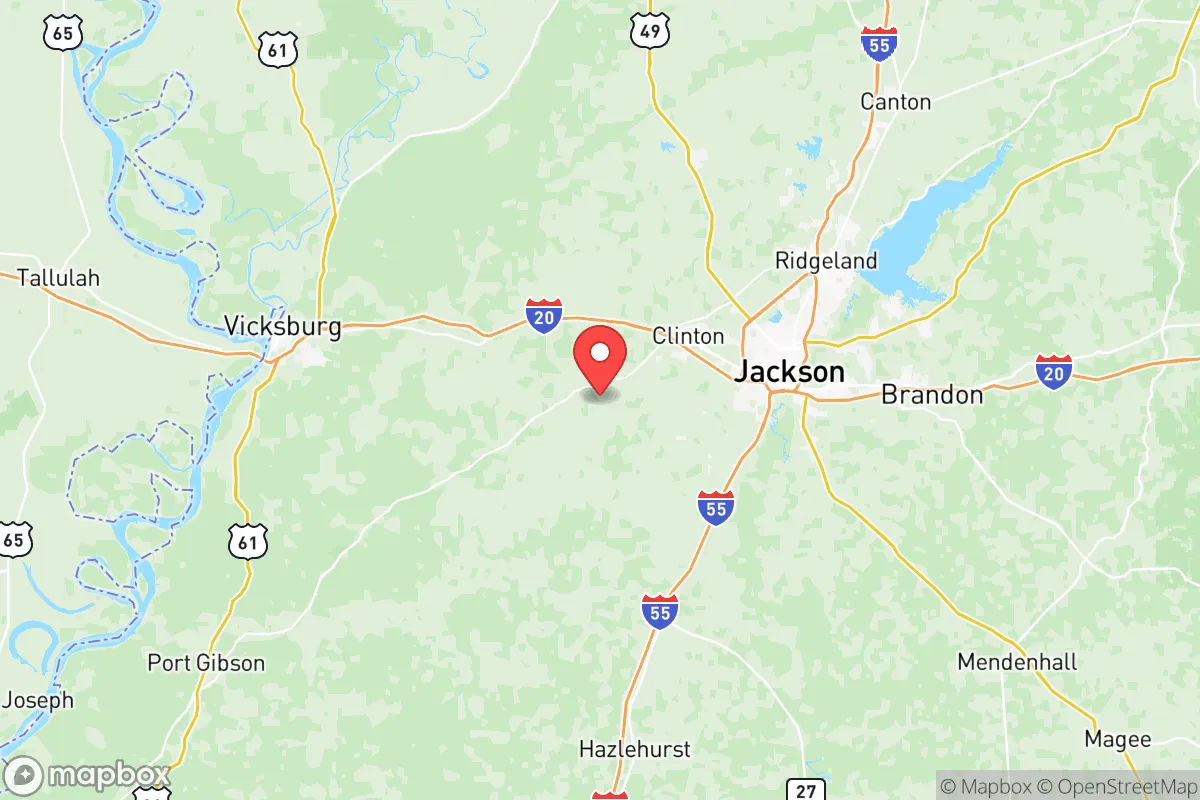
Hinds County, Mississippi, is a deep-blue island within a deep-red state, carrying a Cook PVI of D+11 while the rest of Mississippi sits at R+11. That 22-point partisan gap is the dominant political fact here. The county's Democratic lean is driven almost entirely by Jackson, the state capital and its largest city, where Black voters and liberal-leaning professionals form a solid majority. But drive just 20 minutes west to Clinton, or south to Raymond, and the precincts shift to reliably Republican territory. Utica and Edwards, smaller towns in the southern part of the county, tend to split more evenly, often acting as the swing zones in local races.
How it compares
Mississippi statewide has voted for the Republican presidential candidate by double digits every cycle since 2008. Hinds County, by contrast, has voted for the Democratic candidate by similar margins. In 2024, Kamala Harris carried Hinds with roughly 62% of the vote, while Donald Trump took the state with about 60%. That means Hinds is an outlier in almost every statewide election: a race for governor, lieutenant governor, or attorney general often sees Hinds delivering 65-70% of its vote to the Democrat, while the rest of the state gives the Republican 58-62%. This creates a real tension: a Jackson city councilmember or a Hinds County supervisor from a Jackson district will have a completely different set of political pressures than a supervisor from the Clinton or Raymond areas. The county's legislative delegation in the state house and senate is predominantly Democratic, but those representatives often find themselves in the minority party when they reach the Capitol in Jackson.
What this means for residents
For a liberal resident in Jackson, the local government — the city council, the county board of supervisors, the school board — is likely to be run by fellow Democrats. Policies around affordable housing, public transit, and police reform tend to get a fair hearing. For a conservative resident in Raymond or Clinton, that same county government can feel disconnected. They pay the same property taxes but may feel their priorities — lower taxes, tougher crime enforcement, school choice — are out of step with the Jackson-dominated majority. In practice, this means residents often vote the ballot, not the person: many long-time locals can name a Republican friend who always votes for the Democratic county tax assessor because "he actually answers the phone."
State politics amplify this divide. The Mississippi legislature has the final say on everything from medical marijuana rules to education funding to how the state's share of federal dollars is distributed. Hinds County sends a delegation that consistently votes against the majority Republican agenda, so the county gets fewer earmarks and has to fight harder for infrastructure projects. Jackson's water crisis, for example, was a state-level political flashpoint that saw the city's Democratic mayor blaming a Republican-controlled state government for slow funding, while state leaders pointed to local mismanagement.
Looking ahead, the county's Democratic lean is expected to hold or even deepen as Jackson's population becomes more politically homogeneous. Suburban growth in Clinton and Byram is bringing in more moderate families, but they tend to vote Republican by smaller margins than their parents did. The real shift may come in the 2030 redistricting, when Hinds County could lose a state house seat to more Republican areas, further diluting its influence. For now, the practical reality for residents is that your political experience in Hinds County depends heavily on which part of the county you call home. Jackson feels like a blue city in a red state; Clinton feels like a red town in a blue county. Both are accurate descriptions.

State Political ClimatePolitical Climate in Mississippi
State Political AnalysisPolitical Environment in the State
Mississippi is one of the most reliably Republican states in the country, with a Cook Partisan Voting Index of R+11, meaning it votes about 11 points more Republican than the national average in presidential elections. The state hasn't voted for a Democratic presidential candidate since Jimmy Carter in 1976, and the GOP now holds every statewide office, both U.S. Senate seats, and a supermajority in the state legislature. Over the last 20 years, the shift has been dramatic—rural white voters who were once conservative Democrats have moved almost entirely into the Republican column, while the state's large Black population (about 38% of residents) remains overwhelmingly Democratic, creating a stark racial and geographic political divide that defines every election.
Urban vs. rural divide
The political map of Mississippi is a study in contrasts. The state's only major metro, the Jackson metropolitan area, is a Democratic stronghold driven by a large Black population and the presence of state government and Jackson State University. Hinds County, which contains most of Jackson, routinely votes 70-80% Democratic. But drive 20 minutes north to Madison County—specifically the affluent suburbs of Madison and Ridgeland—and you'll find some of the most Republican turf in the state, with precincts often going 75%+ GOP. The Gulf Coast, anchored by Biloxi and Gulfport, leans Republican but is more competitive, with a mix of military retirees, casino workers, and a growing Hispanic population. The Mississippi Delta, stretching from Greenville to Clarksdale, is heavily Black and poor, and votes overwhelmingly Democratic—though turnout is often low. The northeastern corner around Tupelo and the Golden Triangle (Columbus, Starkville, West Point) is reliably Republican, boosted by the presence of Mississippi State University in Starkville, which leans more moderate than the surrounding countryside. The Pine Belt around Hattiesburg and the southwestern corner near Natchez are more mixed, with Hattiesburg's university population (University of Southern Mississippi) providing a small liberal pocket in an otherwise conservative region. The real engine of Republican dominance, though, is the vast rural expanse—counties like Rankin, DeSoto, Lamar, and Lee routinely deliver 70-80% Republican margins, overwhelming the Democratic votes from Jackson and the Delta.
Policy environment
Mississippi's policy environment is among the most conservative in the nation. The state has no state income tax on wages—it was phased out between 2022 and 2026, leaving only a 4% tax on corporate income and a 7% sales tax on most goods. Property taxes are very low by national standards, with median effective rates around 0.7%. The regulatory posture is business-friendly: Mississippi is a right-to-work state, has no state-level minimum wage above the federal $7.25, and offers generous incentives for economic development. Education policy is a flashpoint: the state funds public schools through a formula (the Mississippi Adequate Education Program) that has been fully funded only a handful of times since 2009, and charter schools are allowed but limited. School choice via vouchers and education savings accounts has expanded in recent years, with a 2024 law creating a pilot ESA program for special-needs students. Healthcare is a major issue—Mississippi has not expanded Medicaid under the Affordable Care Act, leaving roughly 75,000 low-income adults in a coverage gap. The state has some of the strictest abortion laws in the country, with a near-total ban in effect since the Dobbs decision in 2022, including no exceptions for rape or incest. Election laws require a government-issued photo ID to vote, and early voting was expanded in 2024 to allow in-person absentee voting for up to 14 days before an election, though no-excuse absentee voting remains unavailable.
Recent policy direction
Over the past five years, Mississippi has moved decisively in a conservative direction across multiple fronts. On gun rights, the state enacted permitless carry (constitutional carry) in 2016 and has repeatedly rejected any new restrictions—a 2023 bill to raise the age for purchasing assault rifles died in committee. On education and parental rights, the 2022 "Parental Bill of Rights" (HB 1309) gave parents explicit authority over their children's medical decisions and educational records, and a 2023 law banned instruction on sexual orientation and gender identity in K-3 classrooms. On speech and privacy, the state passed a 2023 law (SB 2099) requiring social media platforms to verify the ages of users and obtain parental consent for minors, though it's been challenged in court. Medical and bodily autonomy is sharply restricted: the 2022 trigger law banning abortion has no exceptions for rape or incest, and a 2023 law (HB 1020) created a special court system in Jackson that critics say undermines local control. Property rights are strong—Mississippi is a "Dillon's Rule" state, meaning local governments have only powers explicitly granted by the state, but the legislature has consistently sided with landowners over regulators in disputes over zoning and environmental rules. On voting access, the 2024 early voting expansion was a bipartisan compromise, but the state still has some of the shortest early voting windows in the South and no online voter registration. The overall direction is clear: the legislature is pushing to lock in conservative policies on social issues while keeping taxes low and regulations light, with little appetite for compromise on the cultural flashpoints.
Civil unrest & political movements
Mississippi has a quieter political landscape than many states, but there are visible flashpoints. The most persistent is in Jackson, where a long-running water crisis—boil-water notices have been common for years, and the city's water system partially collapsed in 2022—has sparked protests and lawsuits against both city and state leadership. The state's takeover of the Jackson police department and court system in 2023 (via HB 1020) drew large protests from civil rights groups, who see it as a power grab targeting a Black-majority city. Immigration politics are less heated than in border states—Mississippi's foreign-born population is only about 2.5%—but there have been high-profile raids at poultry plants and a 2023 law requiring all businesses to use E-Verify. There's no sanctuary city movement to speak of; in fact, a 2024 law (SB 2780) explicitly bans any local "sanctuary" policies. Election integrity controversies have been minimal compared to states like Georgia or Arizona, though the 2020 election saw some local GOP activists question results in a few counties. The most visible organized movement on the right is the Mississippi Republican Party's internal factional fights between establishment conservatives and more populist, Trump-aligned activists. On the left, the Mississippi Poor People's Campaign and local NAACP chapters remain active, particularly around voting rights and economic justice. A new resident would notice the political tension most in Jackson and around university towns like Oxford (Ole Miss) and Starkville, where yard signs and bumper stickers are more common than in the rural areas where politics is less publicly displayed.
Projection
Over the next 5-10 years, Mississippi's political trajectory is likely to remain deeply conservative, but with some interesting shifts. The state's population is growing slowly (about 0.1% annually) and aging, with the white population declining slightly and the Hispanic population growing from a small base. The biggest demographic change is the continued suburbanization of the Jackson metro—Madison and Rankin counties are growing faster than the state average, pulling more moderate-to-conservative voters into the orbit of the state's only blue city. The Delta will continue to depopulate, reducing the Democratic vote share from its strongest region. The Gulf Coast is seeing modest in-migration from retirees and remote workers, which could nudge it slightly more moderate on economic issues. The wild card is the state's Black population, which makes up nearly 40% of the state—if turnout among Black voters increases significantly (it's been below 60% in recent midterms), it could make statewide races more competitive, though the GOP's structural advantages in the legislature and the state's gerrymandered congressional map would limit the impact. The most likely scenario is that Mississippi remains R+9 to R+12 for the next decade, with the GOP holding all statewide offices and supermajorities in the legislature, but with occasional competitive races in the 2nd Congressional District (the Delta and Jackson) and in some state legislative seats in the suburbs. A new resident moving in now should expect the state to continue its current policy direction—low taxes, limited government services, conservative social policies—with little chance of a major leftward shift unless national political winds change dramatically.
For someone relocating to Mississippi, the practical takeaway is straightforward: if you're a conservative, you'll find a state that largely aligns with your values on taxes, guns, education, and social issues, with a government that's responsive to those priorities. If you're a liberal, you'll be in a clear minority, but you'll find like-minded communities in Jackson, Oxford, Starkville, and Hattiesburg, and the state's low cost of living and relatively light regulatory touch can be appealing regardless of politics. The key is knowing where you're moving—the political climate in Madison County is night-and-day different from Hinds County, and the experience of living in the Delta is nothing like the Gulf Coast. Pick your location carefully, and you'll find the political environment matches your expectations.
* Values derived from national, state, county, city and local statistics and may differ in a specific area. Last updated: 2026-06-24T12:07:23.000Z
Narrative content on this page is AI-generated and may contain mistakes. Verify any details that matter before acting on them.
ReloMaps may earn a commission from affiliate links at no extra cost to you.

