
Photo: Wikipedia
Demographics of Hinds County
Affluence Level in Hinds County
A below-average socioeconomic profile. Incomes, home values, and educational attainment trail the U.S., with higher poverty and unemployment.
People of Hinds County
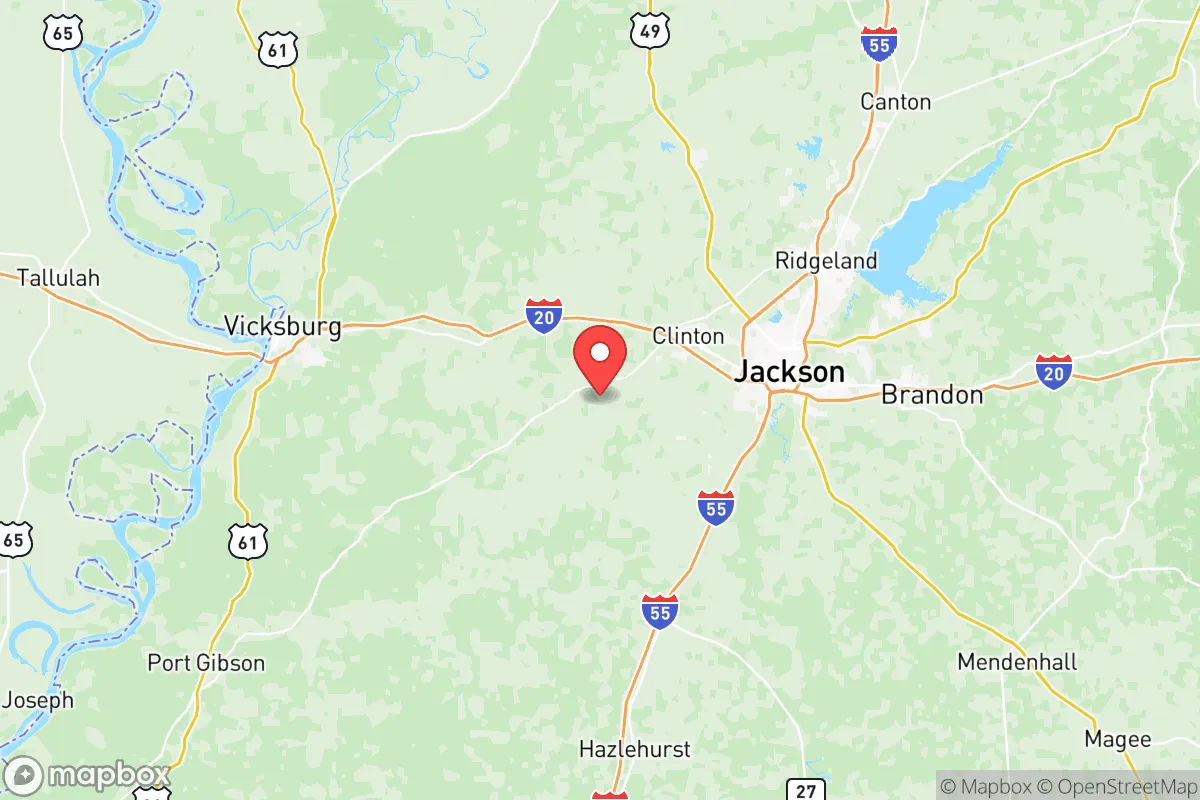
Hinds County, Mississippi, is home to 222,494 residents, making it the most populous county in the state, yet it is defined by a stark demographic and economic divide. The county is overwhelmingly Black (72.2%) with a White population of 23.2%, a small but growing Hispanic community at 2.0%, and a foreign-born population of just 1.2%. Its identity is shaped by the dual anchors of Jackson, the state capital and largest city, and the more suburban, predominantly White communities of the county’s western edge, creating a region of contrasting lifestyles and political dynamics.
Settlement & growth (pre-1960)
The land that became Hinds County was originally inhabited by the Choctaw people, who ceded the territory to the United States in the 1820 Treaty of Doak’s Stand. American settlement began in earnest shortly after, with the county officially established in 1821 and named for General Thomas Hinds, a War of 1812 hero. The first wave of settlers were primarily Anglo-American planters and their enslaved laborers from Virginia, the Carolinas, and Georgia, drawn by the fertile loess soil of the Mississippi River bluffs for cotton cultivation. The county seat was initially located at Clinton, but was moved to the newly founded city of Jackson in 1822, chosen specifically as the state capital for its central location.
Throughout the antebellum period, Hinds County’s economy and population were dominated by plantation agriculture, with enslaved Black people making up a majority of the population by 1860. After the Civil War and emancipation, the county’s Black population remained largely rural and agricultural, working as sharecroppers and tenant farmers. The late 19th and early 20th centuries saw the rise of Jackson as a commercial and political hub, attracting a small but influential class of White merchants, lawyers, and government workers. The Great Migration (roughly 1915–1970) saw tens of thousands of Black residents leave Hinds County for industrial jobs in Chicago, Detroit, and St. Louis, a demographic shift that permanently reduced the county’s Black population share from a post-Reconstruction peak. Meanwhile, the city of Jackson grew as a regional center for insurance, banking, and state government, drawing White professionals from across Mississippi. Suburbanization began in earnest after World War II, with White families moving to new developments in the county’s western areas, particularly around the town of Clinton and the unincorporated community of Byram, which incorporated as a city in 2009.
Modern era (post-1965)
The 1965 Hart-Cellar Act had a minimal direct impact on Hinds County, as the region never became a major destination for post-1965 immigration. The foreign-born population remains very low at 1.2%, far below the national average. The small Hispanic population (2.0%) is largely composed of Mexican and Central American immigrants who arrived from the 1990s onward, working in construction, landscaping, and the poultry processing industry. These families are concentrated in Jackson’s southwest side and in the more affordable suburban areas of the county, such as the city of Pearl (which is actually in Rankin County but draws workers from Hinds) and the town of Terry. The East/Southeast Asian community (0.4%) is very small, with a handful of Vietnamese and Chinese families operating restaurants and nail salons in Jackson. The Indian subcontinent community (0.4%) is similarly tiny, mostly consisting of professionals in medicine and academia associated with the University of Mississippi Medical Center in Jackson.
The dominant demographic story of the post-1965 era is not immigration but domestic migration and suburbanization. White flight from Jackson accelerated dramatically after the 1960s, driven by school desegregation orders and the city’s rising crime rates. By 1980, Jackson’s population had peaked at just over 200,000 and then began a steady decline, while the surrounding suburbs boomed. The White population of Hinds County today is heavily concentrated in the western suburbs: the city of Clinton (home to Mississippi College and a large White professional class), the town of Raymond (the county’s second seat and site of Hinds Community College), and the unincorporated area of Bolton. The city of Jackson itself is now over 80% Black, with a small White minority concentrated in the historic Fondren and Belhaven neighborhoods. The Black population, meanwhile, has also suburbanized to some degree, with middle-class Black families moving to newer subdivisions in the county’s southern and eastern unincorporated areas, as well as to the city of Byram.
The future
Hinds County’s population is projected to continue a slow decline, mirroring the broader trend of Mississippi’s rural and urban core counties. The county lost roughly 5% of its population between 2010 and 2020, and this trend is expected to persist as young people, both Black and White, leave for job opportunities in Atlanta, Dallas, and Nashville. The county is becoming slightly more diverse, but from a very low base: the Hispanic share is expected to grow slowly, perhaps reaching 3-4% by 2035, as families are drawn by low housing costs and construction jobs. The foreign-born population will likely remain below 2%, as Hinds County lacks the established immigrant networks and diverse job base of larger Southern metros. The Black population share is expected to remain stable or increase slightly, as the White population continues to age and suburbanize further into adjacent counties like Madison and Rankin. The cultural identity of Hinds County is becoming more polarized: Jackson is increasingly a center of Black political power and cultural expression, while the western suburbs remain culturally conservative and predominantly White. New residential development is concentrated in the county’s southern and western fringes, particularly around the new Interstate 20/Interstate 220 interchange near Clinton and the expanding town of Raymond.
For someone moving to Hinds County today, the choice is essentially a binary: live in Jackson, a majority-Black city with a vibrant cultural scene, historic architecture, and significant challenges with crime and public schools, or live in the western suburbs, which offer lower crime, better schools, and a more homogeneous, family-oriented environment. The county as a whole is becoming more economically stratified, with a shrinking middle class and a growing gap between the professional class in Clinton and the impoverished neighborhoods of Jackson. It is a place of deep historical roots and stark present-day contrasts, where the legacy of segregation and the Great Migration still shapes where people live and how they see their community.

* Values derived from national, state, county, city and local statistics and may differ in a specific area. Last updated: 2026-06-24T12:07:23.000Z
Narrative content on this page is AI-generated and may contain mistakes. Verify any details that matter before acting on them.
ReloMaps may earn a commission from affiliate links at no extra cost to you.

