
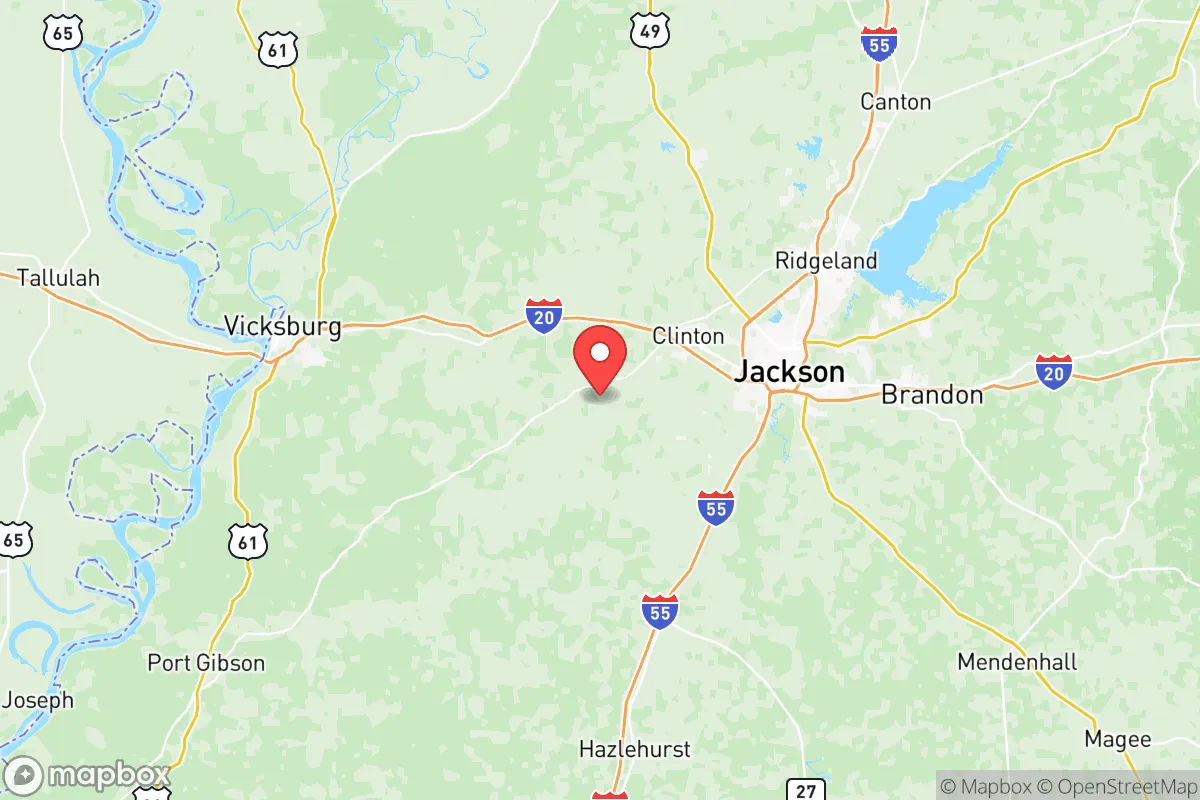
Photo: Wikipedia
Personal Sovereignty in Hinds County
Viable for self-reliance. Generally workable, though some barriers may limit total independence.
What does Personal Sovereignty tell us?
Personal Sovereignty measures your capacity for self-reliance and independence with minimal government friction. Higher scores mean fewer barriers between you and the way you want to live... but it assumes you have the space you need and good neighbors.
What does this tell us?
Personal Sovereignty measures your capacity for self-reliance and independence with minimal government friction. Higher scores mean fewer barriers between you and the way you want to live... but it assumes you have the space you need and good neighbors.
State Policy
Energy independence: Importer (50% of energy produced in-state)
Personal Liberty
Homesteading

Personal Liberty Analysis
Hinds County, Mississippi, presents a complex personal sovereignty landscape where strong state-level protections for gun rights and limited government structure clash with the regulatory weight of a capital city. For individuals and families prioritizing independence, the county offers a distinctly uneven terrain: the rural and suburban stretches enable significant self-reliance, while the urban core of Jackson imposes higher taxes and tighter control over property and development. Understanding these micro-differences is critical for anyone weighing a move to this central Mississippi region.
Tax burden and regulatory posture in Hinds County
Mississippi is generally known as a low-tax state, and Hinds County benefits from several state-level policies that favor personal financial autonomy. There is no state income tax on Social Security benefits, and the state’s flat income tax rate of 4.0% is among the lowest in the nation. However, the county itself levies a combined sales tax rate of 8.0% (7.0% state + 1.0% county) in unincorporated areas, which rises to 9.0% within Jackson city limits due to an additional city tax. Property taxes in Hinds County are moderate, with an average effective rate around 0.82% of assessed home value. This is notably lower than many peer counties in the Deep South, but significantly higher than neighboring rural counties like Copiah or Yazoo, where rates often fall below 0.6%. The regulatory posture is largely light-touch on paper—Mississippi has no state-level building code for single-family homes outside of certain flood zones, and no statewide zoning mandate. In practice, this means communities like Clinton, Byram, and Terry have their own local zoning and permit requirements, which vary substantially. Clinton, for instance, enforces stricter subdivision and stormwater regulations than rural areas like Utica, where unincorporated parcels can be developed with minimal county oversight. For an individual seeking maximum tax freedom, living just outside the Jackson city limits in areas like Raymond or Bolton can reduce both the sales tax burden and local permit costs.
Self-defense and gun law specifics in Hinds County
Mississippi is a constitutional carry state, meaning that as of 2016, any adult who can legally possess a firearm may carry it openly or concealed without a permit. This provision applies uniformly across Hinds County. The county itself has no additional restrictions on firearms beyond state law, though local law enforcement jurisdictions—specifically the Jackson Police Department—have been known to enforce "no-gun" signage on public property more aggressively than in suburban precincts. The state preempts most local firearm ordinances, so cities like Jackson, Clinton, and Byram cannot pass their own gun bans. Stand-your-ground law is fully codified in Mississippi, with no duty to retreat in any place where the individual is lawfully present. Castle doctrine protections extend to occupied vehicles and workplaces. For residents, the practical difference lies in the application of self-defense incidents: prosecutors in Hinds County (Jackson's court system) have historically been less tolerant of firearm discharges in defensive scenarios than those in rural county districts, though no arrest or conviction pattern is starkly different from state averages. Range access is robust, with the Mississippi Law Enforcement Officers' Training Academy range near Raymond open to the public on certain days, and several private ranges in the county's southern half near Terry. For those prioritizing self-defense, the county's legal framework is among the most permissive in the nation, though the urban context of Jackson can create practical friction.
Self-reliance and homesteading viability in Hinds County
The viability of a homesteading or off-grid lifestyle in Hinds County depends almost entirely on location. Zoning is a county-level affair, and the rules vary dramatically by jurisdiction. In unincorporated areas like those around Utica, Bolton, and Learned, there is no minimum lot size for agricultural use, and the county imposes no restriction on keeping livestock (chickens, goats, cattle) as long as the parcel is classified as agricultural. The county's planning commission requires a minimum of 2 acres for a single-family dwelling on a septic system in most rural zones, but this can be as low as 1 acre where public sewer is available. Off-grid living—solar panels, rainwater collection, composting toilets—is not prohibited by county code, but all dwellings must have a permit for a potable water source (well or public) and a septic system approved by the Mississippi Department of Health. The county does not enforce a building code for owner-builder homes on agricultural land, which is a significant advantage for the self-reliant. In contrast, within Jackson, Clinton, or Byram city limits, homesteading is effectively impossible: lot sizes are small (typically 0.25–0.5 acres), livestock is restricted to dogs and cats, and homes must meet the International Residential Code (IRC) for new construction. The county's soil quality in the Pearl River floodplain (eastern Hinds) is rich for gardening, and the growing season averages 230 frost-free days. Water rights are generous: well permits are issued by the state with no metering, and rainwater harvesting is unrestricted. For anyone serious about self-sufficiency, the rural southwest and northwest of the county—around New Hebron and Edwards—offer the best combination of low regulation and fertile land.
Personal liberties in Hinds County (parental rights, medical autonomy, speech, property)
Mississippi's legal environment strongly favors parental rights. The state has a robust "parental bill of rights" statute (SB 2458, 2023) that guarantees parents the right to direct their child's education, medical treatment, and religious upbringing. This law applies uniformly across Hinds County and cannot be preempted by local school boards. Homeschooling is deregulated: parents simply submit an annual "certificate of enrollment" to the local school district (either Hinds County School District or the individual city districts) with no testing or curriculum approval required. Medical autonomy is similarly broad. Mississippi has no state vaccine mandate for adults, and the state's 2024 law prohibits employers from requiring COVID-19 vaccination as a condition of employment. Abortion is effectively banned in Mississippi after 15 weeks (with a heartbeat law that triggers near-total prohibition)—a policy that aligns with the state's conservative legislative posture. Property rights are strongly protected by state law, including a right-to-farm statute shielding agricultural operations from nuisance lawsuits. In Hinds County, the county supervisors have limited eminent domain authority; most takings require state-level approval. Free speech is protected under the First Amendment and the Mississippi Constitution, with no county-level ordinances restricting expressive activity. However, within Jackson city limits, a 2023 noise ordinance has been used to break up political gatherings and public demonstrations, though no successful prosecution has been reported. The Jackson City Council also maintains stricter signage regulations (size and placement) than the county, which can affect the display of political or religious messages on private property. For those who prioritize maximum personal liberty, the rural unincorporated areas of Hinds County provide a nearly barrier-free environment, while the city limits of Jackson impose modest but real constraints on public expression and commercial signage.
Overall, Hinds County offers a personal sovereignty score that ranks well above the national average due to state-level protections for gun rights, parental control, and low property regulation. The county's weakness is its urban core: Jackson's higher tax rate, zoning code, and noise/signage ordinances create a noticeably tighter regulatory environment than most of the Deep South's rural counties. For readers considering relocation, the takeaway is clear: the parts of Hinds County that are not Jackson—specifically the towns of Clinton, Byram, Raymond, Terry, and Utica—deliver an autonomy profile comparable to the state's most libertarian-leaning areas like Lamar or Madison counties. The county as a whole is therefore less a monolith than a mosaic, where one's actual personal freedom depends more on which road they live on than which county they live in.

* Values derived from national, state, county, city and local statistics and may differ in a specific area. Last updated: 2026-06-24T12:07:23.000Z
Narrative content on this page is AI-generated and may contain mistakes. Verify any details that matter before acting on them.
ReloMaps may earn a commission from affiliate links at no extra cost to you.

