Photo: Wikipedia
Quality of Life in Forrest County
A livable area that tracks near national norms for affordability, walkability, and neighborhood health.
What does Quality of Life tell us?
Quality of Life measures an area by evaluating factors like cost of living, nearby amenities, country club access, airport proximity, socioeconomic signals and neighborhood character. For large states, this is a general average — quality of life can vary dramatically between metro areas, suburbs, and rural communities within the same state.
What does this tell us?
Quality of Life measures an area by evaluating factors like cost of living, nearby amenities, country club access, airport proximity, socioeconomic signals and neighborhood character. For large states, this is a general average — quality of life can vary dramatically between metro areas, suburbs, and rural communities within the same state.
Cost of Living
29% below national average
121%
The Real Cost of Living in Forrest County for 2026
| Tier | Individual | Family (4) |
|---|---|---|
| Survival | $15k | $29k |
| Comfortable | $30k | $44k |
| Luxury | $95k+ | $148k+ |
| Elite (Top 5%) | $126k+ | $195k+ |
Quality-of-Life Analysis
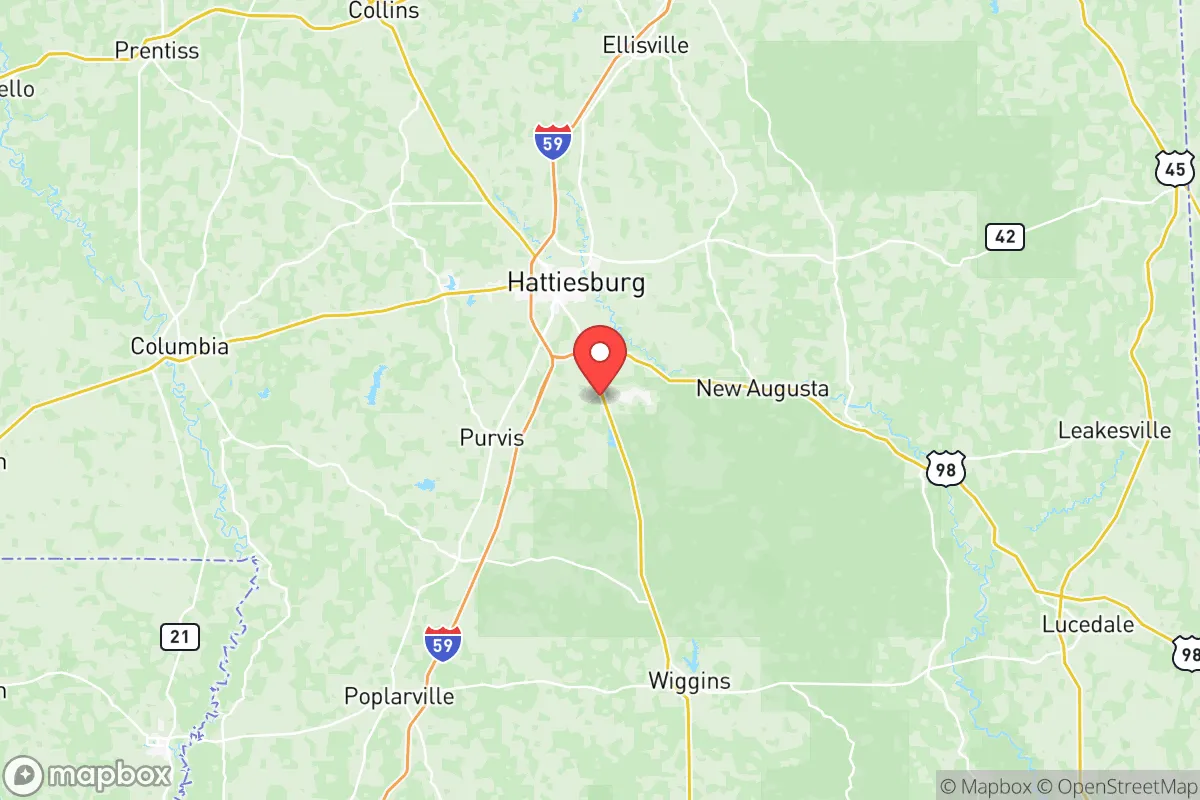
Forrest County, Mississippi offers a diverse quality-of-life spectrum that spans the urban energy of Hattiesburg to the quiet, rural rhythms of communities like Petal and McLain. This range attracts a broad demographic: students and young professionals gravitate to the university-adjacent districts of Hattiesburg, families seek the slower pace and good schools of Petal, and retirees or those seeking land find affordability in the county's unincorporated outposts and smaller towns like Brooklyn and Carnes.
Largest town(s) & population centers
The dominant population center is Hattiesburg, which serves as the economic and cultural hub for the entire Pine Belt region. Home to the University of Southern Mississippi (USM) and William Carey University, daily life in Hattiesburg is lively and amenity-rich, with dining, arts, and medical services centered around the historic downtown and the Midtown corridors. The city's population of roughly 46,000 swells on school days, giving it a distinctly youthful and transient energy. Directly adjacent, Petal (about 10,500 residents) operates as a separate municipality but feels like a suburban extension. Petal is frequently cited for its independent school system and family-oriented neighborhoods, with a quieter, more uniform suburban feel compared to Hattiesburg's diversity. The average commute across the county is roughly 21 minutes, which makes living in Petal and working in Hattiesburg a practical daily reality for thousands.
Smaller towns & rural pockets
Beyond the city limits, Forrest County contains several unincorporated communities and small towns that define its rural character. McLain is the most notable incorporated community outside the Hattiesburg-Petal axis, a tiny town (population under 500) in the county's northern reach, centered on agriculture and timber. Further south and west, the communities of Brooklyn and Carnes are census-designated places that consist of scattered homes, churches, and small farms, with no commercial core to speak of. The area around Runnelstown in the eastern part of the county offers a similar rural existence, with residents often commuting into Hattiesburg for work. These pockets are geographically close to the city—typically a 15-20 minute drive—but feel worlds away in terms of pace, noise, and neighborly interaction.
Cost & lifestyle range
The cost of living across Forrest County is dramatically lower than the national average, with a composite index of 71 (where 100 is the US average). This creates a wide range of attainable lifestyles. At the upper end of the spectrum, newer subdivisions in west Hattiesburg (around the USM campus) and established neighborhoods in Petal (like those off Highway 42) see median home values near the county-wide figure of $152,900, often climbing higher for larger homes. At the lower end, rural areas near Brooklyn or Carnes offer older homes on acreage at significantly lower prices, and the county's median rent of $960 makes for affordable starter housing. The trade-off is stark: urban Hattiesburg offers walkability, entertainment, and job density, while rural parts offer land, quiet, and privacy but require reliance on personal vehicles for every errand. The roughly 21-minute average commute is a testament to how easily one can bridge that lifestyle gap daily.
This county is best suited for individuals who value proximity to university-town amenities without the premium costs of a larger metro. Families thrive in Petal's school-focused environment, while students and creatives are drawn to Hattiesburg's walkable districts. Those seeking acreage and a self-sufficient lifestyle will find value in the county's rural pockets. Forrest County's strength is its ability to let residents choose their pace—from the pace of a college town to the silence of piney woods—all within a short drive.

Crime in Forrest County
Generally safer than 61% of comparable U.S. locations.
Violent CrimeViolent Crime Analysis
Property CrimeProperty Crime Analysis
Crime Analysis
Forrest County, Mississippi, presents a mixed safety picture. Its violent crime rate of 187 incidents per 100,000 residents is nearly one-third below the national average, suggesting serious assaults and robberies are less common here than in many comparably sized counties. However, property crime in the county tells a different story, with a rate of 1,065.3 per 100,000 — roughly equal to the U.S. national average but elevated compared to Mississippi’s statewide property crime benchmark of around 950 per 100,000. The overall safety experience depends heavily on which side of the county you live in, with the City of Hattiesburg driving the majority of crime reports while smaller towns like Petal, McLain, and Brooklyn see dramatically lower incident counts.
Crime in context
Forrest County’s violent crime rate of 187 per 100K sits well below the Mississippi state average of roughly 260 per 100K and also below the U.S. rate of about 380 per 100K. That means your risk of being a victim of homicide, rape, robbery, or aggravated assault in Forrest County is about half the national risk. Property crime, however, is the primary safety concern: at 1,065.3 per 100K, it tracks closely with the national average but is roughly 12% higher than the Mississippi state average. The bulk of property crimes reported in the county are larceny-thefts and burglaries. Readers should note that crime data is collated county-wide; city-level reporting from Hattiesburg (the county seat and an estimated 48,000 residents) typically shows higher per-capita rates, while Petal (roughly 10,800 residents) reports notably fewer incidents. The 12th Chancery Court District, which includes Forrest County, has seen some criticism from law enforcement regarding a perceived leniency in bond-setting and plea deals under progressive-leaning jurisprudence; these judicial trends may encourage property crime recidivism, as offenders cycle quickly back onto the street.
What residents experience
In practical terms, a resident’s experience of safety in Forrest County is largely a story of two geographies. Within the Hattiesburg city limits — especially along the Highway 49 corridor, near the University of Southern Mississippi campus, and in the downtown historic district — police respond to frequent reports of vehicle break-ins, package thefts, and occasional aggravated assaults tied to nightlife disputes. Property crime rates in Hattiesburg proper are elevated, with many offenses concentrated in areas near rental-heavy student housing. In contrast, the city of Petal, separated from Hattiesburg by the Leaf River and governed by its own police department, consistently reports property crime rates 30-40% lower than the county average. Smaller unincorporated communities like McLain and Brooklyn (both roughly 25 miles east of Hattiesburg) report minimal crime, with violent incidents often numbering in the single digits annually. The Forrest County Sheriff’s Department patrols the rural areas and unincorporated pockets, and deputies there emphasize community watch programs. Many long-time residents recommend choosing a home in Petal or the rural eastern side of the county if safety is the top priority, while noting that Hattiesburg’s downtown has seen a modest uptick in street-level property crime since 2022, partially attributable to a revolving-door judicial system in the county’s municipal and circuit courts.
Neighborhood-level variation is pronounced. South of Hardy Street in Hattiesburg, near the Oak Grove area, and west of U.S. 49 in the Timberton subdivision, home break-in rates are notably lower than in the central core. The most statistically dangerous area remains a small zone near the intersection of Broadway Drive and Main Street in Hattiesburg, where a cluster of low-income housing and transient motels drives higher police call volume. In Petal, the safest pockets are the newer subdivisions along Lonnie Bass Road and the neighborhoods near Petal High School. For prospective movers, checking the Hattiesburg Police Department’s monthly crime mapping and the Forrest County Sheriff’s log is recommended before signing a lease or purchase agreement.
* Values derived from national, state, county, city and local statistics and may differ in a specific area. Last updated: 2026-06-22T03:26:47.000Z
Narrative content on this page is AI-generated and may contain mistakes. Verify any details that matter before acting on them.
ReloMaps may earn a commission from affiliate links at no extra cost to you.

