
Photo: Wikipedia
Political ClimatePolitical Climate in Forrest County
Showing district-level results — no local-only data available.
Local Political AnalysisPolitical Analysis of Forrest County
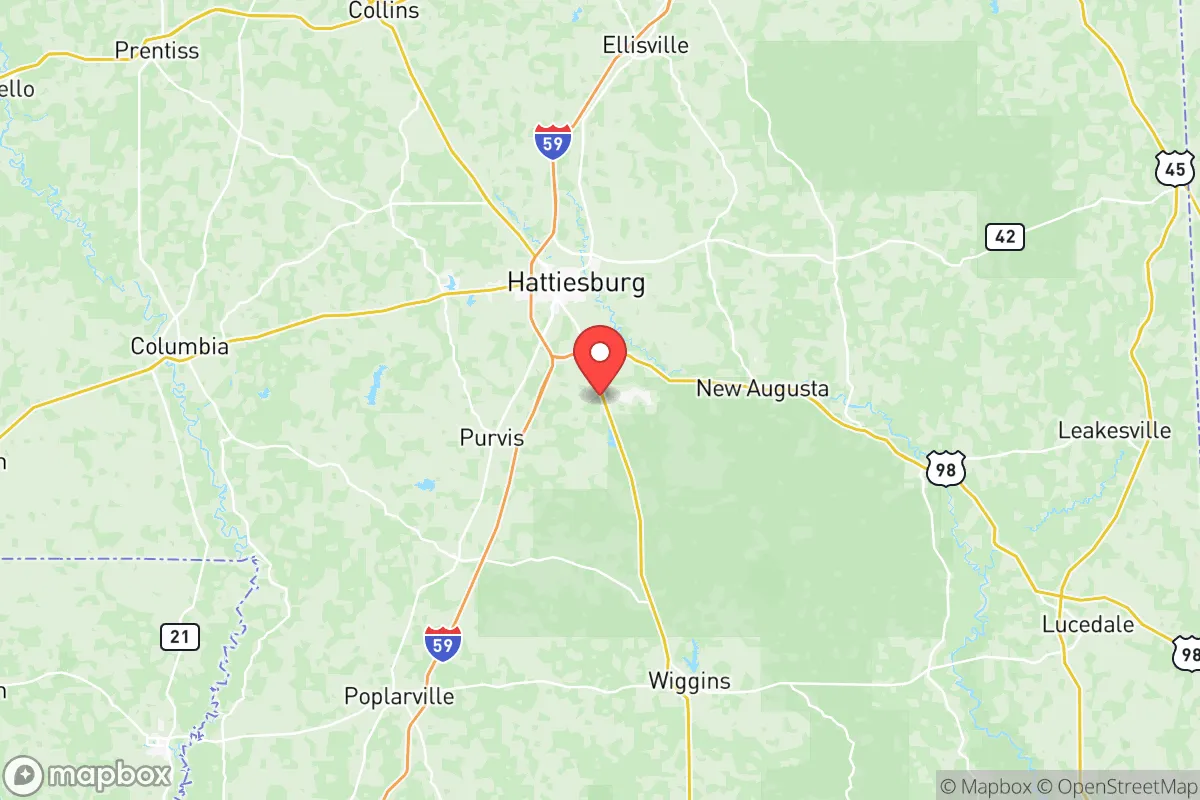
Forrest County, anchored by Hattiesburg, leans solidly Republican with a Cook PVI of R+21, making it significantly more conservative than the state of Mississippi as a whole, which sits at R+11. This trend has intensified over the last two decades, driven by suburban growth in areas like West Hattiesburg and Oak Grove, which now reliably vote red by wide margins. Historically a more moderate swing county thanks to its university and medical hub, the shift mirrors national patterns where college towns have polarized — but here, the surrounding rural and exurban precincts have pulled the county sharply rightward, a change you can really feel on the ground.
How it compares
The R+21 rating means Forrest County is roughly 10 points more Republican than Mississippi at large, a gap that’s rare for a county with a major university. To see the contrast in action, look at the city of Hattiesburg itself: its precincts near the University of Southern Mississippi and the historic downtown core often tilt Democratic, with some precincts voting blue by 5-10 points in recent statewide races. Meanwhile, the unincorporated areas like Petal (a fast-growing town just east) and the rural precincts around Rawls Springs and Dixie vote Republican by margins of 30-40 points. The swing precincts that decide countywide races are now in the suburban bedroom communities along Highway 98 and the 49 corridor — places like the West Oak Grove precinct, which can flip from cycle to cycle but has moved right since 2020. Democrat-leaning voters are now almost entirely concentrated inside the Hattiesburg city limits, meaning the rest of the county has become a Republican stronghold.
What this means for residents
For conservative residents, the political environment is very comfortable: local offices, from the Board of Supervisors to the Chancery Clerk, are held by Republicans, and policy debates tend to focus on growth management, tax rates, and infrastructure rather than cultural flashpoints. The county’s Republican primary is often the de facto general election for local races. For liberal and moderate residents, the reality is more about finding your niche. The Hattiesburg city government itself remains more progressive — the city has a nonpartisan mayor-council system, and local elections see high turnout from university and medical community voters. But countywide, progressive policy proposals (like zoning changes or public transit expansions) rarely gain traction outside the city limits. The practical effect is a patchwork: you can live in the city with its walkable core and diverse electorate, but drive five miles out to Oak Grove and the campaign signs and community concerns shift entirely to lower taxes and more conservative social values.
Culturally, this split defines daily life. The county is home to the University of Southern Mississippi and Forrest General Hospital, two of the area’s largest employers, which pull in a more politically moderate workforce than the surrounding Pine Belt region. You’ll find Hattiesburg hosting Pride events and food truck festivals, while Petal and Oak Grove lean heavily into church-centered community life and strong law-and-order messaging. The only real policy friction that surfaces regularly is over county-wide alcohol sales — Forrest County went wet years ago, but some precincts still vote dry for local option referendums, creating a patchwork of beer and liquor availability that catches newcomers off guard. That’s Forrest County in a nutshell: a deeply red county with a blue speck at its center, and enough space for both to coexist, even if they rarely see eye to eye.

State Political ClimatePolitical Climate in Mississippi
State Political AnalysisPolitical Environment in the State
Mississippi is one of the most reliably Republican states in the country, with a Cook Partisan Voting Index of R+11, meaning it votes about 11 points more Republican than the national average in presidential elections. The state hasn’t voted for a Democratic presidential candidate since Jimmy Carter in 1976, and that streak is unlikely to break anytime soon. Over the last 20 years, the GOP’s dominance has only deepened, driven by the realignment of white rural voters and the collapse of the old “Blue Dog” Democratic coalition that once controlled state government. Today, Republicans hold every statewide office, supermajorities in both legislative chambers, and all four U.S. House seats. For a conservative-leaning relocator, this means a policy environment that’s consistently right-of-center, but the state’s political reality is more layered than the raw numbers suggest.
Urban vs. rural divide
The political map of Mississippi is a textbook case of urban-rural polarization. The state’s few population centers—Jackson, the capital, and the Gulf Coast cities of Biloxi and Gulfport—are the only real Democratic strongholds. Jackson, which is over 80% Black, consistently votes 80-90% Democratic, and its surrounding Hinds County is the state’s most reliably blue jurisdiction. The Gulf Coast, with its mix of casino workers, military families, and retirees, is more competitive but still leans Democratic in local races, though it has been trending rightward in presidential elections. Meanwhile, the vast rural expanse—the Delta, the Pine Belt, and the northeastern hill country—is overwhelmingly Republican. DeSoto County, just south of Memphis, is the state’s fastest-growing and most reliably red suburban powerhouse, often delivering 70%+ margins for GOP candidates. Madison and Rankin counties, the affluent suburbs east of Jackson, are also deep red, with Madison County in particular being a hub for conservative professionals. The only notable exception is the Mississippi Delta, where majority-Black counties like Bolivar and Washington still vote Democratic, but their populations are shrinking, diluting their electoral influence. In practice, a conservative moving to DeSoto County or Madison will find themselves in a deeply Republican environment, while a liberal settling in Jackson or the Coast will be in a blue bubble surrounded by red.
Policy environment
Mississippi’s policy environment is shaped by a low-tax, low-regulation philosophy that appeals to many conservatives. The state has no individual income tax on the first $10,000 of income, and the top rate is just 4.7%, with a phase-down to 4.0% by 2026. Property taxes are among the lowest in the nation, thanks to a homestead exemption that caps the assessed value of owner-occupied homes. Sales tax is a flat 7%, which is high by national standards but typical for a state with no broad-based income tax. The regulatory posture is business-friendly: Mississippi is a “right-to-work” state, and workers’ compensation and unemployment insurance costs are low. Education policy is a mixed bag: the state has a school choice program (the Mississippi Education Scholarship Account) for special-needs students, but traditional public schools remain underfunded and rank near the bottom nationally. Healthcare is a perennial flashpoint: Mississippi has not expanded Medicaid under the Affordable Care Act, leaving roughly 75,000 low-income adults in a coverage gap. Election laws are restrictive by national standards: voter ID is required, early voting is limited to in-person absentee with an excuse, and no-excuse absentee voting does not exist. For a conservative relocator, the tax and regulatory climate is a clear plus, but the education and healthcare systems may require careful planning, especially for families with school-age children or chronic health needs.
Recent policy direction
Over the past five years, Mississippi has moved decisively to the right on a broad range of issues. In 2023, the legislature passed a near-total abortion ban with no exceptions for rape or incest, triggered by the Dobbs decision; the only exception is to save the mother’s life. Gun laws are among the most permissive in the country: permitless carry (constitutional carry) was enacted in 2016, and the state has a strong “stand your ground” law. In 2024, the legislature passed a law banning transgender athletes from women’s sports and restricting gender-affirming care for minors. On education, the state enacted a school choice expansion in 2023 that allows parents to use public funds for private school tuition in certain districts, and a 2022 law prohibits the teaching of “critical race theory” in K-12 classrooms. Property rights are strongly protected: Mississippi is a “right-to-farm” state with laws shielding agricultural operations from nuisance lawsuits. On privacy and surveillance, the state has no comprehensive data privacy law, but it does have a law restricting the use of facial recognition by law enforcement without a warrant. Voting access has tightened: in 2023, the legislature passed a law requiring a photo ID for absentee ballots and shortening the absentee voting window. For a conservative relocator, this direction is likely welcome; for a liberal, it means living under a government that is actively restricting abortion access, LGBTQ+ rights, and voting options.
Civil unrest & political movements
Mississippi has a long history of civil rights activism, and that legacy continues in more muted form today. The state saw significant protests in 2020 after the murder of George Floyd, particularly in Jackson and on the Gulf Coast, where demonstrators called for police reform and the removal of Confederate monuments. The most visible flashpoint was the debate over the state flag, which until 2020 featured the Confederate battle emblem; after widespread protests and pressure from business groups, the legislature voted to remove it, and a new flag without Confederate symbolism was adopted. On the right, the state has a strong gun rights movement, with groups like the Mississippi Gun Owners actively lobbying against any new restrictions. Immigration politics are less heated than in border states, but there is a vocal faction pushing for stricter enforcement; Mississippi has a 2011 law (HB 488) that requires police to check immigration status during lawful stops if they suspect someone is in the country illegally. There is no serious secession or nullification movement, though some local GOP officials have floated “constitutional carry” and “sanctuary city” resolutions for gun rights. Election integrity controversies have been minimal compared to other states, but in 2022, the state’s Republican secretary of state launched a review of voter rolls that found no widespread fraud. For a new resident, the political atmosphere is generally calm, but the legacy of the civil rights era is still visible in the state’s racial divisions and occasional public debates over monuments and symbols.
Projection
Over the next 5-10 years, Mississippi’s political trajectory is likely to remain solidly Republican, but demographic shifts could slowly moderate the state’s hard-right edge. The population is aging and slowly declining, with the biggest losses in the rural Delta and the Pine Belt. In-migration is modest, but the fastest-growing areas—DeSoto County, Madison County, and the Gulf Coast—are attracting younger, more educated residents, many from other Southern states. These newcomers tend to be conservative but may be less culturally traditional than the existing base, potentially softening the state’s stance on issues like marijuana legalization (medical use is already legal, but recreational is not) and education funding. The Black population, which makes up about 38% of the state, remains heavily Democratic, but turnout is often lower than white voters, and gerrymandered districts limit its legislative impact. The biggest wildcard is the potential for Medicaid expansion, which has bipartisan support among business groups and healthcare providers but is blocked by the GOP supermajority. If expansion passes in the next few years, it could shift the political conversation toward healthcare and away from culture war issues. For a relocator moving in now, expect a state that will remain deeply red for the foreseeable future, but with a slightly more pragmatic, suburban flavor in the growing areas, while the rural Delta continues to hollow out.
For a conservative family or individual, Mississippi offers a low-tax, low-regulation environment with strong gun rights, school choice options, and a government that aligns with traditional values. The trade-offs are real: public schools and healthcare infrastructure are weak, especially in rural areas, and the state’s poverty rate (around 19%) is the highest in the nation. For a liberal relocator, the state will feel politically hostile, but the low cost of living and strong community ties in places like Jackson or the Coast can make it livable if you’re willing to be politically isolated. The bottom line: Mississippi is a state where your political views will largely determine your experience, and the trajectory suggests that divide will only widen. Choose your county carefully—DeSoto for suburban comfort, Madison for affluence and schools, Jackson for urban diversity, or the Coast for a more moderate vibe—and you’ll find a place that fits.
* Values derived from national, state, county, city and local statistics and may differ in a specific area. Last updated: 2026-06-22T03:26:47.000Z
Narrative content on this page is AI-generated and may contain mistakes. Verify any details that matter before acting on them.
ReloMaps may earn a commission from affiliate links at no extra cost to you.

