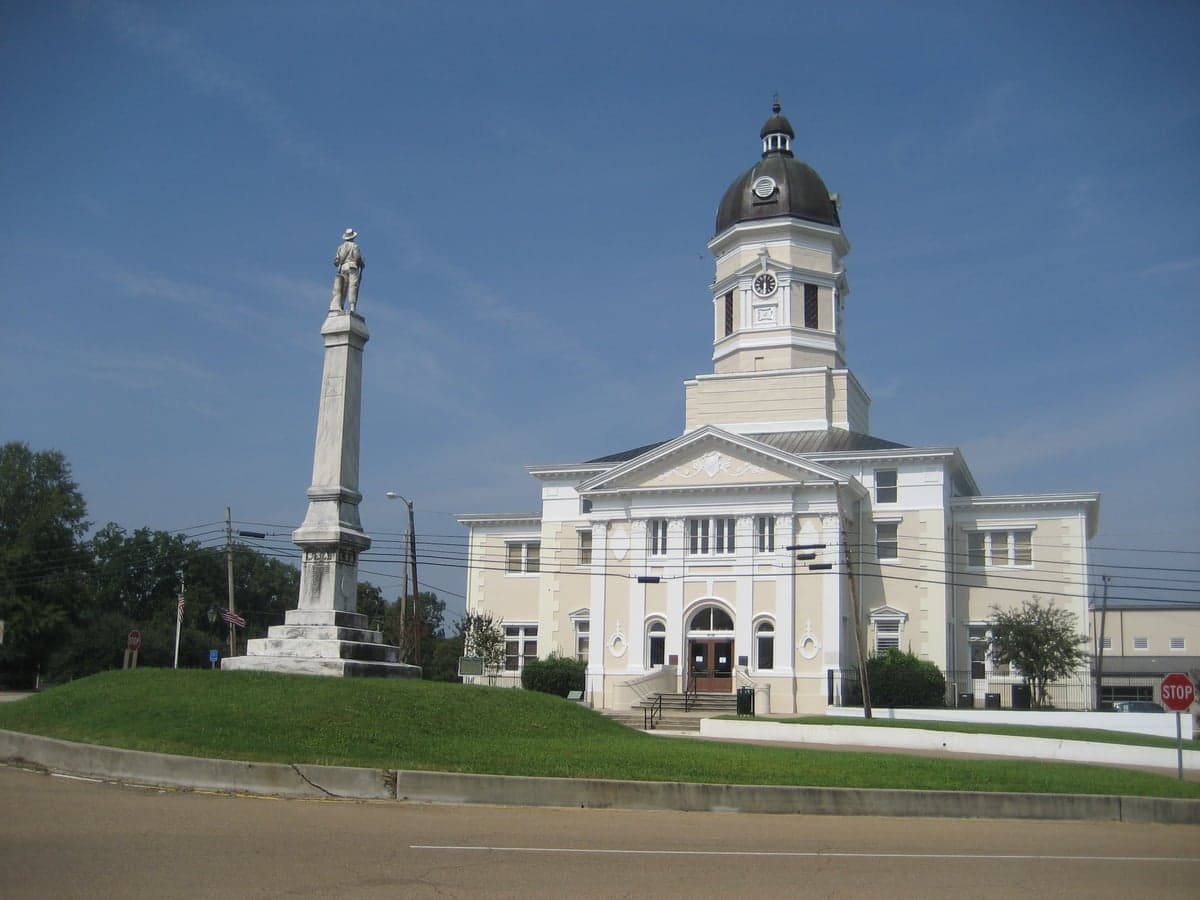
Photo: Wikipedia
Political ClimatePolitical Climate in Claiborne County
Showing county-level results — no local-only data available.
Lean and PVI are calculated from this county’s 2020 and 2024 presidential results, Cook-style.
Political rankings in Mississippi
- Most Conservative Cities in Mississippi
- Most Liberal Cities in Mississippi
- Best Liberal-Leaning Towns in the South
- Best Liberal-Leaning Towns in the Deep South
- Safest Liberal-Leaning Towns in the South
- Safest Conservative-Leaning Towns in the South
- Affordable Small Towns for Conservatives
- Safest Conservative-Leaning Cities in the U.S.
- Most Conservative Counties in Mississippi
- Most Liberal Counties in Mississippi
Local Political AnalysisPolitical Analysis of Claiborne County
Claiborne County is one of the most reliably Democratic counties in the entire state of Mississippi, carrying a Cook PVI of D+34. That means the county votes about 34 points more Democratic than the national average, a stark contrast to the state of Mississippi as a whole, which sits at R+11. The political reality here isn't a recent shift; it's a deep-rooted legacy tied to the county's majority-Black population and its history as a center of the civil rights movement, anchored by the town of Port Gibson.
How it compares
The gap between Claiborne County and the rest of Mississippi is about as wide as it gets in American politics. While statewide candidates like Republicans Tate Reeves and Cindy Hyde-Smith routinely win Mississippi by double digits, Claiborne County consistently delivers 85-90% of its vote to Democratic candidates. The political map inside the county is fairly uniform, but there are subtle variations. The county seat, Port Gibson, is the Democratic stronghold, with precincts there regularly pushing 90%+ for Democrats. The smaller communities of Hermanville and Pattison lean similarly blue, though slightly less overwhelmingly. The only precincts that show any Republican presence at all are the rural, sparsely populated areas along the county's northern edge near the Warren County line, where a handful of white landowners and agricultural operators vote more like their neighbors to the north. Even there, the GOP share rarely cracks 25%.
What this means for residents
For liberal residents, living in Claiborne County means your vote is essentially a lock for the Democratic primary, and the general election is a formality. The real political action happens in the Democratic primary, where local races for sheriff, chancery clerk, and county supervisor are decided. For conservative residents, the practical reality is that they are a permanent minority in local elections. Their influence is felt more at the state level, where they align with the dominant Republican majority in Jackson. This creates an interesting dynamic: a resident can vote for a Republican governor who then appoints officials that oversee state agencies affecting the county, while the county's own board of supervisors is entirely Democratic. It also means that national issues like gun rights or abortion are debated through a local lens that often prioritizes economic development and infrastructure over cultural wedge issues.
Looking ahead, the trajectory is stable. There is no demographic trend suggesting Claiborne County will become competitive for Republicans anytime soon. The county's population is roughly 85% Black, and political allegiances are strongly tied to national Democratic identity. The only meaningful shift in recent years has been a slight increase in turnout among younger voters, which has if anything pushed the county further to the left on issues like criminal justice reform and environmental policy, particularly regarding the Mississippi River and the Natchez Trace corridor.
Culturally, this political isolation has fostered a sense of self-reliance. The county is home to Alcorn State University in Lorman, a historically Black university that acts as a political and cultural hub, hosting forums and voter drives that reinforce the area's Democratic leanings. There is a palpable pride in the county's role in the civil rights movement, with sites like the Port Gibson courthouse and the nearby Grand Gulf Military Monument serving as touchstones. For anyone moving here, the advice is simple: understand that local politics are communal and consensus-driven within the Democratic framework, and that your voice is best heard at the county board meetings and in the primary, not in the general election. It's a place where the national political war feels distant, and the local one is about potholes, schools, and the next economic development project.

State Political ClimatePolitical Climate in Mississippi
State Political AnalysisPolitical Environment in the State
Mississippi is one of the most reliably Republican states in the country, carrying a Cook Partisan Voting Index of R+11, a designation it has held for over a decade. The state hasn't voted for a Democratic presidential nominee since Jimmy Carter in 1976, and the margin has only widened since the early 2000s as white rural voters consolidated behind the GOP. That said, the political reality on the ground is more layered than the raw numbers suggest—there's a resilient Black Democratic coalition, a growing suburban professional class, and a state GOP that has shifted from pragmatic conservatism to a more culturally combative posture over the last five years.
Urban vs. rural divide
The political map of Mississippi is essentially a tale of three distinct zones: the urban Black-majority corridors, the white rural counties, and the fast-growing suburban rings. Jackson, the state capital and largest city, is the anchor of Democratic strength—Hinds County routinely delivers 80%+ margins for Democrats, powered by a Black electorate that makes up roughly 80% of the city's population. The Delta region, stretching from Tunica down through Greenville and Clarksdale, is similarly Democratic-leaning due to majority-Black populations, though turnout there is chronically lower than in the Jackson metro. On the other side, the rural white counties of the Pine Belt and the Hill Country—places like Tupelo, Oxford's surrounding Lafayette County, and the Gulf Coast's Harrison County—are the engine of the state's Republican majority. The real battleground is the suburban crescent around Jackson: Madison County, Rankin County, and DeSoto County in the Memphis suburbs. Madison and Rankin are now among the most Republican counties in the nation, with Madison County voting +38 R in 2024, but they're also the fastest-growing areas in the state, attracting out-of-state transplants who bring a more moderate, business-oriented conservatism. DeSoto County, just south of Memphis, is the state's most politically volatile suburban area—it flipped to Trump by only 12 points in 2020, and local school board races there are often decided by single digits, reflecting a mix of Tennessee commuters and native Mississippians.
Policy environment
Mississippi's policy environment is defined by a low-tax, low-service model that has been in place since the 1980s. The state has no income tax on Social Security benefits, a flat 5% personal income tax that is being phased out entirely by 2026, and a state sales tax of 7% that hits groceries and prescription drugs—one of the highest effective rates in the nation. Property taxes are among the lowest in the country, with a homestead exemption that shields the first $75,000 of a home's value for owner-occupants. The regulatory posture is decidedly business-friendly: Mississippi is a right-to-work state, has no state-level minimum wage above the federal $7.25, and has a tort reform cap on non-economic damages at $1 million. Education policy is a mixed bag—the state has a school choice program (the Mississippi CHOICE Scholarship) that's limited to special needs students, but it also has one of the lowest per-pupil spending levels in the nation at roughly $10,000 per student. Healthcare is the most contentious policy area: Mississippi is one of only ten states that has not expanded Medicaid under the Affordable Care Act, leaving roughly 100,000 working-age adults in the coverage gap. Election law is restrictive by national standards—the state requires a photo ID to vote, has no same-day registration, and has a permanent felony disenfranchisement law that affects about 1.5% of the voting-age population, a policy that has been challenged in federal court.
Recent policy direction
The last three legislative sessions have pushed Mississippi decisively toward a culturally conservative, small-government agenda. In 2024, Governor Tate Reeves signed a near-total abortion ban with no exceptions for rape or incest, which took effect immediately after the Dobbs decision—the state's trigger law was among the strictest in the nation. On gun policy, Mississippi is a constitutional carry state (permitless carry for adults 21 and over, 18 for military), and in 2023 the legislature passed a law prohibiting local governments from enforcing federal gun regulations, a direct nullification-style measure. Parental rights legislation has expanded significantly: the 2022 "Parents' Bill of Rights" requires schools to notify parents of any curriculum involving sexual orientation or gender identity, and the 2023 "Regulate Experimental Adolescent Procedures" law bans gender-affirming care for minors, making it a felony for physicians to provide such treatment. On the tax front, the 2022 Taxpayer Pay Raise Act accelerated the income tax phase-out and cut the corporate rate from 5% to 4%, a move that will cost the state an estimated $500 million annually once fully implemented. Property rights have been strengthened with a 2023 law that limits eminent domain for private economic development. On voting, the state has resisted automatic voter registration and same-day registration, but it did pass a 2024 law allowing online voter registration for the first time. The privacy and surveillance picture is mixed: Mississippi has no comprehensive data privacy law, but it does have a biometric privacy statute and a 2023 law restricting the use of facial recognition by law enforcement without a warrant.
Civil unrest & political movements
Mississippi's political flashpoints are less about street-level protest and more about institutional friction. The most visible movement in recent years has been the fight over the state flag—in 2020, amid nationwide racial justice protests, the legislature voted to remove the Confederate battle emblem, a decision that was driven by a coalition of business leaders and Black lawmakers but opposed by a vocal rural minority. That vote triggered a backlash that helped fuel a 2022 primary challenge to several incumbent Republicans, though none were ultimately defeated. The Jackson water crisis of 2022-2023 became a national political flashpoint, with the Biden administration and state Republicans trading blame over the city's failing infrastructure; the state ultimately took over parts of the city's water system in 2023, a move that local activists framed as a power grab. Immigration politics are relatively quiet—Mississippi has no sanctuary cities, and the state passed a 2023 law requiring all employers to use E-Verify, but the actual immigrant population is small (about 2.5% of residents). Election integrity has been a recurring theme: the state's Republican Secretary of State Michael Watson has pushed for stricter voter roll maintenance, and in 2024 the legislature passed a law requiring post-election audits, though there have been no major fraud cases. The most organized activist movements are on the right—the Mississippi chapter of Moms for Liberty has been active in school board races in Madison and DeSoto counties, and the state's chapter of the National Rifle Association is a perennial force in legislative primaries.
Projection
Over the next five to ten years, Mississippi's political trajectory points toward a continued Republican consolidation, but with a notable shift in flavor. The income tax phase-out will be fully implemented by 2026, which will make the state even more attractive to retirees and remote workers from high-tax states like California and Illinois—in-migration has already picked up, with DeSoto County and the Gulf Coast's Harrison County seeing the largest net gains. That influx will likely moderate the state's cultural conservatism at the margins, particularly in suburban school districts where new arrivals tend to be less animated by the culture war issues that dominate rural politics. The Democratic coalition will remain anchored in Jackson and the Delta, but its share of the statewide vote will likely shrink as the white rural population continues to age and the Black population, while growing, remains geographically concentrated. The wildcard is the ongoing legal challenge to felony disenfranchisement—if the courts strike it down, it could add 30,000 to 50,000 Black voters to the rolls, which would shift the statewide margin by 2-3 points but still not make the state competitive. Expect the state to remain R+10 or R+12 through 2034, with the real action happening in Republican primaries, where the fight between the business-conservative wing and the cultural-conservative wing will intensify as the suburban vote grows.
For a new resident, the bottom line is this: Mississippi is a place where your politics will be in the majority if you lean conservative, but where the practical implications of that lean are modest. You'll pay no state income tax by 2026, you can carry a firearm without a permit, and you'll have broad parental authority over your child's education. If you lean liberal, you'll find a small but active community in Jackson, Oxford, and the college towns, but you'll also find that state law is actively working against many of your priorities—from abortion access to transgender care to voting convenience. The state's politics are stable, predictable, and unlikely to surprise you in either direction over the next decade. What you see is what you get: a deeply red state with a functioning, if limited, democracy, where the real political battles are fought in Republican primaries and local school board meetings, not in statewide general elections.
* Values derived from national, state, county, city and local statistics and may differ in a specific area. Last updated: 2026-11-13T05:24:57.000Z
Narrative content on this page is AI-generated and may contain mistakes. Verify any details that matter before acting on them.
ReloMaps may earn a commission from affiliate links at no extra cost to you.

