Photo: Wikipedia
Demographics of Claiborne County
Affluence Level in Claiborne County
A low-income area with significant economic hardship. Household wealth and educational attainment are well below national averages.
People of Claiborne County
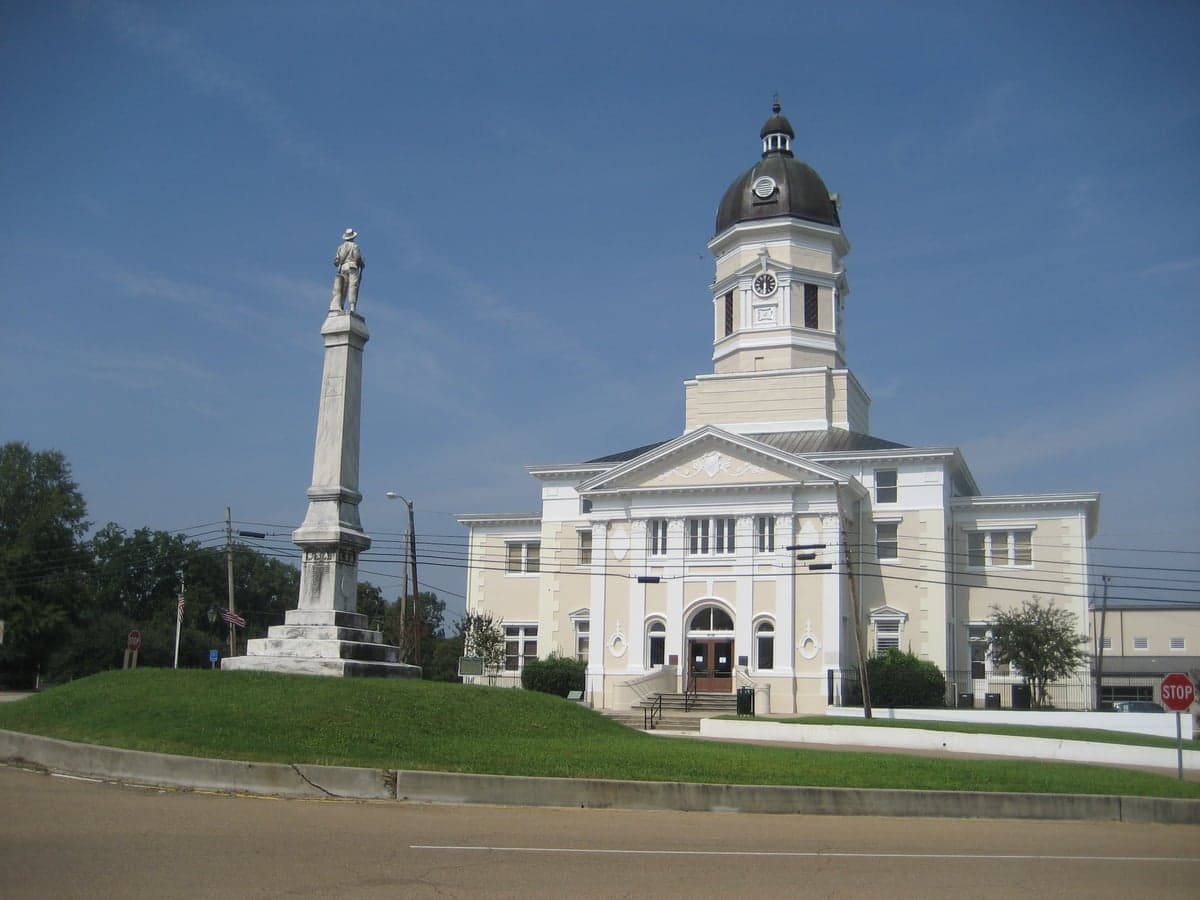
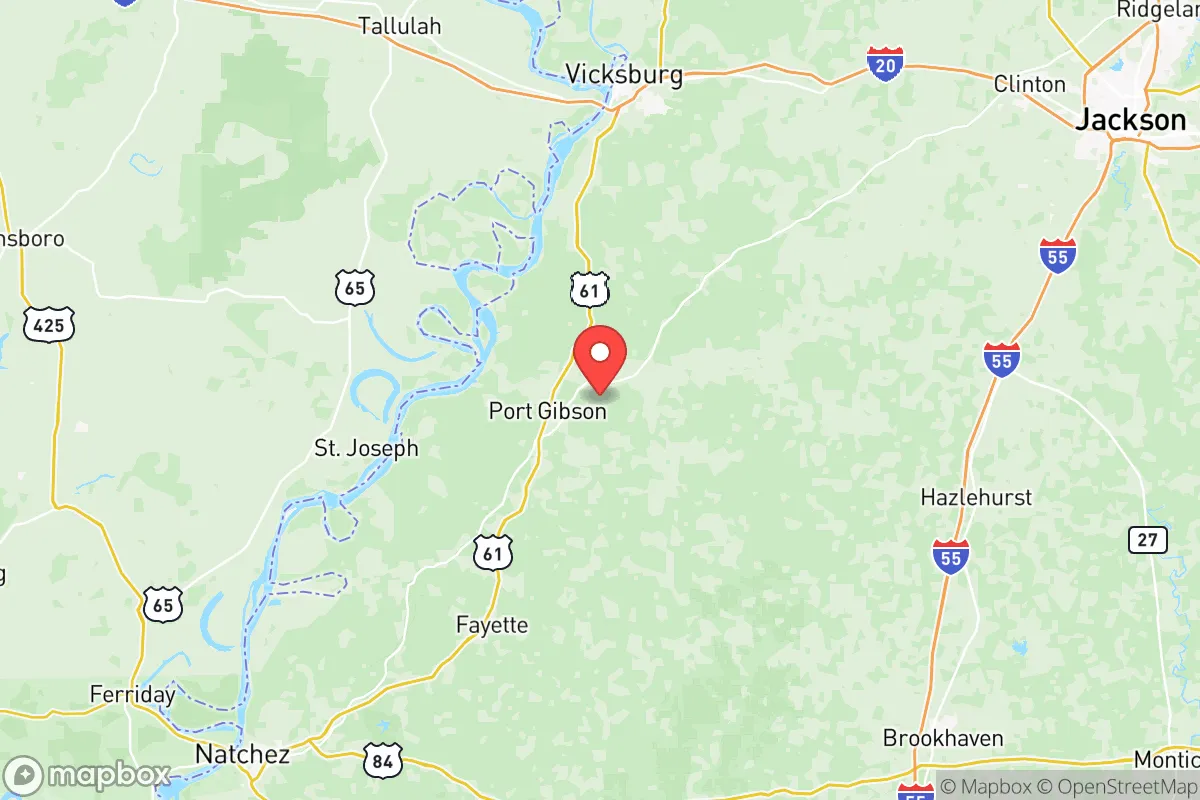
Claiborne County, Mississippi, is one of the most historically significant and demographically distinctive counties in the American South. With a population of 8,908, the county is overwhelmingly Black (86.1%), a direct legacy of the plantation era and the enslaved majority that worked the cotton fields along the Mississippi River. Today, the county is anchored by the town of Port Gibson, the county seat, and is characterized by a deep-rooted, multi-generational African American community, a small White minority (10.8%), and a negligible foreign-born population (0.5%). This is a place where the human story is written in antebellum architecture, Civil War battlefields, and the enduring institutions of Black civic and religious life.
Settlement & growth (pre-1960)
Before American settlement, the region was the domain of the Natchez people, who inhabited the bluffs and river bottoms along the Mississippi. The Natchez were a sophisticated mound-building society, but their population was decimated by French colonial wars in the 1730s, and the remnants were dispersed or absorbed into the Chickasaw and Creek nations. The French established a short-lived presence in the area, but it was not until the early 19th century that Anglo-American settlers, primarily of Scots-Irish and English descent, began arriving in significant numbers following the cession of Choctaw lands in the 1820 Treaty of Doak's Stand.
The defining demographic event in Claiborne County's history was the forced migration of enslaved Africans and African Americans into the region between 1820 and 1860. The county's fertile loess soil was ideal for cotton cultivation, and the plantation economy created a society where enslaved people outnumbered white slaveholders by a wide margin. By 1860, the county's population was roughly 80% enslaved, a ratio that would permanently shape its racial makeup. The town of Port Gibson, spared from destruction by Union General Ulysses S. Grant in 1863 (he reportedly said it was "too beautiful to burn"), became a center of this plantation wealth, while smaller communities like Grand Gulf, now a ghost town, served as bustling river ports for the cotton trade.
After the Civil War and emancipation, the county's Black population remained in place, transitioning from slavery to sharecropping and tenant farming. The 1870s and 1880s saw the establishment of independent Black churches, schools, and fraternal organizations, many of which still exist today. Unlike many Southern counties that experienced a significant out-migration of Black residents during the Great Migration (1910–1970), Claiborne County's Black population stayed relatively stable, largely because the rural agricultural economy, though poor, provided a familiar if difficult livelihood. The White population, by contrast, was always a minority, and its numbers slowly declined as small farms consolidated into larger operations. The county's population peaked at around 17,000 in 1940, and the post-war mechanization of agriculture began a slow, steady decline that continues to this day.
Modern era (post-1965)
The post-1965 era in Claiborne County is not a story of new immigrant waves, as the foreign-born population remains at just 0.5%. Instead, the defining demographic trend has been continued out-migration of both Black and White residents seeking economic opportunity elsewhere. The 1965 Hart-Cellar Act, which transformed American immigration nationally, had virtually no direct impact here; the county's population is almost entirely native-born, with roots stretching back multiple generations.
The most significant modern development was the construction of the Grand Gulf Nuclear Station in the 1970s, located just north of Port Gibson. This facility brought a modest influx of skilled workers and engineers, many of whom were White and from out of state, temporarily stabilizing the county's White population. However, this was a small and transient wave, and the county's overall population continued its long decline from 9,000 in 1980 to 8,908 today. The county's Black majority has become even more pronounced, as White residents have disproportionately left for nearby metropolitan areas like Vicksburg and Jackson. The small town of Hermanville, in the county's eastern section, and the unincorporated community of Pattison, near the nuclear plant, reflect this pattern: aging populations, shuttered businesses, and a reliance on a handful of large employers.
Suburbanization has largely bypassed Claiborne County. Unlike the booming Sun Belt suburbs of Texas or Georgia, this is a rural, poor county with a median household income well below the state average. The college-educated share of the population stands at 20.6%, a figure that is respectable for a rural county but masks a significant brain drain, as young people leave for college and do not return. The county's economy is now anchored by the nuclear plant, a state prison, and healthcare and education jobs in Port Gibson, which serves as the commercial and cultural hub. The Alcorn State University campus, located just across the county line in neighboring Lorman, provides some employment and cultural activity, but it does not reverse the overall trend of population loss.
The future
The demographic trajectory of Claiborne County points toward continued population decline and an increasingly homogeneous, aging Black population. The county is not becoming more diverse; it is becoming less so, as the small White and Hispanic populations (0.2%) are not growing, and there is no meaningful immigration to offset out-migration. The 2020 Census showed a population of 8,908, down from 9,604 in 2010, a loss of roughly 7% per decade. If this trend continues, the county could fall below 8,000 residents by 2040.
The future will likely see further consolidation of services in Port Gibson, which will remain the county's anchor. The surrounding rural communities—like the historic settlement of Rocky Springs, now a ghost town managed by the National Park Service—will continue to depopulate. The county's cultural identity, rooted in African American history, the Civil War, and the Mississippi River, will remain its strongest asset, attracting heritage tourists and a small number of retirees drawn to its low cost of living and historic charm. However, the economic base is fragile, and the county will remain heavily dependent on the nuclear plant and public sector employment.
For a newcomer, Claiborne County offers a unique opportunity to live in a place of profound historical resonance, where the antebellum past is visible on every street corner. But it is not a place of demographic dynamism or growth. The population is stable in its composition, deeply rooted, and overwhelmingly Black, and the county's future will be defined by how it manages decline while preserving its heritage.
In short, Claiborne County is becoming a smaller, older, and more uniformly African American community, a living museum of Mississippi's plantation history and its long aftermath. For those moving in, the appeal is not economic opportunity or demographic diversity, but a deep sense of place, history, and community—a place where the past is always present, and where the people are the story.

* Values derived from national, state, county, city and local statistics and may differ in a specific area. Last updated: 2026-11-13T05:24:57.000Z
Narrative content on this page is AI-generated and may contain mistakes. Verify any details that matter before acting on them.
ReloMaps may earn a commission from affiliate links at no extra cost to you.

