
Photo: Wikipedia
Personal Sovereignty in Claiborne County
Viable for self-reliance. Generally workable, though some barriers may limit total independence.
What does Personal Sovereignty tell us?
Personal Sovereignty measures your capacity for self-reliance and independence with minimal government friction. Higher scores mean fewer barriers between you and the way you want to live... but it assumes you have the space you need and good neighbors.
What does this tell us?
Personal Sovereignty measures your capacity for self-reliance and independence with minimal government friction. Higher scores mean fewer barriers between you and the way you want to live... but it assumes you have the space you need and good neighbors.
State Policy
Energy independence: Importer (28% of energy produced in-state)
Personal Liberty
Homesteading

Personal Liberty Analysis
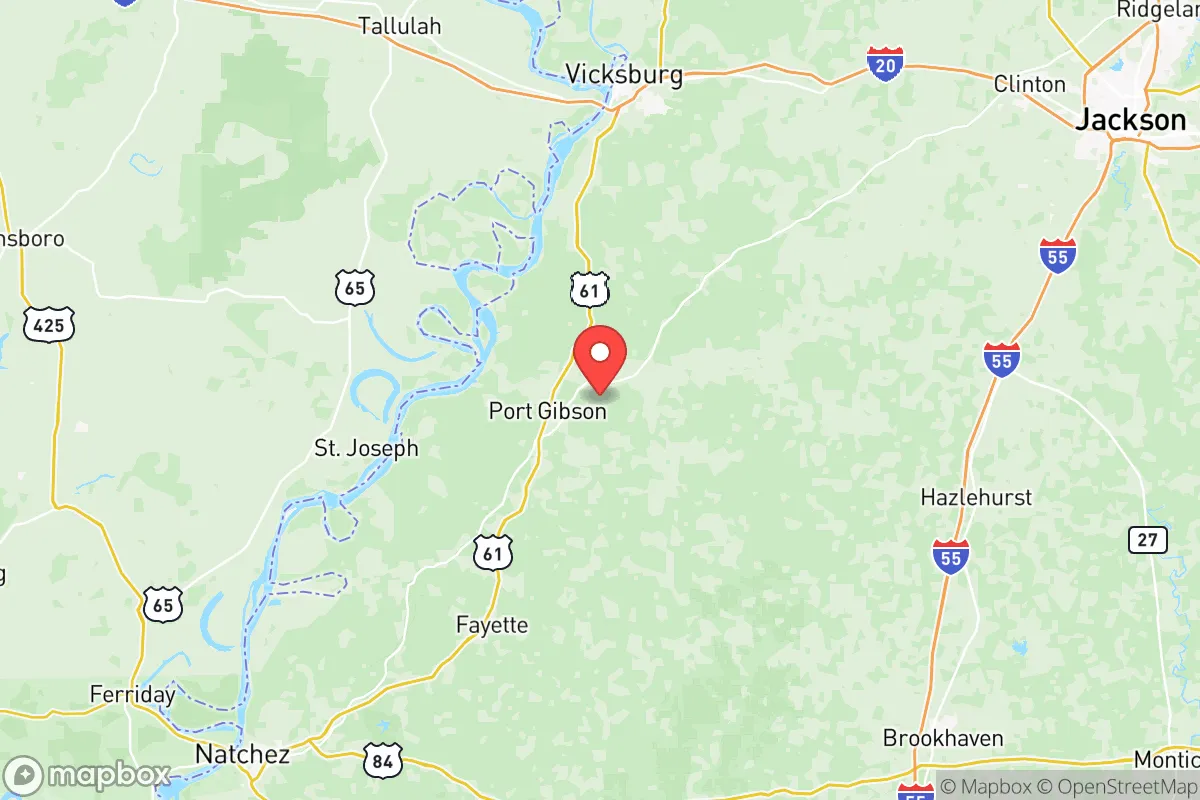
Claiborne County, Mississippi, offers one of the lightest-touch regulatory environments in the Deep South, making it a practical choice for individuals and families prioritizing personal sovereignty over proximity to urban amenities. With a population near 9,000 spread across roughly 500 square miles, the county seat of Port Gibson anchors a region where county government interference in daily life is minimal, and the state's constitutional framework actively shields private conduct from local overreach. For a relocation researcher, the key takeaway is that Claiborne County delivers a high degree of personal autonomy, but it comes with trade-offs in infrastructure and economic opportunity that a freedom-minded household must weigh carefully.
Tax burden and regulatory posture in Claiborne County
Mississippi's tax structure is among the most favorable in the nation for those seeking to keep more of their earned income, and Claiborne County sits squarely within that framework. The state levies a flat personal income tax rate of 4.0% on taxable income above $10,000, with a standard deduction of $2,300 for single filers and $4,600 for married couples filing jointly — a system that effectively exempts lower-income households entirely. Property taxes are the real draw: Claiborne County's millage rate hovers around 100 mills, translating to roughly $1.00 per $100 of assessed value, and Mississippi assesses residential property at only 10% of true value. A home valued at $150,000 carries an annual county tax bill near $1,500, a figure that undercuts most of the Southeast. There is no county-level sales tax beyond the state's 7.0% rate, and no local option for additional levies without a voter referendum, which has not succeeded in recent memory. The regulatory posture is equally restrained: Claiborne County has no county-wide zoning ordinance, meaning land use is governed primarily by state law and deed restrictions rather than planning commissions. Permits for residential construction are issued by the Mississippi Department of Environmental Quality for septic systems and by the county for electrical inspections, but the process is a matter of weeks, not months, and there is no county building code enforcement beyond basic life-safety checks. For a reader comparing this to the permitting gauntlet in Hinds County to the east or Madison County's suburban sprawl, the difference is stark: in Claiborne County, the county government's default answer to a land-use question is "yes, unless state law says otherwise."
Self-defense law and gun rights in Claiborne County
Mississippi is a constitutional carry state, and Claiborne County's sheriff's office — headquartered in Port Gibson — operates within a legal framework that strongly favors the individual's right to self-defense. Since 2016, any person 21 or older who is not otherwise prohibited from possessing a firearm may carry a concealed weapon without a permit, and the county's small population means few interactions with law enforcement over firearms. The state's "stand your ground" statute, codified at Mississippi Code § 97-3-15, removes any duty to retreat before using deadly force in any place where the person has a legal right to be, and it extends to the curtilage of one's home, vehicle, and place of business. Claiborne County courts, which sit in the historic courthouse in Port Gibson, have a reputation for applying this statute without the prosecutorial second-guessing seen in more urban jurisdictions. For those who prefer a permit for reciprocity when traveling, the Mississippi Department of Public Safety issues enhanced carry permits valid in 38 states, and the application process is straightforward — a background check and a $100 fee, with no training requirement for the standard permit. The county's gun culture is practical rather than performative: hunting is a primary use of firearms here, with the 60,000-acre Grand Bay National Wildlife Refuge and the surrounding bottomlands of the Mississippi River offering deer, turkey, and waterfowl seasons that run from October through January. There are no county-level restrictions on magazine capacity, firearm types, or ammunition sales, and the sheriff's office has publicly stated it will not enforce any federal rule that conflicts with state law — a posture consistent with Mississippi's 2023 Second Amendment Preservation Act, which prohibits state cooperation with federal firearm registration schemes.
Self-reliance and homesteading viability across the county
Claiborne County is a genuine homesteading frontier, but viability varies sharply by location, and a prospective landowner should choose their parcel with care. The unincorporated areas around Pattison and Hermanville offer the most permissive environment: no zoning, no subdivision regulations, and no county oversight of agricultural structures, meaning a family can erect a barn, chicken coop, or greenhouse without any permit. Lot sizes in these areas commonly run 5 to 40 acres, with prices between $1,500 and $3,000 per acre — among the lowest in Mississippi. Off-grid feasibility is real but requires planning: the county has no ordinance requiring grid connection, and solar installations are unregulated beyond the state's net-metering rules, which allow systems up to 20 kW to sell excess power back to Entergy Mississippi at the retail rate. Water is the critical variable. The Mississippi River alluvial aquifer beneath the western half of the county provides abundant, potable well water at depths of 100 to 200 feet, and a drilled well with a submersible pump typically costs $5,000 to $8,000. The eastern portion of the county, around Alcorn and the Pine Ridge community, sits on the loess bluffs where wells may need to go 300 feet or deeper, pushing costs toward $12,000. Septic systems require a county health department permit and a percolation test, but the clay-loam soils in most of the county pass readily, and the process takes under a month. The town of Port Gibson itself is the exception to the county's laissez-faire posture: the city enforces a modest set of lot maintenance ordinances and requires a $50 business license for home-based enterprises, though it does not restrict livestock within city limits beyond a nuisance clause. For the truly self-reliant, the Grand Gulf area along the river offers the cheapest land — some parcels under $1,000 per acre — but flood risk and the absence of paved roads make it a choice for the experienced off-gridder, not a first-time homesteader.
Personal liberties: parental rights, medical autonomy, and property
Mississippi's legal climate in Claiborne County is strongly protective of parental authority and individual medical choice, with state law preempting most local attempts to regulate private conduct. The Mississippi Parental Rights Act, passed in 2023, establishes that parents have a fundamental right to direct the upbringing, education, and health care of their minor children, and it creates a legal cause of action against any government entity that infringes on that right. In practice, this means no county-level mask mandates, vaccine requirements, or school curriculum overrides — the Claiborne County School District, which serves Port Gibson and the surrounding communities, operates under state curriculum standards but has no local board policies that exceed them. Medical autonomy is similarly protected: Mississippi does not require parental consent for a minor to receive mental health counseling beyond state guidelines, but it does require parental notification for most medical procedures, and the state's 2024 "Medical Freedom Act" prohibits employers and government entities from requiring COVID-19 vaccination as a condition of employment or service. Speech and assembly rights are robust in this rural county; there are no local noise ordinances beyond a general nuisance statute, and the county's public meetings are sparsely attended, meaning a citizen who shows up to the Board of Supervisors meeting on the first Monday of the month can speak directly to elected officials without a sign-up sheet or time limit. Property rights are the strongest pillar: Mississippi's "private property protection" statute requires the county to compensate landowners for any regulatory taking that reduces property value by 40% or more, and Claiborne County has never invoked eminent domain for a private development in its history. The one area where the county is less permissive is alcohol regulation — Port Gibson is a "dry" municipality, meaning no package sales within city limits, though the unincorporated county allows beer and wine sales with a state permit. For a family that values the right to raise children without government interference, make medical decisions privately, and use their land as they see fit, Claiborne County's legal posture is about as close to a blank slate as exists in the continental United States.
Relative to other parts of Mississippi and the broader Southeast, Claiborne County ranks in the top tier for personal sovereignty, comparable to the hill counties of the northeast or the coastal counties of the Gulf — but with lower land prices and a smaller government footprint than almost any alternative. The trade-off is real: the county has no hospital (the nearest is in Vicksburg, 30 minutes north), limited broadband outside Port Gibson, and a poverty rate near 30% that reflects a thin economic base. A freedom-minded household that can provide its own infrastructure — water, power, and internet — will find Claiborne County exceptionally permissive. Those who need external services will find the autonomy comes at the cost of convenience. For the reader weighing a move, the honest assessment is that Claiborne County offers maximum legal latitude for self-directed living, with the caveat that self-reliance is not just permitted here — it is effectively required.

* Values derived from national, state, county, city and local statistics and may differ in a specific area. Last updated: 2026-11-13T05:24:57.000Z
Narrative content on this page is AI-generated and may contain mistakes. Verify any details that matter before acting on them.
ReloMaps may earn a commission from affiliate links at no extra cost to you.

