
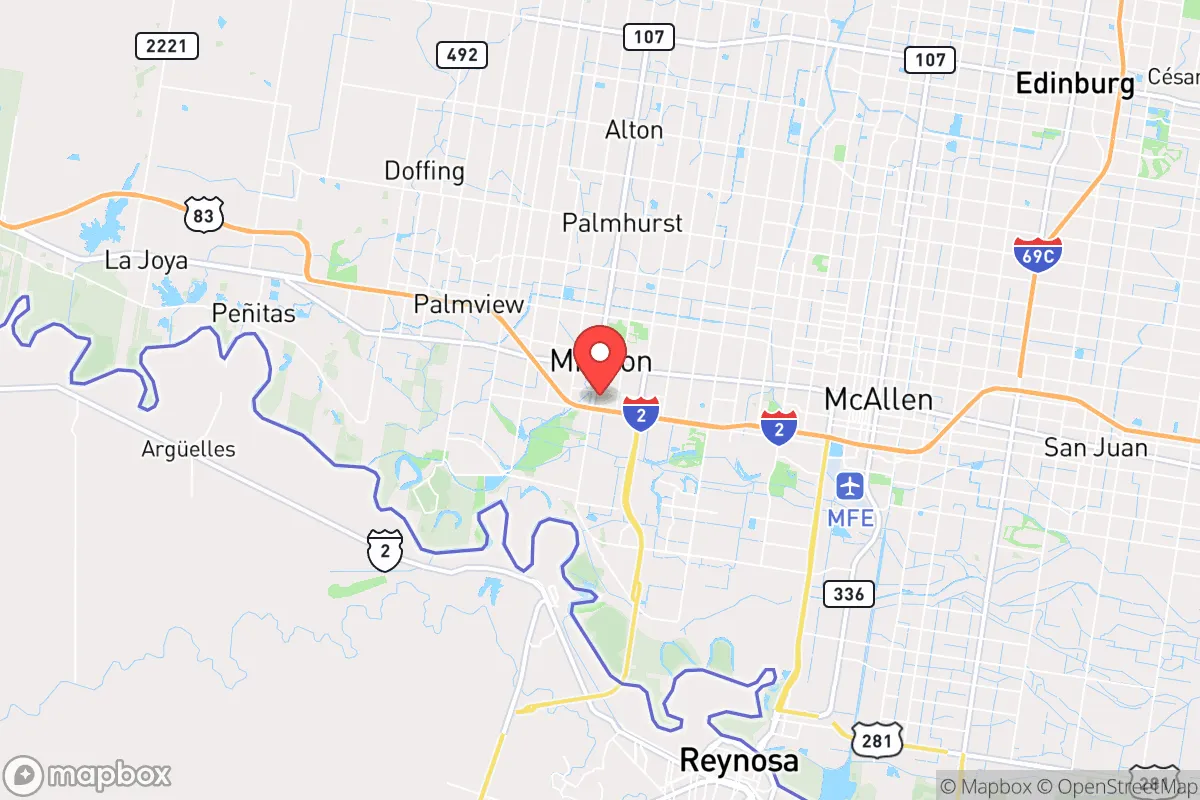
Photo: Wikipedia
Personal Sovereignty in Mission, TX
Strong independent fundamentals that actively favor personal liberty and low regulation.
What does Personal Sovereignty tell us?
Personal Sovereignty measures your capacity for self-reliance and independence with minimal government friction. Higher scores mean fewer barriers between you and the way you want to live... but it assumes you have the space you need and good neighbors.
What does this tell us?
Personal Sovereignty measures your capacity for self-reliance and independence with minimal government friction. Higher scores mean fewer barriers between you and the way you want to live... but it assumes you have the space you need and good neighbors.
State Policy
Energy independence: Net exporter (195% of energy produced in-state)
Personal Liberty
Homesteading

Personal Liberty Analysis
Mission, Texas, offers a personal sovereignty environment shaped by Texas’s strong individual-rights framework and the practical realities of a border-region city where local governance tends to be less intrusive than in major metropolitan areas. Residents here enjoy the state’s famously low tax burden, permissive self-defense laws, and a regulatory culture that generally favors property rights and personal autonomy, though the city’s location in Hidalgo County introduces some unique considerations around zoning and local ordinances. For those prioritizing independence, Mission represents a middle ground where state-level protections are robust, but the day-to-day experience of freedom depends on understanding how local rules interact with state law.
Tax burden and regulatory posture in Mission and Hidalgo County
Texas imposes no state income tax, which is the single largest sovereignty advantage for Mission residents. The state funds itself through a combination of a 6.25% state sales tax (with local add-ons bringing the total in Mission to 8.25%) and property taxes that are among the highest in the nation by effective rate. Hidalgo County’s property tax rates are moderate for Texas, but the lack of income tax means homeowners bear the primary tax burden. Mission’s city government maintains a relatively light regulatory touch compared to larger Texas cities like Austin or Houston. Business licensing is straightforward, with no city-level occupational licensing beyond state requirements, and home-based businesses are permitted in most residential zones with minimal paperwork. The city’s zoning code is conventional but not overly restrictive — residential lots in single-family zones allow for accessory structures, small-scale agriculture, and limited commercial activity without special permits. Environmental regulations are minimal at the local level, with no city-specific air quality or emissions rules beyond state and federal baseline requirements. The overall regulatory posture is permissive, though residents should be aware that Hidalgo County’s floodplain regulations and drainage requirements can add costs for new construction or major renovations, particularly in lower-lying areas near the Rio Grande.
Self-defense and gun law specifics in Mission
Texas is a constitutional carry state, meaning that as of 2021, any adult legally eligible to possess a firearm may carry it openly or concealed in Mission without a permit. This applies to all public spaces not specifically prohibited by law, including parks, sidewalks, and most businesses unless they post a 30.06 (concealed) or 30.07 (open carry) sign. Mission’s city council has not enacted any local ordinances restricting firearms beyond state law, so there are no city-specific waiting periods, magazine capacity limits, or additional background check requirements. The city’s police department generally respects the state’s preemption statute, which prohibits local governments from passing gun regulations stricter than state law. For self-defense in the home, Texas’s Castle Doctrine applies fully in Mission — there is no duty to retreat if an intruder unlawfully enters a residence, vehicle, or workplace. The state’s Stand Your Ground law extends this principle to any place where a person has a legal right to be, removing the duty to retreat in public spaces before using deadly force. Hidalgo County’s district attorney has a reputation for being prosecution-minded on violent crime, but self-defense claims are handled according to state law, and there is no local policy of charging defensive gun uses as a matter of course. For those concerned about border-related crime, the proximity to the Rio Grande does not create any special restrictions on firearm ownership or carry for law-abiding residents.
Self-reliance and homesteading viability in Mission
Mission’s residential zoning allows for significant self-reliance activities on standard lots. The city’s minimum lot size in single-family residential zones is 5,000 square feet, with many established neighborhoods featuring lots of 7,500 to 10,000 square feet — ample space for vegetable gardens, small orchards, and chicken coops. The city code explicitly permits keeping up to six chickens on residential lots under 10,000 square feet, and more on larger parcels, with no permit required for coops as long as they are set back from property lines. Goats and other small livestock are allowed on lots of one acre or more, which are available in the city’s extraterritorial jurisdiction and unincorporated areas of Hidalgo County. Rainwater harvesting is legal and encouraged, with no state or local restrictions on collection from rooftops, and the city does not impose usage fees on harvested water. Off-grid living is feasible in the county’s rural areas but faces practical hurdles within city limits: Mission requires connection to municipal water and sewer for any habitable structure, and solar panels must comply with building codes but are not prohibited. The city’s climate — average 300+ sunny days per year — makes solar power highly viable, and net metering is available through the local electric cooperative, Magic Valley Electric Cooperative, which serves most of the area. For those seeking true self-sufficiency, properties in unincorporated Hidalgo County outside Mission’s zoning jurisdiction offer more flexibility, including the ability to drill private wells and install septic systems without city oversight.
Personal liberties in Mission: parental rights, medical autonomy, speech, and property
Texas law provides strong protections for parental rights, and Mission’s local government does not actively challenge these. The state’s 2023 law prohibiting public schools from requiring students to use pronouns inconsistent with their biological sex, and the requirement for parental consent before any medical treatment or mental health counseling, apply fully in Mission Consolidated Independent School District. The district’s policies align with state law, and there is no local school board initiative to expand or restrict these protections beyond the state baseline. Medical autonomy in Mission is shaped by Texas’s general regulatory environment: there is no state or local vaccine mandate for adults, and the city does not operate any public health orders that restrict individual medical choices. The state’s ban on COVID-19 vaccine mandates by private employers does not apply to healthcare facilities, but Mission’s major employers — including the school district, city government, and regional hospitals — have not imposed broad mandates beyond federal requirements for healthcare workers. Freedom of speech is protected under the First Amendment, and Mission has no local ordinances restricting public expression beyond standard time, place, and manner regulations for large gatherings. Property rights are strong: Texas’s property code gives landowners broad discretion over their land, and Mission’s code enforcement is complaint-driven rather than proactive, meaning the city does not conduct routine property inspections. The city’s building permit process is straightforward, with typical residential permits issued within 10 business days, and there are no rent control or landlord-tenant regulations beyond state law.
Overall, Mission offers a personal sovereignty profile that is strong by national standards, driven primarily by Texas’s state-level protections for gun rights, parental authority, and property freedom. The city’s local government adds minimal additional regulatory burden, making it a practical choice for those who value autonomy without the extreme isolation of rural counties. Compared to border cities like Brownsville or El Paso, Mission’s regulatory environment is similarly light, though its proximity to the Rio Grande means residents should be aware of federal jurisdiction in certain matters. For a relocation audience that prioritizes independence, Mission represents a solid option where state law provides a robust floor for personal sovereignty, and local governance rarely exceeds it.

* Values derived from national, state, county, city and local statistics and may differ in a specific area. Last updated: 2026-11-11T17:26:40.000Z
Narrative content on this page is AI-generated and may contain mistakes. Verify any details that matter before acting on them.
ReloMaps may earn a commission from affiliate links at no extra cost to you.

