Photo: Wikipedia
Demographics of Scott County
Affluence Level in Scott County
An upper-middle-class area. Household wealth, education levels, and homeownership run ahead of national benchmarks.
People of Scott County
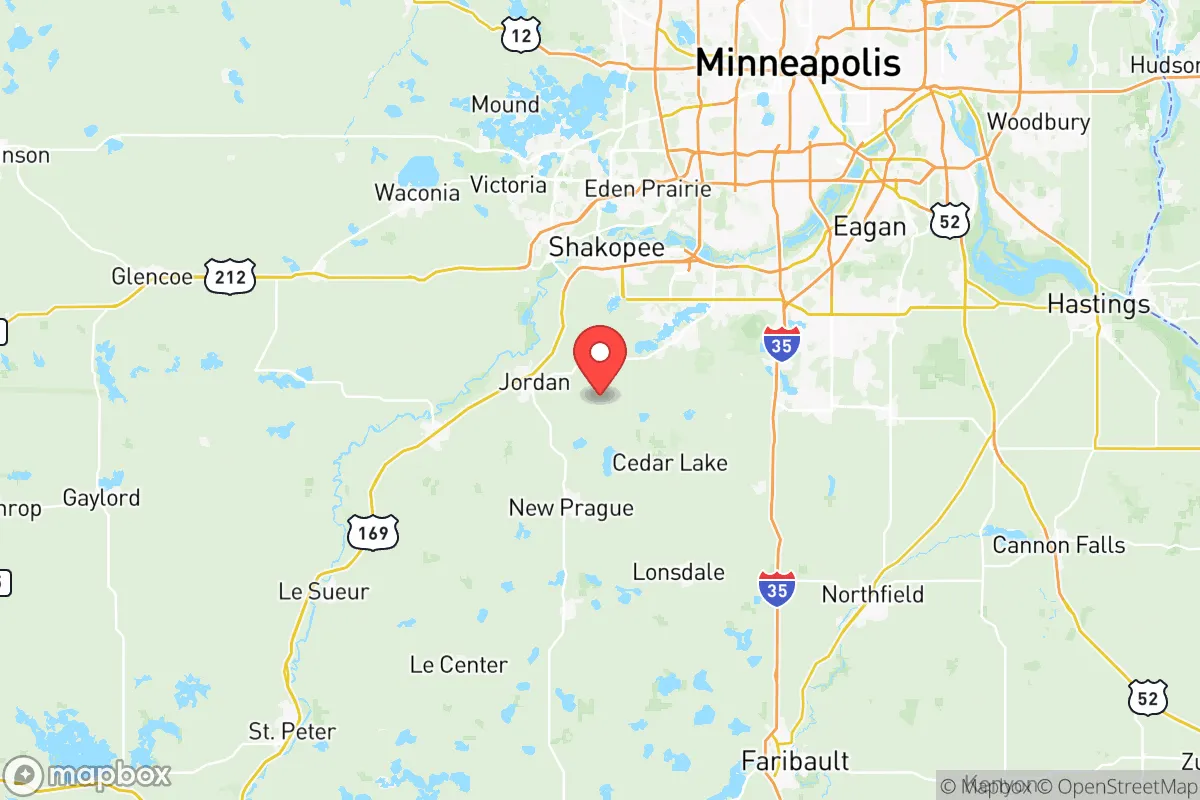
Scott County, Minnesota, today is a rapidly growing suburban and exurban powerhouse of over 152,000 residents, characterized by a predominantly white (76.6%) population that is notably well-educated (43.1% college-educated) and increasingly diverse. Its identity is shaped by a blend of historic agricultural roots, a strong Catholic and Lutheran heritage from its early European settlers, and a modern wave of families and professionals drawn from the Twin Cities metro area for its highly-rated schools, lower crime rates, and larger homes. The county’s population is younger and more family-oriented than the state average, with a median age of 37.5, and it is experiencing a steady, if measured, diversification driven by growing Hispanic, Black, and East/Southeast Asian communities.
Settlement & growth (pre-1960)
The land now known as Scott County was originally the territory of the Dakota (Sioux) people, particularly the Mdewakanton band, who lived in seasonal villages along the Minnesota and Credit Rivers. French fur traders and explorers passed through in the 17th and 18th centuries, but no permanent European settlement occurred until the 1830s, following the 1837 Treaty with the Dakota that opened the area for American settlement. The county was formally organized in 1853, and the first major wave of settlers were Yankees from New England and New York, who established the county seat of Shakopee (1851) and the river town of Jordan (1853), drawn by the fertile soil of the Minnesota River valley and the promise of wheat farming.
The second, and far more transformative, wave arrived from the 1860s through the 1890s: German and Irish immigrants. Germans, many from the Rhineland and Bavaria, became the dominant ethnic group, founding the towns of Belle Plaine (settled 1854, incorporated 1874) and New Prague (1856), the latter of which remains a cultural touchstone with its annual Kolacky Days festival. Irish immigrants, fleeing the Great Famine, concentrated in Shakopee and the farming hamlet of St. Patrick (unincorporated), where they built St. Patrick’s Catholic Church in 1868. These groups were overwhelmingly Catholic, and the county’s religious landscape was defined by a network of parish churches and parochial schools. A smaller but notable wave of Czech and Slovak immigrants also settled in the Lydia and Union Hill areas in the 1870s, drawn by railroad construction and agricultural labor.
For nearly a century, Scott County remained a rural, agricultural economy dominated by dairy farming, corn, and soybeans. The population grew slowly, reaching just 15,000 by 1900 and only 21,000 by 1960. The county’s identity was insular, German-speaking, and deeply tied to the land. The only significant non-white presence during this period was a small number of African American railroad workers and servants in Shakopee, and a handful of Mexican migrant laborers who followed the sugar beet harvest seasonally, but neither group established a permanent community.
Modern era (post-1965)
The 1965 Hart-Cellar Act had a minimal direct impact on Scott County’s demographics for its first two decades. The real transformation began in the 1980s and accelerated after 2000, driven not by international immigration but by massive domestic migration from Minneapolis and its inner-ring suburbs. The construction of Interstate 35W and Highway 169 turned Scott County into a commuter-shed for the Twin Cities, and the population exploded from 43,000 in 1970 to 89,000 in 2000, and then to 152,957 by 2025. This wave was overwhelmingly white, college-educated, and family-oriented, settling in master-planned subdivisions in Shakopee, Savage, Prior Lake, and Eden Prairie (the latter technically in Hennepin County but functionally part of the same suburban corridor).
International immigration began to register meaningfully only after 2000. The foreign-born population today stands at just 3.1%, well below the state average of 8.5%, but it is growing. The largest new group is Hispanic (6.2% of the county), primarily of Mexican and Central American origin, concentrated in Shakopee and Belle Plaine, where they work in food processing (e.g., the Cargill plant in Shakopee) and construction. The Black population (5.2%) is largely composed of African American families moving from Minneapolis and St. Paul for better schools and housing, with a smaller but growing Somali community in Shakopee. East/Southeast Asian communities (4.7%)—primarily Hmong, Vietnamese, and Chinese—are concentrated in Savage and Prior Lake, drawn by tech and healthcare jobs. The Indian subcontinent population (1.4%) is the fastest-growing group, with professionals in IT and engineering settling in Shakopee and Savage, near employers like Seagate Technology and Shutterfly. Notably, the county’s Native American population remains very small (0.5%), as the Shakopee Mdewakanton Sioux Community, while economically powerful through its Mystic Lake Casino, is a sovereign nation with a small enrolled membership.
The future
Scott County is projected to continue growing, reaching an estimated 175,000–185,000 by 2040, driven by ongoing suburban expansion and infill development. The population is becoming more diverse, but slowly. The white share is declining (from 85% in 2010 to 76.6% today) as Hispanic, Black, and Asian communities grow through both immigration and higher birth rates. The Indian subcontinent population, in particular, is expected to double its share to 2.5–3% by 2040, concentrated in Shakopee and Savage. However, the county is unlikely to become a majority-minority area within the next 20 years; its diversity will remain moderate compared to Hennepin or Ramsey counties. New communities are dispersing rather than forming ethnic enclaves, as the suburban housing stock and school system attract a broad mix of families. The cultural identity is evolving from a German-Catholic rural past to a generic, family-centric suburban present, with less emphasis on ethnic festivals and more on youth sports, chain restaurants, and megachurches. For a newcomer, this means moving into a place that is safe, well-run, and increasingly varied in its people, but where the dominant culture remains solidly Midwestern, conservative-leaning, and oriented around raising children.
Scott County is becoming a more diverse, more educated, and more connected suburb of the Twin Cities, shedding its rural past while retaining a slower pace and lower cost of living than the urban core. For families and individuals seeking good schools, low crime, and a community that is changing but still predominantly white and family-oriented, it offers a stable, growing environment with a gradually broadening cultural landscape.

* Values derived from national, state, county, city and local statistics and may differ in a specific area. Last updated: 2026-07-05T15:36:50.000Z
Narrative content on this page is AI-generated and may contain mistakes. Verify any details that matter before acting on them.
ReloMaps may earn a commission from affiliate links at no extra cost to you.

