
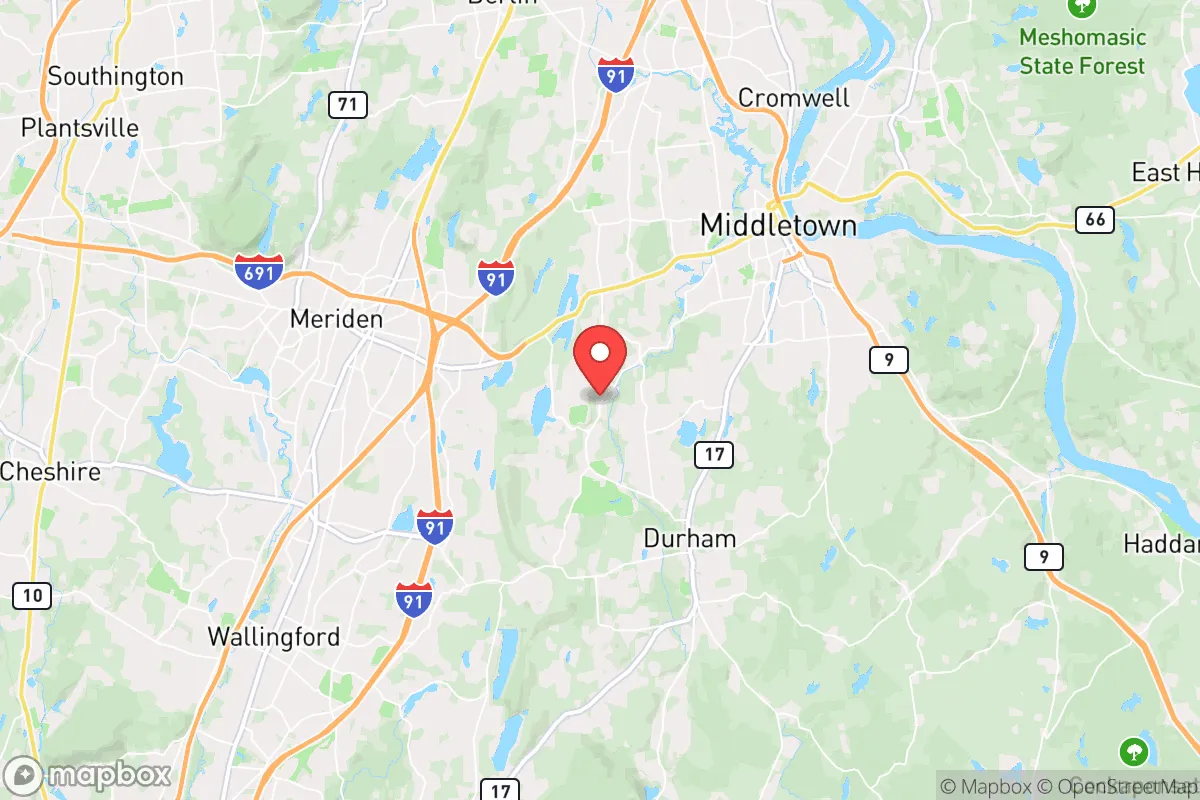
Photo: Wikipedia
Personal Sovereignty in Middlefield, CT
Viable for self-reliance. Generally workable, though some barriers may limit total independence.
What does Personal Sovereignty tell us?
Personal Sovereignty measures your capacity for self-reliance and independence with minimal government friction. Higher scores mean fewer barriers between you and the way you want to live... but it assumes you have the space you need and good neighbors.
What does this tell us?
Personal Sovereignty measures your capacity for self-reliance and independence with minimal government friction. Higher scores mean fewer barriers between you and the way you want to live... but it assumes you have the space you need and good neighbors.
State Policy
Energy independence: Importer (5% of energy produced in-state)
Personal Liberty
Homesteading

Personal Liberty Analysis
Middlefield, Connecticut offers a nuanced environment for personal sovereignty that balances the state’s broader regulatory framework with local conditions favoring self-reliance. While Connecticut as a whole leans toward higher taxes and stricter gun laws, Middlefield’s rural character, larger lot sizes, and lower population density create practical space for autonomy-minded individuals and families. The town’s zoning and land-use policies, combined with its location in the lower-tax Middlesex County, make it a more viable option for those seeking independence than many other parts of the state, though it does not approach the sovereignty found in less-regulated states like New Hampshire or Texas.
Tax burden and regulatory posture in Middlefield compared to surrounding areas
Connecticut’s tax burden is among the highest in the nation, and Middlefield residents face this reality directly. The state’s income tax ranges from 3% to 6.99%, with a top marginal rate kicking in at $500,000 for single filers. Property taxes in Middlefield are levied at a mill rate of approximately 32.5 mills (as of 2025), meaning a home assessed at $300,000 incurs roughly $9,750 annually in local property tax. This is slightly below the Connecticut average but still significant. Middlesex County’s overall tax burden is moderate relative to Fairfield County, but it remains a major factor for anyone considering relocation. The regulatory environment in Connecticut is generally heavy-touch: the state has strict environmental regulations, building codes, and land-use permitting processes. However, Middlefield’s local government is relatively small and less bureaucratic than nearby cities like Middletown or Meriden. The town’s Planning and Zoning Commission reviews most residential projects, but for standard single-family homes on existing lots, the process is straightforward. There is no local income tax, and the town’s budget is modest, which keeps the mill rate stable. For a reader prioritizing low taxes and minimal regulation, Middlefield is a compromise: it offers lower property taxes than many Connecticut towns but still operates within a high-tax state framework.
Self-defense and gun law specifics in Connecticut and Middlefield
Connecticut has some of the strictest gun laws in the United States, and Middlefield residents must comply with them fully. The state requires a permit to purchase any firearm, a background check for all sales (including private transfers), and a permit to carry a handgun openly or concealed. The carry permit process involves an 8-hour safety course, fingerprinting, and a state police background check; issuance is shall-issue, meaning the state must approve qualified applicants, but the process can take several months. Magazine capacity is limited to 10 rounds, and the state bans certain firearms defined as “assault weapons” under its 2013 law. Self-defense in the home is generally protected under the Castle Doctrine, but Connecticut does not have a Stand Your Ground law; instead, it imposes a duty to retreat in public spaces if safely possible. For a reader who values the right to armed self-defense, Middlefield’s legal environment is restrictive compared to states like Florida or Arizona. However, the town’s low crime rate (violent crime is roughly 1.2 incidents per 1,000 residents, well below the national average) means that the practical need for defensive firearms is lower than in urban areas. Local gun clubs and ranges, such as the Middlefield Sportsmen’s Club, provide training and community for responsible gun owners. The key takeaway: personal sovereignty in self-defense is legally constrained, but the rural setting reduces the friction of daily life with firearms.
Self-reliance and homesteading viability: lot sizes, zoning, and off-grid feasibility
Middlefield’s zoning and land-use policies are relatively favorable for homesteading and self-reliance compared to most Connecticut towns. The minimum lot size in residential zones is typically one acre, with many properties in the town’s rural areas sitting on two to five acres or more. This allows for substantial gardening, small-scale livestock (chickens, goats, and even a cow or two with proper permits), and the construction of outbuildings like barns or workshops. The town’s zoning code permits accessory apartments and home-based businesses, which supports income diversification. Off-grid living is legally challenging in Connecticut: the state requires connection to the electrical grid for new construction, and well water and septic systems are standard but must meet strict health department codes. Solar panels are permitted and encouraged, with net metering available, but going fully off-grid (no utility connection) is not allowed for primary residences. Rainwater collection is legal but regulated; the state limits it to 50 gallons per property without a permit. For a reader seeking true off-grid independence, Middlefield is not the place—Connecticut’s building codes and utility requirements prevent it. However, for those who want a large garden, keep animals, and reduce reliance on grocery stores and supply chains, the town’s rural zoning and available land make it one of the more viable options in the state. The local agricultural community is active, with the Middlefield Agricultural Commission supporting farmers and homesteaders.
Personal liberties: parental rights, medical autonomy, speech, and property
Connecticut’s legal framework generally prioritizes state authority over individual autonomy in several key areas. Parental rights are protected under state law, but the state has broad authority over education and child welfare. Connecticut mandates school attendance from age 5 to 18, and homeschooling is legal but requires annual notice and portfolio review by the local school district. The state’s vaccination requirements for school entry are among the strictest in the nation, with only medical exemptions allowed (no religious or philosophical exemptions). Medical autonomy is limited: Connecticut has a legal right to refuse medical treatment, but the state’s public health powers are expansive, as seen during the COVID-19 pandemic when mask and vaccine mandates were enforced. The state also has a physician-assisted suicide law, which some view as an expansion of personal medical choice. Free speech is protected under the First Amendment, and Connecticut has no unique restrictions beyond federal law. Property rights are relatively strong for rural landowners: there is no statewide rent control, and zoning is handled locally. However, the state’s environmental regulations can restrict land use, particularly near wetlands or water bodies. For a reader who values parental control over education and medical decisions, Connecticut’s environment is more restrictive than states like Idaho or South Dakota. Middlefield’s local school board and town government are generally responsive to residents, but they operate within state mandates. The overall balance: personal liberties in Middlefield are constrained by state law, but the town’s small size and rural character allow for more informal autonomy than in urban Connecticut.
In summary, Middlefield, CT provides a moderate level of personal sovereignty that works best for those who accept Connecticut’s state-level constraints while leveraging the town’s rural advantages. The tax burden is high, gun laws are strict, and off-grid living is not feasible, but the town’s large lots, low crime, and agricultural zoning create real opportunities for self-reliance. Compared to other New England towns, Middlefield is a middle-ground option—more freedom than suburban Fairfield County or urban Hartford, but less than rural towns in New Hampshire or Maine. For a conservative-leaning individual or family who values independence but needs to stay in Connecticut for work or family reasons, Middlefield is a strong candidate worth serious consideration.

* Values derived from national, state, county, city and local statistics and may differ in a specific area. Last updated: 2026-09-02T17:21:24.000Z
Narrative content on this page is AI-generated and may contain mistakes. Verify any details that matter before acting on them.
ReloMaps may earn a commission from affiliate links at no extra cost to you.

