
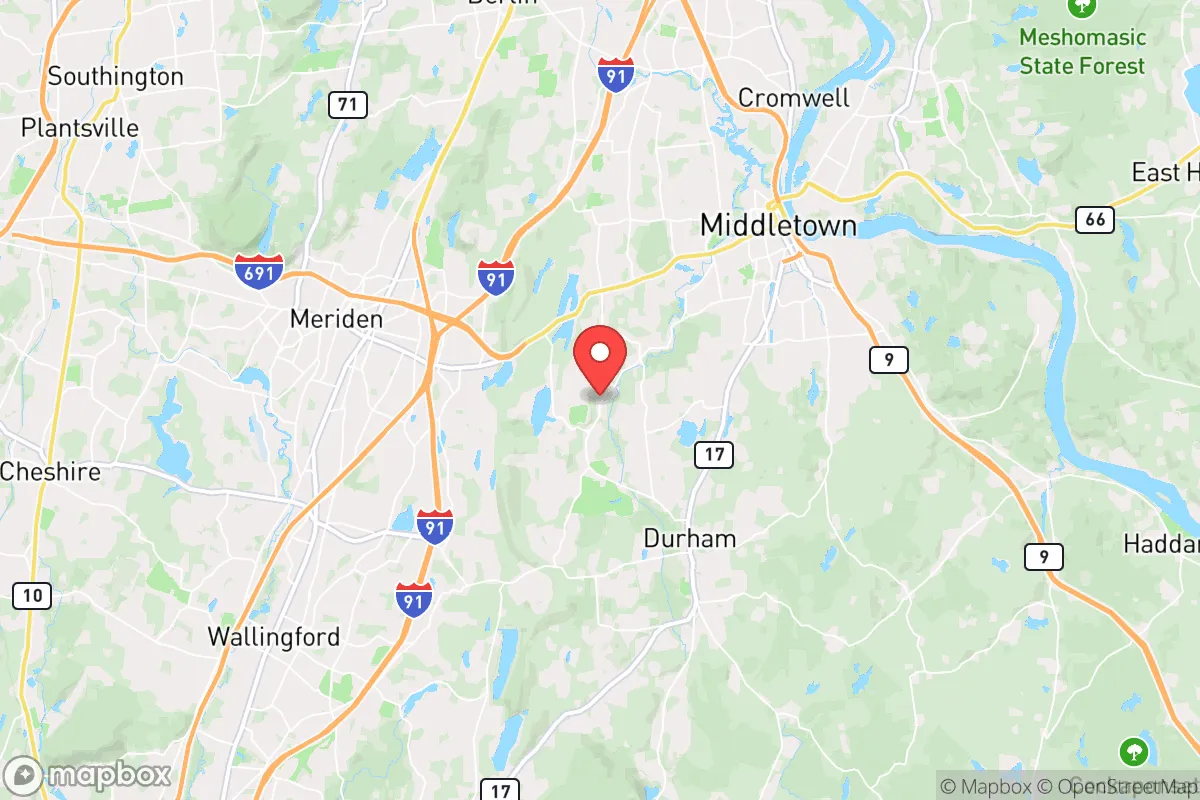
Photo: Wikipedia
Demographics of Middlefield, CT
Affluence Level in Middlefield, CT
A below-average socioeconomic profile. Incomes, home values, and educational attainment trail the U.S., with higher poverty and unemployment.
People of Middlefield, CT
The people of Middlefield, CT today form a community of 47,646 residents that is notably more diverse than its rural Connecticut surroundings, with a distinctive blend of long-standing Italian and Polish families, a growing Hispanic population concentrated in the town's southern corridor, and a significant Black community rooted in the central neighborhoods near the town's historic commercial core. The town's character is shaped by its position as a bedroom community for Hartford and Middletown, with a density of roughly 1,200 people per square mile that feels suburban but not sprawling. A college-educated share of 40.7% reflects the professional workforce drawn to the area's relatively affordable housing and good schools, while the foreign-born population of just 3.9% indicates that most diversity comes from domestic migration rather than new immigration.
How the city was settled and grew
Middlefield's original settlement in the late 17th century was driven by English Puritan families from the Massachusetts Bay Colony who received land grants along the Coginchaug River. The town's first neighborhoods—Main Street Historic District and the area around Jackson Hill—were built by these farming families, who established the Congregational Church and the town's first school. The industrial era of the mid-19th century brought a wave of Irish immigrants who built the railroad and worked in the local quarries, settling in what became known as Irish Hill near the town's eastern edge. By the 1890s, Italian immigrants arrived to work in the trap rock quarries and the growing tobacco fields, establishing a dense ethnic enclave in the West Street corridor that remains a center of Italian-American identity today. Polish families followed in the early 1900s, drawn by factory jobs in nearby Middletown, and concentrated in the Ridge Road area, where St. Francis of Assisi Church became their cultural anchor. These waves created a town that was overwhelmingly white and Catholic by 1950, with a population of just over 10,000.
Modern era (post-1965)
The post-1965 period transformed Middlefield's demographics through two major forces: the suburbanization of Hartford's Black and Puerto Rican populations, and the construction of Interstate 691, which made the town a viable commuter suburb. Black families began moving into the South Main Street and Cherry Hill neighborhoods in the 1970s, drawn by affordable ranch houses and the town's reputation for good schools. Today, Black residents make up 13.3% of the population, with the highest concentrations in the central and southern parts of town. The Hispanic population—now 11.8%—grew primarily through Puerto Rican migration from Hartford in the 1980s and 1990s, settling in the Meriden Road corridor and the apartment complexes near the town's southern border. East and Southeast Asian communities (2.8%) arrived more recently, largely as professionals in healthcare and engineering, and are dispersed across the newer subdivisions near Country Club Road. The Indian subcontinent population (2.5%) is similarly professional and concentrated in the same newer developments, reflecting the town's appeal to educated workers at nearby Pratt & Whitney and the University of Connecticut. The white population, now 64.7%, has aged in place in the historic neighborhoods, with many younger white families moving to newer subdivisions on the town's western edge.
The future
Middlefield's population is becoming more diverse, but the pace is slowing. The Hispanic and Black shares are projected to grow modestly over the next decade, driven by natural increase and continued out-migration from Hartford, while the white population will continue to decline as older residents pass away and younger families choose more affordable towns further north. The East/Southeast Asian and Indian populations are likely to remain small but stable, as the town's housing stock—dominated by single-family homes with median prices around $350,000—limits the influx of new immigrants who typically prefer denser, more urban settings. New development is concentrated in the Westfield Hills subdivision and the Briarwood area, where townhouses and smaller lots are attracting first-time buyers and young families of all backgrounds. The cultural identity of Middlefield is evolving from a quiet, predominantly Italian-American town into a more pluralistic suburb where the annual St. Sebastian Festival still draws crowds, but the local schools now celebrate Hispanic Heritage Month and Black History Month with equal prominence.
For someone moving in now, Middlefield offers a stable, family-oriented community with genuine diversity that feels organic rather than forced. The town is becoming more middle-class and professional, with less of the blue-collar character that defined it through the 1990s. The schools are strong, the commute to Hartford is manageable, and the neighborhoods remain safe and well-maintained. The trade-off is that Middlefield is not a place of rapid growth or dramatic change—it is a town settling into its new demographic reality, where the old Italian bakeries on Main Street now share the block with a Dominican restaurant and a halal market, and where the next generation of residents will likely be more diverse, but not dramatically different, than the current one.

* Values derived from national, state, county, city and local statistics and may differ in a specific area. Last updated: 2026-09-02T17:21:24.000Z
Narrative content on this page is AI-generated and may contain mistakes. Verify any details that matter before acting on them.
ReloMaps may earn a commission from affiliate links at no extra cost to you.

