Photo: Wikipedia
Political ClimatePolitical Climate in Midland County
Showing district-level results — no local-only data available.
Local Political AnalysisPolitical Analysis of Midland County
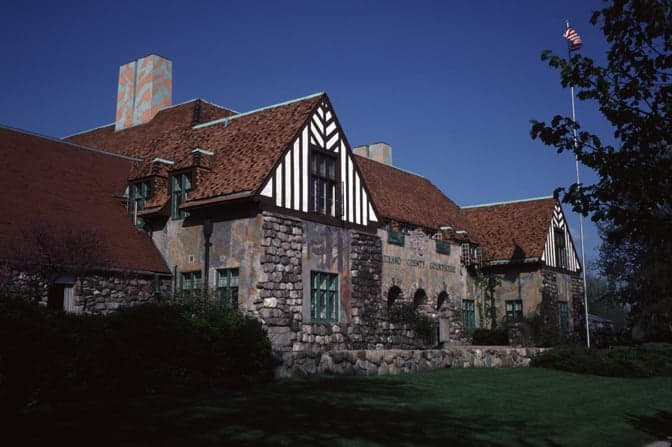
Midland County, Michigan, is a classic swing county that has drifted rightward in recent cycles, carrying a Cook Partisan Voting Index of R+1. That makes it slightly more Republican than the state of Michigan as a whole, which sits at EVEN. But don't let the single-point tilt fool you — this county is genuinely competitive, with a political geography that splits neatly between the city of Midland itself and the surrounding townships. In 2020, the county went for Trump by about 3 points, down from a 17-point Romney win in 2012, but still redder than the state's razor-thin Biden margin. The real story here is the growing polarization between the urban core and the exurbs, and how that shapes daily life for everyone.
How it compares
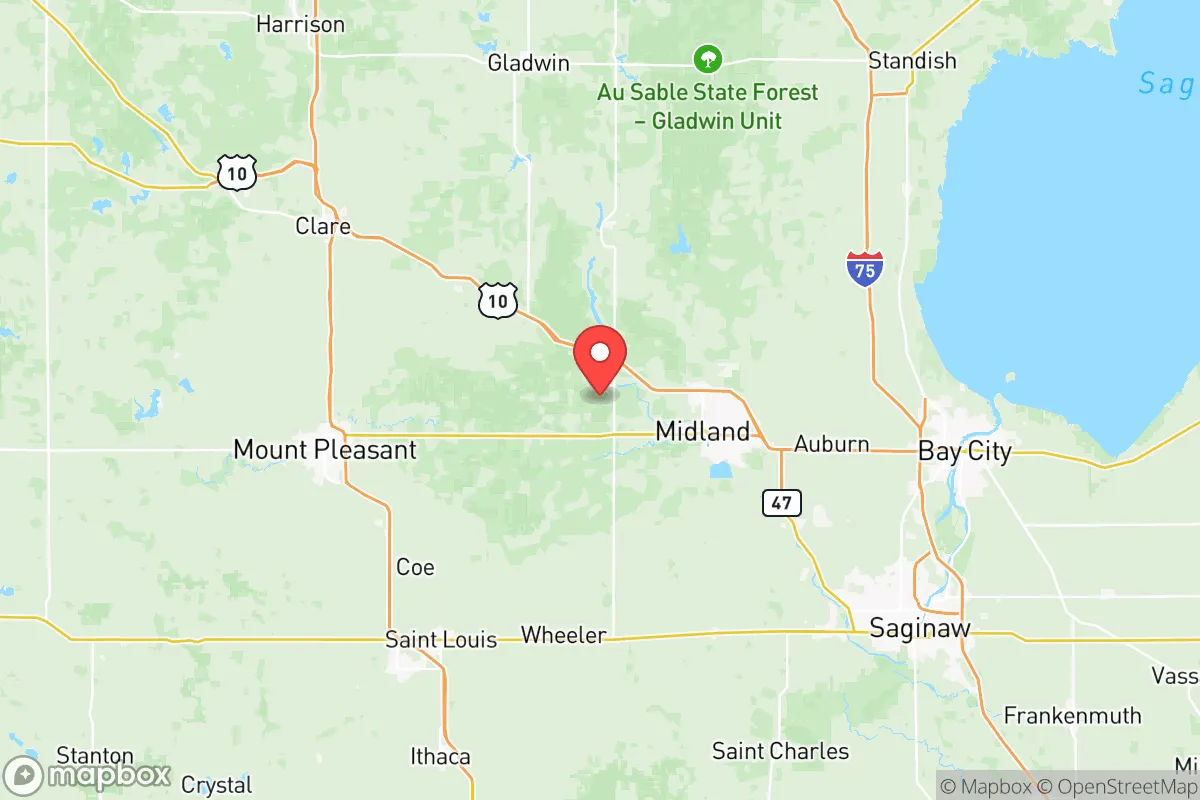
Midland County's R+1 rating puts it just to the right of Michigan's EVEN statewide average, but that single number masks a lot of internal variation. The city of Midland — home to Dow Inc. and a well-educated professional class — leans blue, with precincts around the downtown and near Northwood University often voting Democratic by 5-10 points. In contrast, the townships of Larkin, Homer, and Mills Township are reliably red, often going Republican by 15-20 points. The swing precincts are in the suburban fringe of Midland Township and the area around Sanford Lake, where independent voters and union households at the Dow chemical plants can flip an election. Compared to neighboring Bay County (D+4) or Saginaw County (D+3), Midland is notably more conservative, but it's still a far cry from the deep-red counties further north like Gladwin or Clare. The county's trajectory mirrors Michigan's broader suburban shift: the city is getting bluer, the rural townships are getting redder, and the middle ground is shrinking.
What this means for residents
For conservative residents, Midland County offers a comfortable environment where Republican candidates are competitive in most races, and local offices like county commission and soil conservation board are often held by conservatives. The county GOP is active, and you'll see plenty of yard signs in the townships during election season. For liberal residents, the city of Midland provides a blue-leaning enclave where Democratic candidates can win precincts, and local activism around environmental issues — especially related to the Dow chemical plant and the Tittabawassee River cleanup — has a strong foothold. The practical effect of the county's purple status is that neither party takes it for granted. Campaign ads and canvassing are common in the final weeks before elections, and local issues like zoning, school funding, and road maintenance often get debated along partisan lines. The county commission is currently split, with a slight Republican majority, meaning neither side gets everything they want.
Culturally, Midland County stands apart from much of mid-Michigan because of the outsized influence of Dow Inc. and the Dow Foundation. The company's philanthropic footprint is everywhere — from the Dow Diamond baseball stadium to the Midland Center for the Arts to the extensive network of parks and trails. This creates a civic culture that is more corporate and professional than the surrounding agricultural counties. You'll find a higher concentration of college-educated residents, especially in the city, and a local economy that is less dependent on manufacturing alone. Policy-wise, the county has been a testing ground for public-private partnerships in infrastructure and education, and the local government tends to be pragmatic rather than ideological. That said, the cultural divide between the city and the townships is real: the rural parts of the county are more likely to fly Trump flags and oppose mask mandates, while the city is more likely to host Pride events and farmers markets. It's a place where you can find both a Dow executive and a third-generation farmer living within 10 miles of each other, and both feel like they have a stake in the county's future.

State Political ClimatePolitical Climate in Michigan
State Political AnalysisPolitical Environment in the State
Michigan is the ultimate swing state in the 2020s, carrying a Cook PVI of EVEN and a political identity that has seesawed violently over the last decade. After voting for Trump in 2016 by a razor-thin 0.2% margin, the state flipped hard for Biden in 2020 by nearly 3 points, then saw a massive Republican wave in the 2022 midterms that flipped the State House and Senate, only for Democrats to reclaim full control of state government in 2024 with a trifecta. This whiplash isn't random—it reflects a state where the old blue-collar Democratic coalition in places like Macomb County and the Upper Peninsula has fractured, while the suburbs of Grand Rapids and Oakland County have drifted leftward, creating a perfect partisan stalemate at the statewide level.
Urban vs. rural divide
The political map of Michigan is a textbook study in geographic polarization. The Democratic base is concentrated in three major metro corridors: Detroit (Wayne County), Ann Arbor (Washtenaw County), and Grand Rapids (Kent County), which together cast roughly 40% of the state's vote. Wayne County alone delivered 68% of its vote to Biden in 2020, while Kent County—once a Republican stronghold—has flipped to become a reliable Democratic county thanks to the growth of Grand Rapids' progressive-leaning downtown and suburbs. On the Republican side, the rural Lower Peninsula and the entire Upper Peninsula are deeply red. Counties like Osceola, Missaukee, and Montcalm routinely vote 70-75% Republican. The key battlegrounds are the "blue wall" suburbs of Macomb County (just north of Detroit) and the exurban ring around Grand Rapids (Ottawa County). Macomb County, home to the famous "Reagan Democrats," voted for Trump in 2016 and 2020 but swung back toward Democrats in 2024, making it the single most watched county in the state. Meanwhile, Ottawa County—historically one of the most conservative counties in the Midwest—has seen a growing progressive movement in Holland and Grand Haven, though it still leans Republican overall.
Policy environment
Michigan's policy environment is a mixed bag that reflects its swing-state status. The state has a flat income tax rate of 4.25% (reduced from 4.35% in 2023 via a trigger law), and no tax on Social Security benefits—a major draw for retirees. Property taxes are moderate, with a 6-mill state education tax and local millages that vary widely. The regulatory posture is generally business-friendly, with a right-to-work law that was repealed by the Democratic trifecta in 2023, then reinstated by voter referendum in 2024—a chaotic back-and-forth that illustrates the state's volatility. Education policy is a flashpoint: Michigan has one of the strongest charter school laws in the nation, but also some of the lowest per-pupil funding in the Midwest. The state's 2023 "Read by Grade Three" law has been controversial among parents, with some calling it too rigid. Healthcare is dominated by Blue Cross Blue Shield of Michigan, and the state expanded Medicaid under the Affordable Care Act in 2014. Election laws are relatively moderate: no-excuse absentee voting was approved by voters in 2018, and same-day voter registration is available, but voter ID is required at the polls.
Recent policy direction
The 2023-2024 Democratic trifecta enacted a flurry of legislation that shifted the state's policy direction sharply leftward after decades of divided government. On gun policy, Michigan passed universal background checks and a "red flag" law (extreme risk protection order) in 2023, making it the first state in the Great Lakes region to do so. On education and parental rights, the state repealed the 2012 right-to-work law and expanded collective bargaining for teachers, while also passing a "reproductive freedom" constitutional amendment in 2022 that enshrined abortion rights up to fetal viability. On privacy and surveillance, Michigan has no comprehensive data privacy law, but a 2023 law restricts police use of facial recognition technology without a warrant. Property rights remain strong, with no statewide rent control and a relatively straightforward eminent domain process. On voting and ballot access, the 2022 "Promote the Vote" constitutional amendment expanded early voting and required drop boxes in every jurisdiction, while a 2024 law made it a felony to harass election workers. For conservatives, the gun laws and union policies are the biggest red flags; for liberals, the lack of a state-level paid family leave law and the continued existence of a flat tax are disappointments.
Civil unrest & political movements
Michigan has been a national flashpoint for political movements on both sides. The 2020 "Operation Gridlock" protest at the state capitol in Lansing, where armed demonstrators protested COVID-19 restrictions, became a symbol of the broader anti-lockdown movement. The Whitmer kidnapping plot in 2020, in which a militia group allegedly planned to kidnap the governor, remains a defining scar on the state's political psyche. On the left, the "Rise Up Michigan" coalition has organized massive protests against Republican-backed election laws, and the state's large Arab American population in Dearborn and Hamtramck has been increasingly vocal on foreign policy issues, particularly regarding Palestine. Immigration politics are relatively low-key compared to border states, but the city of Detroit has a "sanctuary city" ordinance that limits cooperation with federal immigration enforcement, while rural counties like Ottawa and Livingston have passed resolutions declaring themselves "Second Amendment sanctuaries." Election integrity remains a live issue: the 2020 election in Michigan was the subject of numerous lawsuits and audits, all of which confirmed the results, but distrust persists among a significant portion of the Republican base, particularly in rural areas.
Projection
Over the next 5-10 years, Michigan is likely to remain a competitive swing state, but the demographic trends favor a slight leftward drift. The continued growth of Grand Rapids and the Ann Arbor suburbs, combined with the outmigration from rural areas, will slowly erode the Republican base. However, the GOP's strength in the Upper Peninsula and the exurban ring around Detroit (Macomb, Livingston, and St. Clair counties) will keep the state competitive. The wild card is the Arab American vote in Dearborn, which has historically been Democratic but has shown signs of fracturing over foreign policy issues. If that bloc shifts Republican, it could flip the state back to red in a close election. For a new resident, the practical implication is that Michigan will continue to be a place where your local government's politics depend heavily on which county you choose to live in—you can find deep-blue Ann Arbor or deep-red Midland within a two-hour drive. The state's policy environment will remain volatile, with every election potentially flipping the trifecta and reversing the last cycle's laws.
For a relocator, the bottom line is that Michigan offers a genuine choice: you can live in a progressive urban center like Ann Arbor or Grand Rapids, a conservative exurb like Rochester Hills or Grand Haven, or a deeply red rural county like Alpena or Gladwin. The state's political climate is not monolithic, and your experience will be shaped far more by your chosen county and city than by the state as a whole. The tax environment is moderate, the schools vary wildly by district, and the policy landscape can shift dramatically with each election cycle. If you value political stability, Michigan may frustrate you; if you want to live in a place where your vote actually matters in a presidential election, there are few better choices in the country.
* Values derived from national, state, county, city and local statistics and may differ in a specific area. Last updated: 2026-06-17T04:35:57.000Z
Narrative content on this page is AI-generated and may contain mistakes. Verify any details that matter before acting on them.
ReloMaps may earn a commission from affiliate links at no extra cost to you.

