Photo: Wikipedia
Demographics of Ingham County
Affluence Level in Ingham County
A below-average socioeconomic profile. Incomes, home values, and educational attainment trail the U.S., with higher poverty and unemployment.
People of Ingham County
The people of Ingham County, Michigan, today number 282,015, forming a population that is 67.4% white, 11.2% Black, 8.7% Hispanic, 4.1% East and Southeast Asian, and 2.1% Indian (subcontinent). Anchored by the state capital of Lansing and home to Michigan State University in East Lansing, the county is defined by a sharp educational divide: 41.3% of adults hold a college degree, one of the highest rates in the state, yet the overall character remains a mix of government employment, manufacturing heritage, and university-driven innovation. The population is less diverse than the national average but significantly more so than most of rural Michigan, with a foreign-born share of just 5.4% that is concentrated heavily in the Lansing-East Lansing corridor.
Settlement & growth (pre-1960)
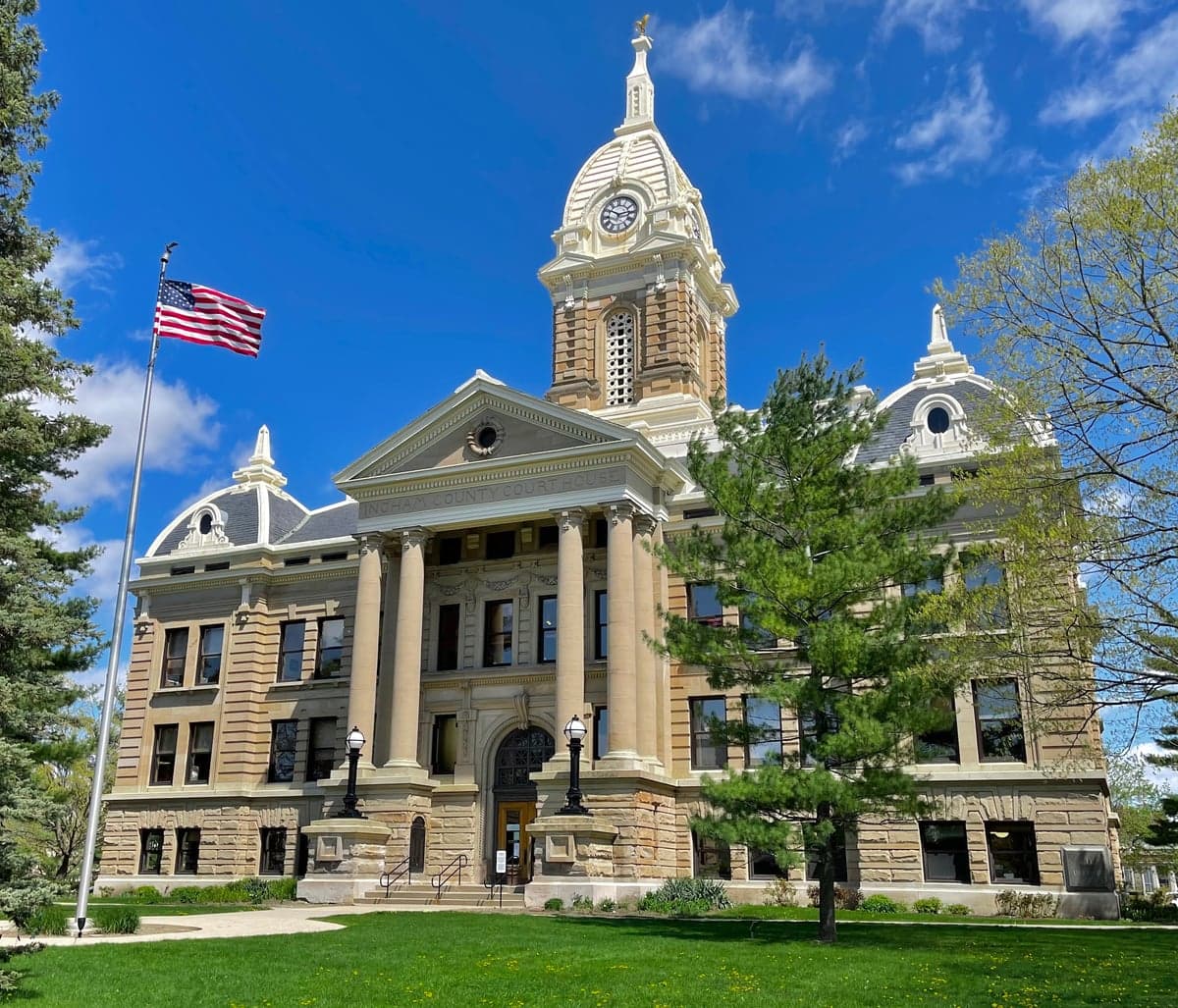
Before European settlement, the area now known as Ingham County was part of the traditional homeland of the Anishinaabe peoples, particularly the Ojibwe (Chippewa) and Odawa. The county was organized in 1838, carved from land ceded by Native nations in the 1819 Treaty of Saginaw. The first permanent American settlers arrived in the 1830s and 1840s, predominantly Yankees from New York and New England, who were drawn by cheap federal land and the promise of fertile soil along the Grand River and the Red Cedar River. These early settlers founded the county's original townships and the village of Mason, which became the county seat in 1843 after a contentious political battle with the rival settlement of Dansville.
The arrival of the Michigan Central Railroad in the 1840s transformed the county. The line connected the village of Lansing (then a small lumber and farming hamlet) to Detroit and Chicago, and in 1847 the state legislature controversially moved the capital there from Detroit. This decision triggered a wave of speculators, carpenters, and government clerks. By the 1850s, Lansing was a boomtown, and the surrounding townships of Meridian and Delhi began filling with farmers supplying the growing capital. A second major wave came with the founding of Michigan Agricultural College (now Michigan State University) in East Lansing in 1855, which drew faculty, students, and support staff from across the Northeast and Midwest.
From the 1880s through the 1920s, European immigration reshaped the county's industrial base. German and Polish immigrants settled in Lansing's working-class neighborhoods, particularly the Old Town district and the near west side, finding work in the city's burgeoning automotive and manufacturing plants. The REO Motor Car Company, founded in Lansing in 1905, and later Oldsmobile (headquartered in Lansing from 1897) pulled thousands of workers from southern and eastern Europe. A smaller but notable wave of Dutch immigrants settled in the agricultural areas around Williamston and Webberville, establishing dairy farms and Christian Reformed churches that remain community anchors today.
The Great Migration brought Black families from the rural South to Lansing's industrial jobs, particularly during World War I and World War II. By 1950, Lansing's Black population had grown to roughly 8% of the city, concentrated in the south side and the Genesee neighborhood. This period also saw the arrival of Appalachian white migrants, many from Kentucky and Tennessee, who came for auto and assembly-line work and settled in the southwest side and Holt area. The county's population grew from 52,000 in 1900 to 211,000 by 1960, driven almost entirely by industrial employment and the expansion of Michigan State University.
Modern era (post-1965)
The 1965 Hart-Cellar Act had a modest effect on Ingham County compared to coastal regions, but it did open the door to new immigrant streams. The most visible post-1965 group has been East and Southeast Asian communities, particularly Chinese, Korean, and Vietnamese families, who now make up 4.1% of the county. These populations are overwhelmingly concentrated in East Lansing and the Okemos area of Meridian Township, drawn by Michigan State University's graduate programs and the region's relatively affordable housing. The Indian subcontinent population (2.1%) followed a similar path, with many arriving as H-1B tech workers and university researchers, settling in the same East Lansing-Okemos corridor and in Bath Township.
Hispanic population growth (now 8.7%) has been more diffuse but significant. Mexican-origin families began arriving in the 1970s and 1980s, initially for agricultural work in the county's remaining fruit and vegetable farms around Dansville and Stockbridge, then moving into construction, landscaping, and food processing in Lansing. The Hispanic community today is spread across the county, with notable concentrations in Lansing's southwest side and in Holt (Delhi Township).
Domestic migration patterns since 1970 have been equally transformative. The decline of American auto manufacturing hit Lansing hard: Oldsmobile's Lansing assembly plants shed thousands of jobs between 1980 and 2004, and the city lost roughly 20% of its population between 1970 and 2010. White flight to suburbs accelerated during this period, with Meridian Township (Okemos) and Holt absorbing much of the departing middle class. At the same time, Michigan State University's growth as a research powerhouse (now employing over 11,000 people) brought a steady influx of out-of-state and international students and faculty, insulating East Lansing and its immediate suburbs from the worst of the Rust Belt decline. The Black population, which peaked at roughly 24% of Lansing's city population in 2000, has since declined slightly as some families have moved to suburban communities like Delta Township and Grand Ledge.
The future
Ingham County's population is projected to remain roughly stable through 2040, with modest growth in the university corridor and continued slow decline in the city of Lansing proper. The county is becoming more diverse, but slowly: the white share has fallen from 78% in 2000 to 67.4% today, with most of the growth coming from Hispanic and East/Southeast Asian communities. The Indian subcontinent population is the fastest-growing group by percentage, though from a small base, and is likely to continue concentrating in the Okemos and Haslett areas near the university.
The key demographic wildcard is Michigan State University's enrollment trajectory. If the university continues to attract international students (particularly from China, India, and South Korea) and out-of-state domestic students, the East Lansing-Okemos corridor will become more diverse and more transient. If enrollment contracts, the county could see a net population decline and a reversion toward a whiter, older demographic profile. The county's cultural identity is likely to remain bifurcated: a cosmopolitan, highly educated university zone in the east, and a more traditional, working-class, and politically conservative western half centered on Mason and Leslie.
For someone moving to Ingham County today, the choice is essentially a choice between two distinct communities. The eastern corridor offers diversity, high educational attainment, and a progressive culture, but at higher housing costs. The western and southern townships offer lower taxes, more space, and a slower pace, but with fewer amenities and less demographic diversity. The county as a whole is stable, affordable by national standards, and unlikely to experience dramatic change — a middle-American compromise that suits families and professionals who want access to a Big Ten university and a state capital without the costs of a major coastal city.

* Values derived from national, state, county, city and local statistics and may differ in a specific area. Last updated: 2026-06-15T19:40:47.000Z
Narrative content on this page is AI-generated and may contain mistakes. Verify any details that matter before acting on them.
ReloMaps may earn a commission from affiliate links at no extra cost to you.

