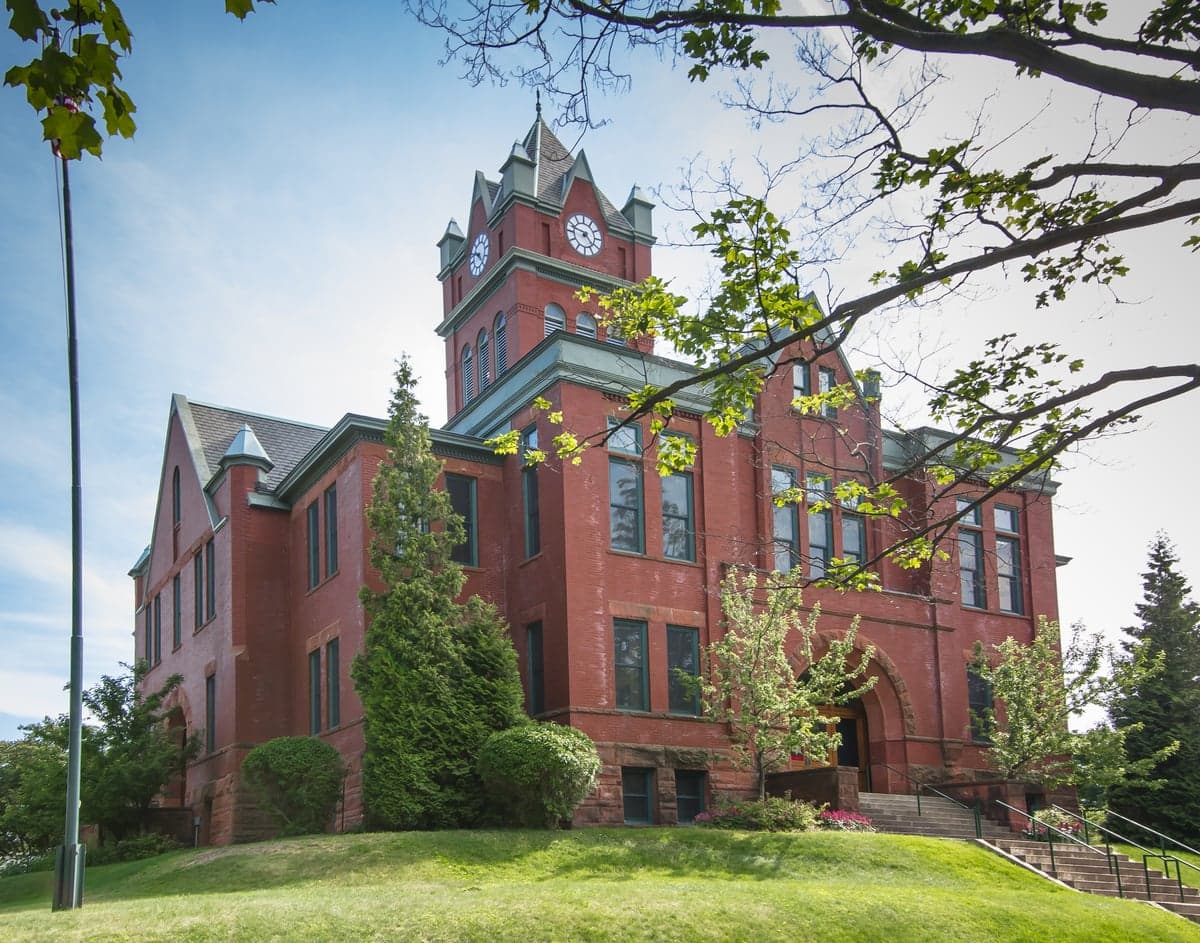
Photo: Wikipedia
Political ClimatePolitical Climate in Grand Traverse County
Showing district-level results — no local-only data available.
Local Political AnalysisPolitical Analysis of Grand Traverse County
Grand Traverse County has long been a reliably Republican stronghold in northern Michigan, carrying a Cook Partisan Voting Index of R+11, but don't let that number fool you into thinking it's a monolith. The county's political reality is far more nuanced, with a clear urban-rural split that has only widened in recent years. While the county as a whole hasn't voted for a Democratic presidential candidate since 2008, when it narrowly went for Barack Obama, the margins have tightened in the last two cycles, suggesting a slow but steady drift toward competitiveness, especially in and around the city of Traverse City itself.
How it compares
Compared to the state of Michigan, which sits at a Cook PVI of EVEN, Grand Traverse County is significantly more conservative. The state as a whole is a true battleground, swinging between parties in presidential and gubernatorial races, while Grand Traverse has remained a reliable Republican base. However, the comparison reveals the county's internal fractures. The city of Traverse City and its immediate suburbs, like the Old Mission Peninsula, lean increasingly blue, often voting for Democratic candidates by double digits. In contrast, the rural townships—such as Paradise Township, Fife Lake, and Union Township—are deeply red, frequently delivering 70% or more of their votes to Republican candidates. The swing precincts are found in the more suburban areas like Acme Township and parts of East Bay Township, where moderate voters and newcomers from downstate have made races for county commission and state house seats increasingly competitive. This dynamic means Grand Traverse County is not a simple red county; it's a place where the political temperature varies dramatically depending on whether you're in a downtown Traverse City coffee shop or a farm supply store in Kingsley.
What this means for residents
For conservative residents, the county's R+11 lean means they are generally well-represented at the local level, with Republican majorities on the county commission and in most township boards. They can expect policies that favor limited government, lower taxes, and Second Amendment rights to be the default. For liberal residents, the reality is more about finding their voice in the city and working to flip suburban precincts. They have found success in recent years, electing Democrats to the state house in the 104th district (which covers Traverse City) and pushing for progressive policies on environmental protection and affordable housing within the city limits. The practical effect is that a resident's experience of local government can feel very different depending on their address—a liberal in Traverse City might feel their values are reflected in city council decisions, while a conservative in a rural township might feel their voice is the dominant one in their local school board or planning commission.
Culturally, this political divide manifests in distinct policy priorities. The county is a hotspot for debates over land use and development, with conservatives often championing property rights and economic growth, while liberals push for stricter environmental regulations to protect the area's natural beauty, particularly around the Grand Traverse Bay and the Boardman River. The local paper, the Traverse City Record-Eagle, covers these battles extensively, and they are a regular feature of county commission meetings. The area's growing popularity as a tourist and second-home destination has also injected a new layer of tension, with long-time residents of both political stripes sometimes feeling priced out by newcomers, though they disagree on the solutions. In short, Grand Traverse County is a politically vibrant place where the state's overall swing-state nature is mirrored in microcosm, but with a distinct northern Michigan flavor and a Republican tilt that remains the baseline for the foreseeable future.

State Political ClimatePolitical Climate in Michigan
State Political AnalysisPolitical Environment in the State
Michigan is the ultimate swing state, with a Cook PVI of EVEN that perfectly captures its knife-edge balance. Over the past 20 years, the state has lurched from reliably blue (voting for Democrats in every presidential election from 1992 to 2012) to a true battleground where Donald Trump flipped it in 2016 by just 10,704 votes, Joe Biden reclaimed it in 2020 by 154,000 votes, and Trump won it back in 2024 by roughly 80,000 votes. The dominant coalition is a three-way tug-of-war: the heavily unionized, diverse Detroit metro area pulls left; the conservative western and northern Lower Peninsula and Upper Peninsula pull right; and a shrinking but still potent bloc of moderate suburbanites in places like Oakland County and Kent County (Grand Rapids) decides every election.
Urban vs. rural divide
The political map of Michigan is a study in stark contrasts. Wayne County (Detroit) and Washtenaw County (Ann Arbor) are the Democratic engine rooms, delivering margins of 300,000+ votes combined. The city of Detroit itself is over 78% Black and reliably delivers 95% of its vote to Democrats. Meanwhile, the rural thumb, the entire western side of the state from the Indiana border up to the Mackinac Bridge, and the Upper Peninsula are deeply Republican. Ottawa County (Holland) and Livingston County (Howell) routinely vote 65-70% Republican. The real action is in the suburbs: Macomb County (Warren, Sterling Heights) is the iconic "Reagan Democrat" bastion that flipped from Obama to Trump to Biden and back to Trump. Oakland County (Bloomfield Hills, Troy) was once a GOP stronghold but has trended blue since 2016 as college-educated professionals shifted left. Grand Rapids (Kent County) is the conservative anchor of West Michigan, but its inner-ring suburbs are slowly moderating as the city grows.
Policy environment
Michigan's policy environment is a mixed bag that reflects its swing-state status. The state has a flat income tax of 4.25%, which was reduced from 4.35% in 2023 via a 2015 law that triggers automatic cuts when revenues exceed a certain threshold. Property taxes are high, averaging about 1.6% of home value, thanks to the 1994 Proposal A school funding reform that shifted reliance to local millages. Sales tax is 6%, with no local add-ons. The regulatory posture is moderate: Michigan is a right-to-work state as of 2012, but Democrats repealed that law in 2023 (effective 2024), meaning union dues can again be mandatory in unionized workplaces. Education policy is a perennial battleground: the state has a robust charter school sector (over 300 schools) and one of the nation's most expansive school choice programs, but Detroit's public schools have been under state emergency management for years. Election laws are relatively open: no-excuse absentee voting was approved by voters in 2018, and same-day voter registration was added in 2020. There is no voter ID law requiring a photo; a signed affidavit suffices.
Recent policy direction
The last three years have seen a dramatic policy shift under a Democratic trifecta (2023-2024). Gun laws tightened significantly: universal background checks and safe storage requirements were passed in 2023, and a "red flag" law (extreme risk protection order) took effect in 2024. Self-defense law remains relatively strong—Michigan is a "stand your ground" state, but the new red flag law allows temporary seizure of firearms without criminal charges. Parental and education rights saw a major pushback: the 2023 repeal of the 2012 right-to-work law was a blow to conservative labor policy, and the state banned school districts from withholding books based on "partisan or doctrinal" disapproval (a response to book-banning efforts). On speech and privacy, Michigan has no broad surveillance law, but local police use of automated license plate readers is widespread. Medical and bodily autonomy: abortion rights were enshrined in the state constitution via Proposal 3 in 2022, making Michigan one of the most protective states post-Dobbs. Property rights are generally strong, though the state's new renewable energy siting law (2023) allows the state to override local zoning for large solar and wind projects. Taxation: the income tax rate is on a slow downward glide path, but Democrats raised the corporate income tax from 6% to 7.25% in 2023. Voting access expanded: automatic voter registration at the DMV and nine days of early in-person voting were enacted in 2023.
Civil unrest & political movements
Michigan has been a flashpoint for political activism on both sides. The 2020 "Operation Gridlock" protest at the state capitol in Lansing, where armed demonstrators opposed COVID-19 lockdowns, became a national symbol of right-wing mobilization. The Gretchen Whitmer kidnapping plot in 2020 also put Michigan's extremist fringe in the spotlight. On the left, the 2023 United Auto Workers strike against the Big Three automakers was the largest in decades, with picket lines at plants in Wayne, Macomb, and Washtenaw counties. Immigration politics are relatively quiet—Michigan has no sanctuary city laws, though Detroit and Ann Arbor have "welcoming city" ordinances that limit cooperation with ICE. Election integrity remains a hot-button issue: the 2020 election in Michigan was subject to numerous audits and lawsuits, with Antrim County initially reporting a software error that briefly flipped results (later corrected). The state's new early voting system has been criticized by conservatives as vulnerable to fraud, though no evidence of widespread issues has emerged. The Upper Peninsula has a small but vocal "Lake Superior Republic" secession movement, mostly symbolic. A new resident in Grand Rapids or Traverse City would notice the prevalence of "Trump 2024" flags and "Fuck Biden" bumper stickers in equal measure, while in Ann Arbor, "In This House We Believe" yard signs are ubiquitous.
Projection
Over the next 5-10 years, Michigan is likely to remain a toss-up, but with a slight rightward drift. In-migration patterns favor conservatives: the fastest-growing counties are in the conservative western side (Ottawa, Kent, Allegan) and the northern tourist areas (Grand Traverse, Leelanau). The Detroit metro is losing population, particularly in Wayne County, which weakens the Democratic base. However, the suburbs of Oakland and Washtenaw counties are becoming more liberal as young professionals move in. The wild card is the auto industry's transition to electric vehicles: if it creates jobs in the liberal southeast, Democrats benefit; if it destroys traditional union jobs, Republicans gain. The state's aging population (Michigan has the 10th oldest median age in the U.S.) tends to vote more Republican, but younger voters moving to Grand Rapids and Traverse City are more moderate. Expect the state to remain a presidential battleground, with control of the legislature likely flipping back and forth. A new resident moving to the state in 2026 should expect to see continued partisan gridlock on major issues, with the state Supreme Court (currently 4-3 Democratic) being the decisive arena for abortion, labor, and election laws.
Bottom line for a new resident: Michigan offers a genuine swing-state experience where your vote actually matters. If you're conservative, you'll find a welcoming home in the western and northern parts of the state, with lower taxes and strong property rights, but you'll need to accept that the state's largest cities and the state government in Lansing will often be controlled by Democrats. If you're liberal, you'll feel at home in Ann Arbor, Detroit, or the inner-ring suburbs, with strong abortion protections and union-friendly policies, but you'll be surrounded by rural and exurban areas that vote heavily Republican. The practical takeaway: your daily life will be shaped more by your county and city government than by the state—choose your location carefully. The political climate is heated but not dangerous, and most Michiganders are friendly to neighbors regardless of party affiliation. Just don't expect to agree with everyone at the dinner table.
* Values derived from national, state, county, city and local statistics and may differ in a specific area. Last updated: 2026-11-03T18:29:31.000Z
Narrative content on this page is AI-generated and may contain mistakes. Verify any details that matter before acting on them.
ReloMaps may earn a commission from affiliate links at no extra cost to you.

