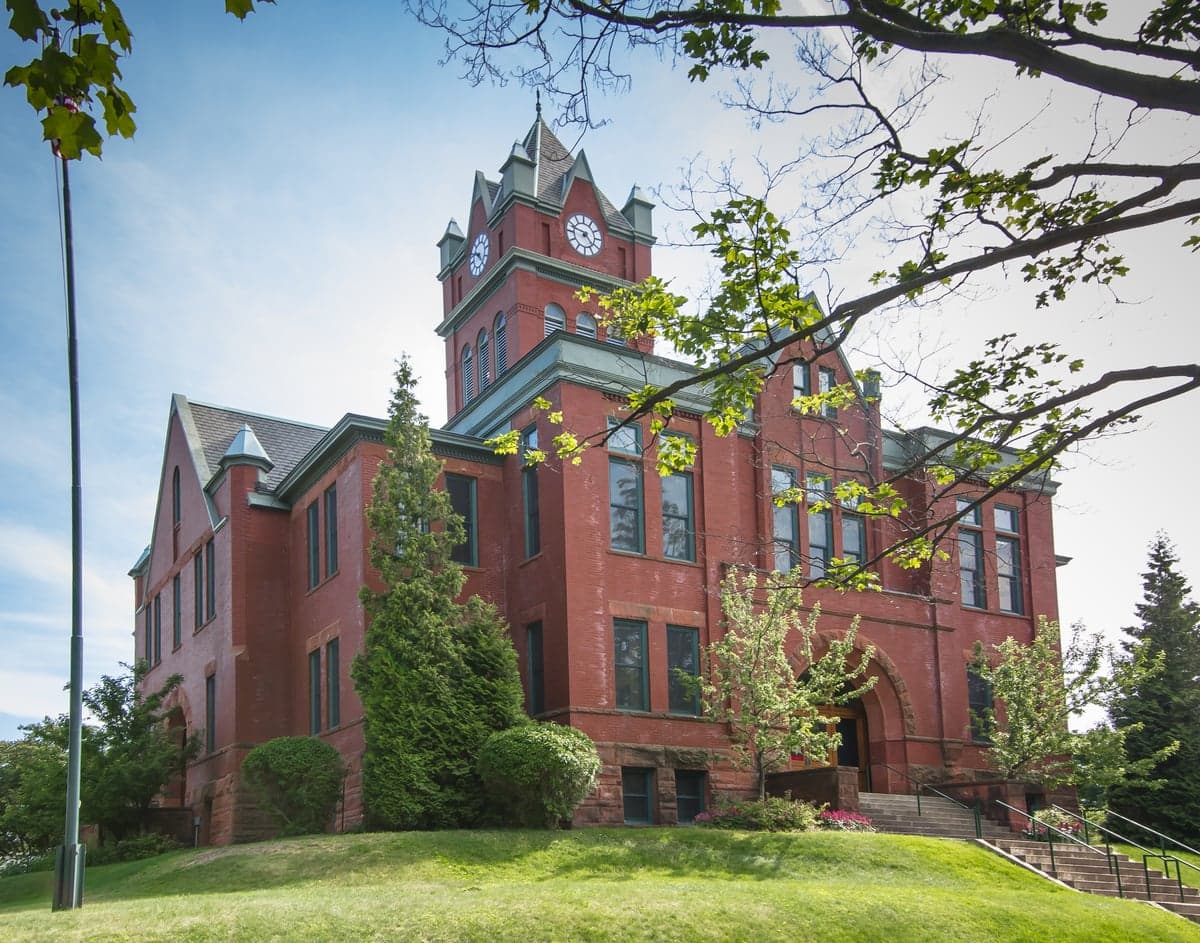
Photo: Wikipedia
Demographics of Grand Traverse County
Affluence Level in Grand Traverse County
A middle-class area roughly in line with national averages across income, home values, education, and employment.
People of Grand Traverse County
The people of Grand Traverse County today number roughly 95,757, forming a population that is overwhelmingly white (91.3%) and notably less diverse than Michigan as a whole, with a foreign-born share of just 0.7% — one of the lowest in the state. The county’s identity is shaped by a blend of historic Odawa settlement, 19th-century Yankee and European logging-era migration, and a modern influx of second-home owners and remote workers drawn to the Lake Michigan shoreline and the Traverse City area. Despite modest Hispanic (3.3%) and East/Southeast Asian (0.5%) communities, the population remains culturally anchored in its rural and small-town Great Lakes roots, with a growing college-educated cohort (40.3%) reshaping the local economy and political leanings.
Settlement & growth (pre-1960)
Long before European arrival, the Grand Traverse region was home to the Odawa (Ottawa) people, who established seasonal villages along the Boardman River and the shores of Grand Traverse Bay. The Odawa used the area as a hub for fishing, maple sugaring, and trade, with key settlements near present-day Traverse City and Omena. French fur traders and Jesuit missionaries passed through in the 17th and 18th centuries, but permanent European settlement did not begin until after the 1836 Treaty of Washington, which ceded Odawa lands to the United States and confined many Odawa to reservations, including the Grand Traverse Band of Ottawa and Chippewa Indians, whose modern governance center is in Peshawbestown in neighboring Leelanau County.
The first major wave of American settlers arrived in the 1840s and 1850s, primarily Yankees from New York and New England. They were drawn by the promise of cheap land under the federal land-grant system and the booming lumber industry. Traverse City, founded in 1851 by Perry Hannah and other capitalists, quickly became the region’s sawmill and shipping hub. These early settlers were overwhelmingly Protestant, English-speaking, and politically Whig-turned-Republican, establishing a cultural template that would persist for generations. Smaller settlements like Old Mission and Kingsley grew as farming and logging outposts, with the former becoming known for its cherry orchards by the late 19th century.
From the 1870s through the early 1900s, a second wave brought German, Polish, and Dutch immigrants, who worked in the sawmills, farms, and the growing fruit industry. German families concentrated in the Chums Corner area and around Interlochen, where they established Lutheran churches and small farms. Polish immigrants settled in Grawn and the eastern part of the county, finding work in lumber camps and later in the cherry-processing plants. Dutch families, many from the Netherlands, arrived around the turn of the century and took up dairy farming and fruit growing near Benzonia and Lake Ann. By 1910, the county’s population had reached roughly 23,000, with lumber already in decline and agriculture — especially cherries and apples — becoming the economic mainstay.
The period from 1920 to 1960 saw slower growth. The Great Depression hit the fruit industry hard, but the construction of the Grand Traverse County Road Commission and state highways improved access. Tourism began to emerge as a driver, with the founding of the Interlochen Center for the Arts in 1928 drawing seasonal visitors. The population crept to about 33,000 by 1950, remaining overwhelmingly white and native-born. No significant new immigrant groups arrived during this era; the county’s demographic character was set by the Yankee and Northern European stock of the 19th century.
Modern era (post-1965)
The 1965 Hart-Cellar Act had minimal direct impact on Grand Traverse County. Unlike urban Michigan counties, the foreign-born population here remained below 1% through the 1990s and still sits at just 0.7% in 2026. The county did not experience the large-scale immigration from Asia, Latin America, or the Middle East that reshaped cities like Detroit or Grand Rapids. Instead, the post-1965 demographic story is one of domestic migration and suburbanization.
Beginning in the 1970s, the county began attracting retirees and second-home buyers from downstate Michigan, particularly from the Detroit and Flint areas. This “lake migration” accelerated in the 1990s and 2000s, with new subdivisions and condominium developments spreading along the Leelanau Peninsula and around Long Lake and Silver Lake. The population grew from 54,000 in 1980 to 86,000 in 2010, driven almost entirely by white domestic in-migration. The Hispanic population, while small at 3.3%, grew from near zero in 1990, concentrated among seasonal agricultural workers in the cherry and apple orchards around Buckley and Kingsley. Many of these families are of Mexican descent, and a small but stable community has formed, with bilingual services appearing in local schools.
The East/Southeast Asian population (0.5%) and Indian-subcontinent population (0.2%) are tiny and dispersed, with no distinct ethnic enclaves. Most Asian and Indian residents are professionals working in healthcare at Munson Medical Center in Traverse City or in the tech and education sectors. The Black population (0.9%) is similarly small and scattered, with no historic Black neighborhood; most Black residents arrived after 2000, drawn by employment in the service industry or by marriage. The county’s racial homogeneity is notable: it is whiter than 95% of U.S. counties, and its diversity index is among the lowest in Michigan.
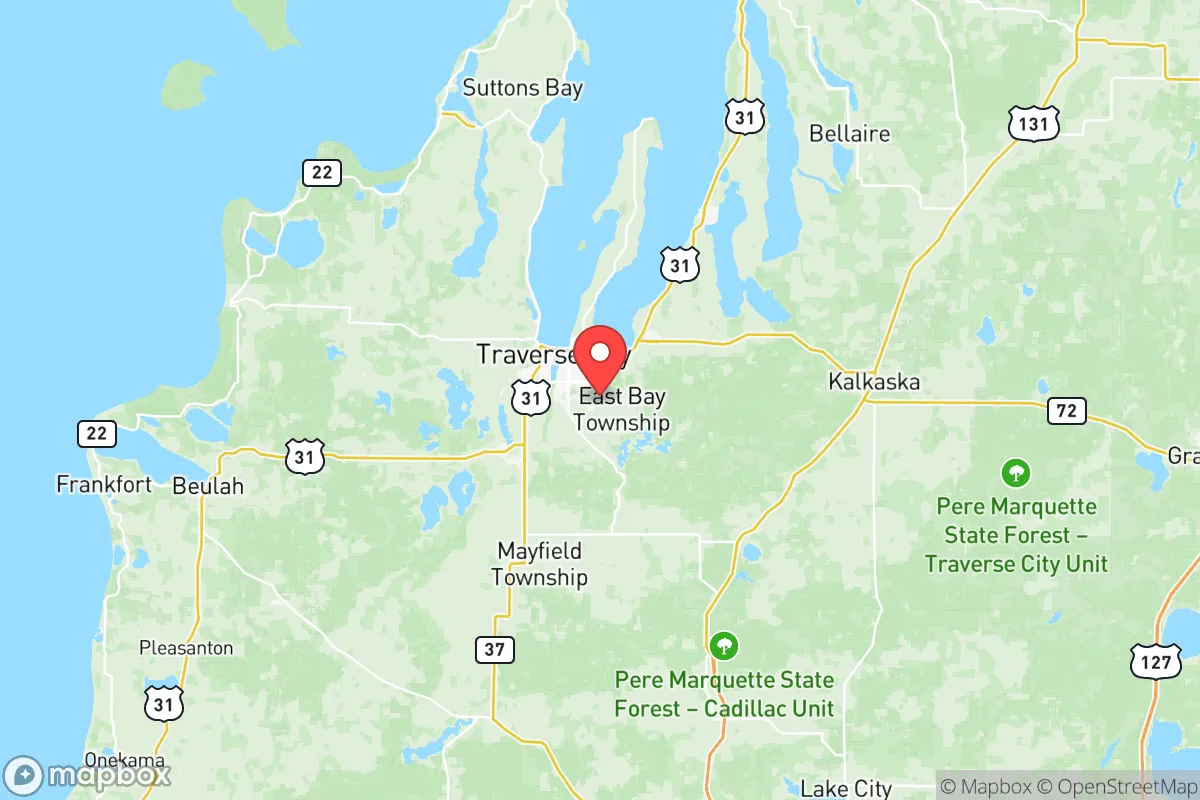
Suburbanization reshaped the county’s geography. Traverse City itself grew denser, but the most dramatic growth occurred in the townships: Garfield Township (which includes the Cherry Capital Airport area) and East Bay Township saw their populations double between 1990 and 2020, as new strip malls, housing developments, and office parks spread along U.S. 31 and M-72. The county’s college-educated share rose from 22% in 2000 to 40.3% in 2026, reflecting the influx of remote workers and retirees with higher education levels.
The future
Grand Traverse County is projected to grow slowly but steadily, reaching roughly 105,000 by 2040. The population will likely become slightly more diverse, but the pace will be gradual. The Hispanic share may rise to 5-6% as agricultural families settle permanently and as service-sector jobs in Traverse City attract younger Latino workers from other parts of Michigan. The East/Southeast Asian and Indian populations may grow modestly as Munson Medical Center and the tech sector expand, but they will remain below 2% each. The Black population is unlikely to exceed 2% without a major economic shift.
The most significant demographic trend is the aging of the population. The county’s median age is already 44, well above the national average, and the share of residents over 65 is projected to exceed 25% by 2035. This will increase demand for healthcare, senior housing, and age-restricted communities, particularly in Traverse City and Garfield Township. Younger families are being priced out of the housing market, as second-home buyers and remote workers drive up home prices — the median home value in the county has doubled since 2015. This may push younger residents toward more affordable towns like Kingsley or Fife Lake, or out of the county entirely.
Culturally, the county is becoming more politically divided. The Traverse City urban core leans increasingly Democratic, while the outlying townships and villages remain reliably Republican. This polarization mirrors national trends but is amplified by the influx of liberal-leaning remote workers from downstate and coastal cities. The county’s identity as a quiet, rural, conservative-leaning resort area is slowly giving way to a more polarized, amenity-driven community where housing affordability and environmental preservation are the dominant local issues.
For someone moving to Grand Traverse County now, the region offers a high quality of life with strong schools, low crime, and exceptional natural beauty — but it is not a diverse or rapidly changing place. The population is stable, white, and aging, with a growing but still small Hispanic community and a scattering of Asian and Indian professionals. New arrivals will find a community that values its historic character and is cautious about growth, but that is slowly adapting to the pressures of tourism, remote work, and climate-driven migration from the Sun Belt. The county’s future is one of managed, moderate change — not transformation.

* Values derived from national, state, county, city and local statistics and may differ in a specific area. Last updated: 2026-11-03T18:29:31.000Z
Narrative content on this page is AI-generated and may contain mistakes. Verify any details that matter before acting on them.
ReloMaps may earn a commission from affiliate links at no extra cost to you.

