Photo: Wikipedia
Political ClimatePolitical Climate in Bristol County
Showing district-level results — no local-only data available.
Local Political AnalysisPolitical Analysis of Bristol County
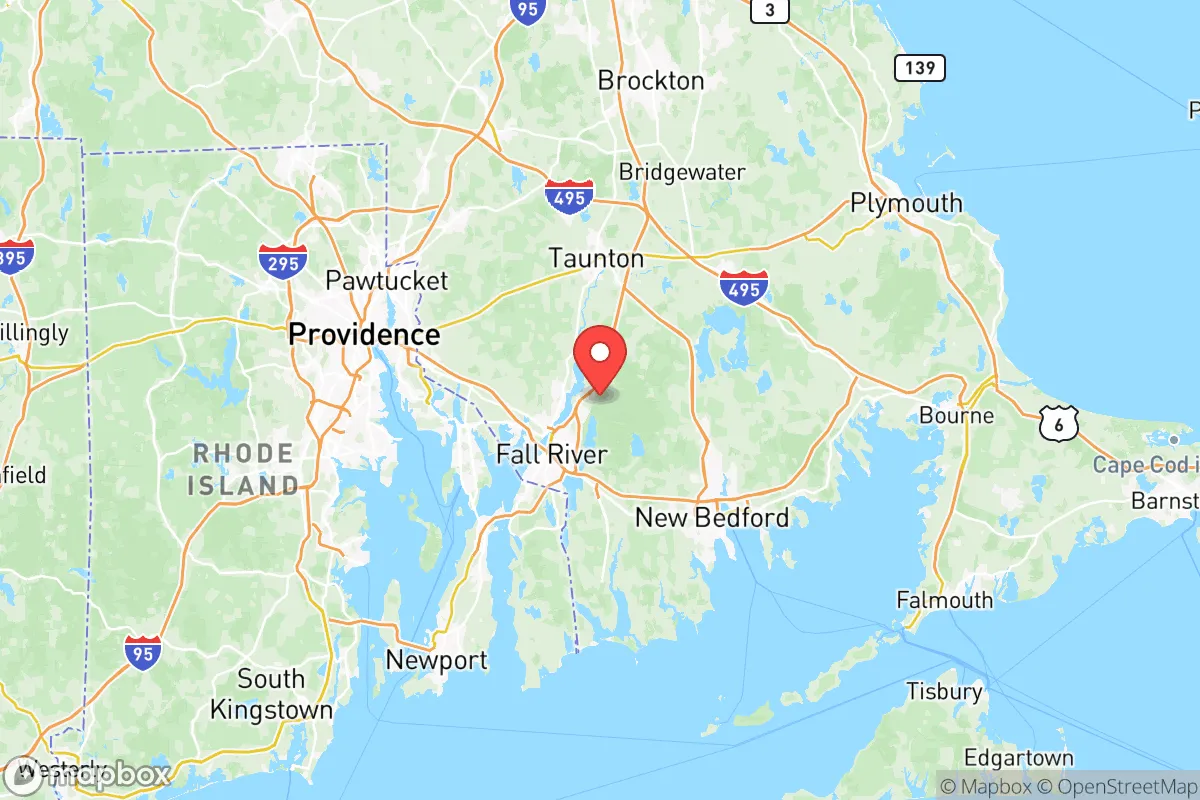
Bristol County, Massachusetts, sits politically to the right of the rest of the state, with a Cook Partisan Voting Index (PVI) of D+11 compared to the state’s D+15. That four-point gap might sound small, but it reflects a real, lived-in divide. The county has been drifting slowly rightward over the past decade, driven largely by working-class communities in the southeastern part of the county that feel disconnected from the liberal politics of Boston and Cambridge. While Massachusetts as a whole has become reliably Democratic, Bristol County still holds onto a noticeable conservative and moderate streak, especially in its smaller towns and rural areas.
How it compares
The state’s D+15 PVI makes it one of the most Democratic states in the country, but Bristol County’s D+11 rating shows it’s not a monolith. The real story is the internal split. Towns like Dartmouth, Fairhaven, and New Bedford lean heavily Democratic, with New Bedford’s working-class Portuguese and Cape Verdean communities reliably turning out for Democrats. But head to Taunton, Raynham, or Rehoboth, and you’ll find precincts that vote Republican by double digits. Freetown and Lakeville are classic swing areas—they voted for Trump in 2016 and 2020, but also backed Democratic Governor Maura Healey in 2022. The county’s political center of gravity is shifting eastward, with the more conservative towns in the western part of the county growing faster than the older, more liberal coastal cities.
What this means for residents
For a conservative resident, Bristol County offers more breathing room than most of Massachusetts. You’ll find Republican town committees that are active and vocal, especially in Seekonk and Norton. Gun rights are a live issue here—many towns have passed Second Amendment sanctuary resolutions, and local gun shops do brisk business. For a liberal resident, the county still feels solidly blue in the aggregate, with Democratic candidates winning most countywide races. But you’ll notice the difference in local school board meetings, where debates over curriculum and library books can get heated in a way they don’t in Cambridge. The practical upshot: if you’re conservative, you can find your people and your politics here without feeling like a total outlier. If you’re liberal, you’ll win most elections but have to engage with a vocal minority that doesn’t share your views.
Cultural and policy distinctions
The biggest cultural divide in Bristol County isn’t just partisan—it’s about identity. The coastal cities like Fall River and New Bedford have deep Portuguese and Azorean roots, with strong labor unions and a blue-collar Democratic tradition that feels different from the suburban liberalism of the state’s interior. Inland towns like Attleboro and Mansfield are more suburban, with a mix of commuters to Providence and Boston, and they tend to be more moderate-to-conservative on fiscal issues. Policy-wise, Bristol County has been a battleground over the state’s new MBTA Communities Act, which mandates denser housing near transit stops. Towns like Raynham and Taunton have pushed back hard, while New Bedford has embraced it. That fight—over housing, growth, and local control—is likely to define the county’s politics for the next decade, with the conservative-leaning towns trying to slow down the state’s liberal agenda while the coastal cities ride it.

State Political ClimatePolitical Climate in Massachusetts
State Political AnalysisPolitical Environment in the State
Massachusetts holds a Cook Partisan Voting Index of D+15, making it one of the most reliably Democratic states in the country. No Republican has won its electoral votes since 1984, and Democrats currently hold every statewide office, both U.S. Senate seats, and a supermajority in the state legislature. Over the last 10–20 years, the state has moved steadily leftward, driven by the Boston metroplex's growing dominance and the GOP's near-total collapse in the suburbs — a far cry from the 1990s when Republicans like William Weld and Paul Cellucci could win the governorship by running as fiscal moderates.
Urban vs. rural divide
The political map of Massachusetts is defined by the gravitational pull of Greater Boston. Boston proper, Cambridge, Somerville, and Brookline vote at D+40 or higher and produce the overwhelming majority of Democratic votes statewide. Worcester, once a swing city, now reliably backs Democrats, though its outlying towns like Holden and Paxton break right. Springfield and the rest of western Mass's old industrial cities lean solidly blue, while the surrounding hill towns of Franklin County and the Berkshires — places like Sheffield and Great Barrington — combine rural character with progressive politics. The actual Republican base is geographically thin and scattered: Plymouth County towns such as Wrentham and Norfolk, the Cape's mid-Cape villages like Yarmouth, and parts of central Mass like Sturbridge or Oxford. But these are isolated pockets, not a region that can flip a statewide election. If you're a conservative looking for a cluster of like-minded neighbors, the I-495 outer suburbs hold the last meaningful concentrations, but they are shrinking fast as exurban newcomers trend blue.
Policy environment
Massachusetts carries the highest effective state and local tax burden in the continental U.S. — income taxes sit at 5% on most earnings, with a 4% surtax on income over $1 million thanks to the 2022 Fair Share Amendment. Property taxes are locally set and vary wildly: a home in Boston's outer neighborhoods may levy under $7 per $1,000, while a similar-value property in a small town like Sturbridge can run above $17. The state imposes a strict regulatory regime on housing, energy, and business — permitting a single-family home routinely takes months longer than in New Hampshire or Rhode Island. Education spending is among the nation's highest per pupil, and the state mandates universal pre-K access in many districts. Healthcare is near-universal through MassHealth expansion and the Connector marketplace, preserved from the 2006 Romney-era reforms. On election access, Massachusetts now offers same-day voter registration, no-excuse mail-in voting, and early in-person voting made permanent after the pandemic. The net effect is a high-cost, high-service state where government touches nearly every aspect of daily life.
Recent policy direction
The last five years have seen the legislature accelerate a progressive agenda across nearly every front. On gun and self-defense law, the 2024 gun reform bill (H.4885) expanded the existing assault-weapons ban, restricted "high-capacity" magazines further, and mandated microstamping on new handgun sales — effectively ending the sale of many common semi-automatic models while leaving existing owners in a legal gray area. The state already had a "red flag" law and discretionary licensing. On parental and education rights, Massachusetts has moved in the opposite direction from many states: it banned conversion therapy in 2019, mandates LGBTQ+ inclusive curriculum in public schools (the 2022 "Safe Schools" update), and does not require schools to notify parents of a student's gender identity changes. Medical and bodily autonomy is fully protected — the ROE Act (2020) codified abortion access up to fetal viability and beyond for health reasons, and a 2024 shield law protects providers who prescribe or mail abortion pills to patients in restrictive states. Privacy and surveillance: the state passed a comprehensive data privacy law in 2023 regulating how companies collect personal data, though warrantless license-plate reader sharing between police departments remains common. Property rights are constrained by Chapter 40B (the affordable housing law) which lets developers bypass local zoning if a town is below 10% affordable housing — a perennial source of friction in small towns. On voting and ballot access, the permanent vote-by-mail expansion (2022) and automatic voter registration have increased turnout but been criticized by conservatives for diluting the security of same-day voting. The direction is consistent: every cycle adds another layer of state control over local decision-making, with no recent major legislation pulling in the other direction.
Civil unrest & political movements
Massachusetts has a long tradition of protest, but the recent flashpoints have centered on race, policing, and immigration. Boston saw sustained Black Lives Matter demonstrations in 2020 that were among the largest per capita in the Northeast, leading to the defunding of the Boston Police gang unit and a shift toward "community response" models. The state operates under a de facto sanctuary policy — since 2017, state police have been barred from cooperating with ICE detainer requests, and the 2023 "Safe Communities" amendment further restricted county sheriffs from holding inmates for federal immigration enforcement. This has created a sharp divide: liberal activists want a mandatory statewide ban on all ICE collaboration, while towns like Wrentham and Plymouth have passed symbolic resolutions opposing the policy. The "right to shelter" law, a 1983 statute guaranteeing emergency housing to homeless families, has been strained by the influx of migrant families since 2022, leading to protests outside shelters in suburban locations and a fierce debate over who qualifies. Left-wing activist groups like the Massachusetts Peace Action and the Sunrise Movement are loud but largely inside the Democratic coalition. Right-wing organizing is marginal: the state affiliate of the Second Amendment sanctuary movement won resolutions in a handful of small towns but failed to create any legal carve-outs, and the Massachusetts GOP's internal feuds have left it unable to capitalize on any backlash. Election integrity controversies are minimal — the state's fully paper-ballot system and mandatory post-election audits have kept conspiracy theories at the fringe. A new resident arriving from a red state will notice the near-total absence of conservative media, churches with political messages, or open-carry activity; the flashpoints are all over immigration and housing cost, not culture-war battles common elsewhere.
Projection
Over the next 5–10 years, Massachusetts will become more Democratic, more expensive, and more centralized. The demographic trends are locked in: young professionals and students pour into the Boston-Cambridge corridor, while the state's rural and exurban population ages and shrinks. The Republican Party shows no signs of rebuilding a statewide coalition — it has no bench, no credible gubernatorial candidate, and a primary electorate that still favors hardline social conservatives who cannot win the general. The only real check on Democratic supermajorities is the legislature's own internal split between the Boston progressive caucus and the more moderate "New Democrat" coalition from the suburbs, but that divide is narrowing. On policy, expect a push for rent control (a 2024 bill nearly passed), a carbon tax, and further restrictions on single-family zoning under the MBTA Communities Act (which forces transit-adjacent towns to allow multi-family housing). The sanctuary and right-to-shelter debates will intensify if migration continues, but the state's political center of gravity is unlikely to budge. Anyone moving in now should expect that state government will be uniformly progressive for the foreseeable future, and that local towns retain only as much autonomy as the legislature chooses to allow on any given year.
For a conservative-leaning individual or family, Massachusetts offers a high-quality environment for education and healthcare — you will pay heavily for them in taxes and see your values reflected in few public policies. Your practical choices come down to town government: select a community like Wrentham, Norfolk, or Oxford where the local culture and school board tilt center-right, and accept that state-level elections will continue to go the other way by large margins. For a liberal relocator, the fit is nearly seamless — the state will match your politics on most issues, though you will pay for that alignment in housing costs and taxes. The bottom line is that Massachusetts works exactly as its political system intends: high taxes, high services, and a government that has
* Values derived from national, state, county, city and local statistics and may differ in a specific area. Last updated: 2026-06-20T18:37:32.000Z
Narrative content on this page is AI-generated and may contain mistakes. Verify any details that matter before acting on them.
ReloMaps may earn a commission from affiliate links at no extra cost to you.

