
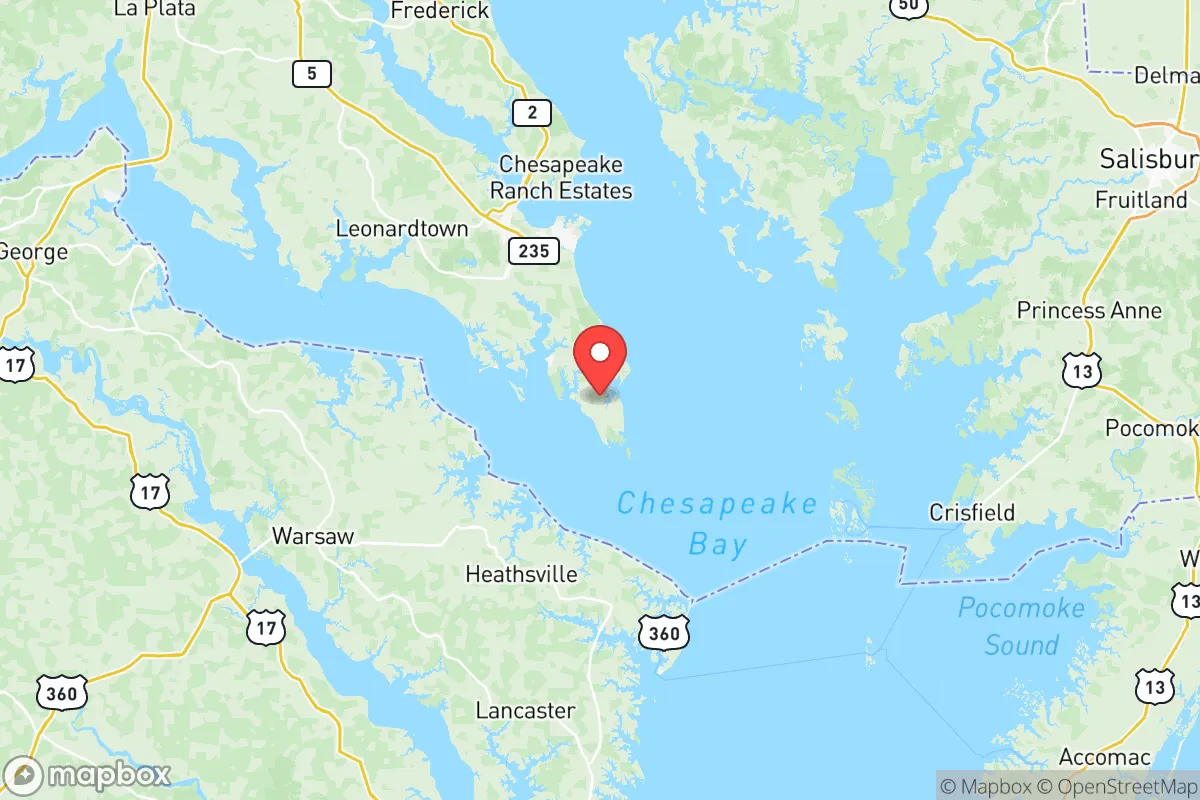
Photo: Wikipedia
Political ClimatePolitical Climate in St Marys County
Showing county-level results — no local-only data available.
Lean and PVI are calculated from this county’s 2020 and 2024 presidential results, Cook-style.
Political rankings in Maryland
- Most Conservative Cities in Maryland
- Most Liberal Cities in Maryland
- Best Conservative-Leaning Towns in the Mid-Atlantic
- Safest Liberal-Leaning Towns on the East Coast
- Safest Conservative-Leaning Towns on the East Coast
- Affordable Small Towns for Conservatives
- Most Affordable Liberal-Leaning Small Towns in the U.S.
- Safest Liberal-Leaning Cities in the U.S.
- Most Conservative Counties in Maryland
- Most Liberal Counties in Maryland
Local Political AnalysisPolitical Analysis of St Marys County
St Marys County has long been a conservative stronghold in a deeply blue state, carrying a Cook PVI of R+9 while the rest of Maryland sits at D+17. That 26-point gap isn't just a statistic—it shapes everything from local policy to daily conversations. The county has trended slightly redder over the past decade, driven by growth in exurban communities and a steady influx of military-affiliated families tied to Naval Air Station Patuxent River. But the picture isn't uniform: the county's southern and rural precincts lean heavily Republican, while the more densely populated areas around Lexington Park and California show more competitive, sometimes even Democratic-leaning, voting patterns.
How it compares
Compared to Maryland as a whole, St Marys County is a political outlier. The state's D+17 rating reflects the overwhelming Democratic majorities in the Baltimore-Washington corridor, but St Marys votes more like a Southern Maryland cousin of the Eastern Shore. In the 2024 presidential race, the county went for the Republican candidate by roughly 12 points, while the state overall backed the Democrat by over 20. The contrast is starkest when you look at specific towns: Leonardtown, the county seat, is a swing area where local races are often decided by a few hundred votes, while Mechanicsville and Charlotte Hall in the north lean reliably red. Lexington Park, home to many base employees and younger families, shows more Democratic support, especially in precincts near the base. St Marys City, with its college population, also tilts left. The county's Republican edge is driven by strong turnout in rural precincts like Loveville and Dameron, where conservative values and gun rights are deeply held.
What this means for residents
For conservative residents, St Marys County feels like a refuge within a blue state. Local government is reliably Republican, with the Board of County Commissioners holding a 4-1 GOP majority as of 2025. That means lower taxes, fewer regulations, and a pro-business environment that contrasts sharply with Montgomery or Prince George's counties. For liberal residents, the reality is more mixed: they can find like-minded neighbors in Lexington Park or around the college, but they're often outvoted on countywide issues. School board races and zoning decisions tend to reflect the county's conservative lean, though there's enough of a moderate streak—especially among military families—that extreme positions rarely win. The practical effect is that St Marys has a slower, more deliberate pace of change than the rest of Maryland, which suits many residents just fine.
Culturally, the county's political identity shows up in visible ways. You'll see more Trump flags and "Don't Tread on Me" plates in rural areas than you would in Annapolis or Baltimore, but the vibe is more "leave us alone" than confrontational. The county has resisted some state-level mandates on housing density and environmental regulations, and local debates often center on balancing growth with the rural character that defines the area. For newcomers, the key takeaway is that St Marys is a place where your politics matter less than your willingness to show up at the volunteer fire department or the county fair—but if you're coming from a deep-blue area, you'll notice the difference from the moment you drive past the first "Trump 2024" sign on Route 5.

State Political ClimatePolitical Climate in Maryland
State Political AnalysisPolitical Environment in the State
Maryland is one of the most reliably Democratic states in the country, with a Cook Partisan Voting Index of D+17, meaning it votes about 17 points more Democratic than the national average in presidential elections. The state hasn’t voted for a Republican presidential candidate since George H.W. Bush in 1988, and Democrats hold supermajorities in both chambers of the General Assembly. Over the last 20 years, the state has shifted further left, driven primarily by explosive population growth in the Washington, D.C. suburbs, particularly Montgomery and Prince George’s counties, which now cast roughly a third of all votes statewide. That said, the state is far from a monolith — the rural Eastern Shore, Western Maryland, and parts of the central spine remain deeply conservative, creating one of the sharpest urban-rural divides in the country.
Urban vs. rural divide
The political map of Maryland is essentially a story of two states. The D.C. suburbs — Montgomery County and Prince George’s County — are the engine of the Democratic majority, routinely delivering 75-85% of their votes to Democratic candidates. Baltimore City is similarly dominant for the left, though its shrinking population has reduced its statewide clout. The other major population center, the Baltimore suburbs in Baltimore County and Howard County, lean Democratic but are more moderate and have shown some drift toward the center in local races. On the other side, the Eastern Shore counties like Queen Anne’s, Talbot, and Wicomico are reliably Republican, often voting 60-65% for GOP candidates. Western Maryland — Garrett County and Allegany County — is the most conservative region in the state, with Garrett routinely voting 75%+ Republican. Frederick County, once a conservative stronghold, has become a true swing county as D.C. exurbs push north, and it flipped to Biden in 2020 after supporting Trump in 2016. Anne Arundel County, home to Annapolis, is another bellwether — it leans Democratic now but still elects moderate Republicans in local races.
Policy environment
Maryland’s policy environment is shaped by one-party Democratic control, but the state’s tax and regulatory posture is more moderate than deep-blue states like California or New York. The state has a progressive income tax structure with rates from 2% to 5.75%, and local counties add their own piggyback taxes, pushing the top combined rate over 8% in places like Montgomery County. Property taxes are set at the county level and vary widely — Baltimore City has one of the highest rates in the state at over 2.2%, while Garrett County is under 1%. Sales tax is 6%, with no local add-ons. Education policy is heavily centralized, with the state’s Blueprint for Maryland’s Future law pouring billions into public schools, but also imposing strict accountability and curriculum standards. Healthcare is dominated by the state’s Medicaid expansion and the Maryland Health Benefit Exchange, which have driven uninsured rates below 6%. Election laws are among the most accessible in the country — no-excuse mail-in voting, same-day registration, and early voting are all standard. Gun laws are among the strictest nationally, requiring a handgun qualification license, a 7-day waiting period, and a ban on assault weapons and high-capacity magazines. The state also has a red flag law and requires universal background checks for private sales.
Recent policy direction
Over the last five years, Maryland has moved decisively left on several fronts. In 2023, the legislature overrode Governor Wes Moore’s veto to pass the Trans Health Equity Act, which requires Medicaid to cover gender-affirming care, and the Abortion Care Access Act, which expanded the pool of providers allowed to perform abortions and created a state-funded abortion training program. On gun policy, the 2023 Gun Safety Act tightened licensing requirements and expanded the list of prohibited places to carry, though parts of it were blocked by federal courts. On the property rights front, the state passed the Renters’ Rights and Stabilization Act in 2024, which limits rent increases to 5% plus inflation in certain counties, a move that has alarmed landlords and real estate investors. On education, the Blueprint for Maryland’s Future has dramatically increased teacher salaries and expanded pre-K, but also introduced a controversial “science of reading” mandate that has shifted curriculum away from whole-language instruction. On the privacy and surveillance front, the state passed the Maryland Online Data Privacy Act in 2024, which gives consumers the right to opt out of data collection and requires explicit consent for sensitive data. Voting access has been expanded with automatic voter registration at motor vehicle offices and the Maryland Voting Rights Act, which requires jurisdictions with a history of voter suppression to pre-clear election changes with the state. On the parental rights front, the state has moved in the opposite direction of many red states — in 2024, the legislature passed a bill requiring school boards to adopt policies that affirm LGBTQ+ students, including allowing them to use their chosen names and pronouns without parental notification, a flashpoint for conservative families.
Civil unrest & political movements
Maryland has a long history of political activism, from the 2015 Baltimore protests following Freddie Gray’s death to more recent demonstrations over police reform and abortion rights. The state is home to a robust network of progressive activist groups, particularly in Montgomery County and Baltimore, that have successfully pushed for rent control, police accountability, and environmental justice. On the right, conservative activism is concentrated in the rural counties and the Eastern Shore, where groups like the Maryland Republican Party and local Tea Party affiliates have organized around school board elections, gun rights, and opposition to sanctuary policies. Immigration politics are a persistent flashpoint — Maryland is a sanctuary state, with a 2023 law prohibiting state and local law enforcement from cooperating with federal immigration enforcement except in limited circumstances, and several counties, including Frederick and Harford, have passed resolutions opposing the policy. Election integrity controversies have been relatively muted compared to other states, but conservative groups have raised concerns about the state’s widespread mail-in voting system, and the 2022 gubernatorial election saw a minor controversy over ballot drop boxes in Montgomery County. There is no serious secession or nullification movement in Maryland, though some rural counties have periodically floated the idea of joining West Virginia or forming a new state, but these remain fringe proposals.
Projection
Over the next 5-10 years, Maryland is likely to become even more Democratic, driven by continued in-migration to the D.C. suburbs from other parts of the country and the natural demographic trends of an increasingly diverse and urbanized population. The state’s Republican Party is struggling to find a viable statewide message — the last Republican governor, Larry Hogan, won by running as a moderate who distanced himself from the national party, but that model has not produced a successor. The rural counties will continue to lose population and political influence, while the D.C. suburbs and Baltimore suburbs will grow. The most interesting dynamic to watch is Frederick County, which is rapidly becoming a Democratic stronghold as exurban development pushes north, and Harford County, which is still reliably Republican but seeing slow demographic change. For a conservative relocator, the practical reality is that the state’s policy environment will continue to move left on guns, taxes, education, and social issues, and the political climate in the population centers will become increasingly hostile to conservative viewpoints. However, the rural and exurban areas will remain conservative enclaves, and the state’s moderate tax structure and strong economy may still appeal to those who can tolerate the political direction.
For a new resident, the bottom line is that Maryland offers a high quality of life with excellent schools, strong job markets, and beautiful natural landscapes, but the political climate is unapologetically progressive and likely to become more so. Conservatives moving here should expect to live in a state where their views are a minority in the legislature and the major media markets, but where they can find like-minded communities in the rural counties and some exurban areas. Liberals will find a state that largely aligns with their values on social issues, gun control, and environmental policy, but should be prepared for high taxes and a high cost of living in the areas where most of the political power is concentrated. The key is to choose your county carefully — the difference between living in Garrett County and Montgomery County is as stark as living in two different states, and that’s not an exaggeration.
* Values derived from national, state, county, city and local statistics and may differ in a specific area. Last updated: 2026-11-18T22:13:56.000Z
Narrative content on this page is AI-generated and may contain mistakes. Verify any details that matter before acting on them.
ReloMaps may earn a commission from affiliate links at no extra cost to you.

