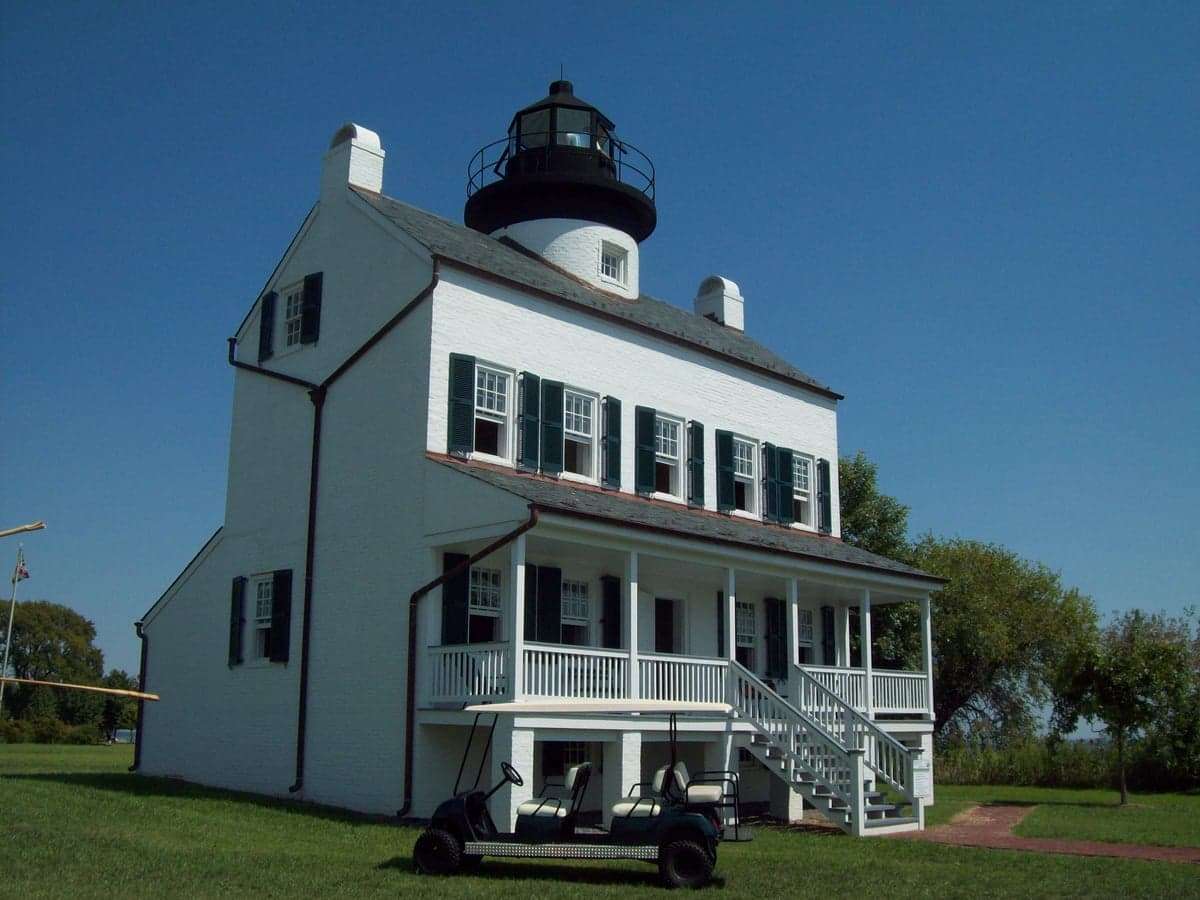
Photo: Wikipedia
Personal Sovereignty in St Marys County
Viable for self-reliance. Generally workable, though some barriers may limit total independence.
What does Personal Sovereignty tell us?
Personal Sovereignty measures your capacity for self-reliance and independence with minimal government friction. Higher scores mean fewer barriers between you and the way you want to live... but it assumes you have the space you need and good neighbors.
What does this tell us?
Personal Sovereignty measures your capacity for self-reliance and independence with minimal government friction. Higher scores mean fewer barriers between you and the way you want to live... but it assumes you have the space you need and good neighbors.
State Policy
Energy independence: Importer (18% of energy produced in-state)
Personal Liberty
Homesteading

Personal Liberty Analysis
St Marys County, Maryland offers a notably higher degree of personal sovereignty than much of the Washington D.C. exurban corridor, though it operates within a state framework that imposes significant constraints on individual autonomy. The county’s rural character, combined with a local political culture that leans more conservative than the state average, creates an environment where self-reliance is both respected and practically necessary. While Maryland’s state-level tax burden and regulatory density are among the highest in the nation, St Marys County itself maintains a lighter touch on land use, property rights, and self-defense than jurisdictions closer to the capital, making it a pragmatic choice for freedom-minded relocators who cannot or will not leave the Mid-Atlantic entirely.
Tax burden and regulatory posture in St Marys County
Maryland’s state income tax is progressive, with rates from 2% to 5.75%, and St Marys County adds a local income tax of 3.2% — the maximum allowed by state law — bringing the combined top marginal rate to 8.95%. Property taxes are moderate for the region: the county rate is $0.872 per $100 of assessed value, and with fire, library, and solid waste districts, the total effective rate typically lands between $0.95 and $1.05 per $100. This is lower than neighboring Calvert County ($1.08) and far below Montgomery County ($1.15+). The county’s regulatory posture is best described as permissive within state constraints. Zoning in the rural tier — covering most of the county outside Leonardtown, California, and Lexington Park — allows agricultural and residential uses with minimal bureaucratic friction. Building permits are straightforward for owner-built structures, though state-mandated stormwater management and critical area buffer rules (for properties within 1,000 feet of tidal waters) add complexity. The county does not impose rent control, business licensing is simple for home-based enterprises, and there is no county-level plastic bag ban or energy code stricter than the state baseline. The Maryland Department of the Environment (MDE) retains authority over septic systems and well permits, which can be a bottleneck for rural properties, but local health department staff in St Marys are generally described as pragmatic rather than adversarial.
Self-defense and gun law specifics in St Marys County
Maryland is a shall-issue state for concealed carry permits following the Bruen decision, and St Marys County’s sheriff’s office processes applications efficiently — typically 60-90 days for residents. The county is home to the St Mary’s County Rifle Club near Mechanicsville, one of the oldest continuously operating ranges in the state, and the Southern Maryland Shooting Club in Charlotte Hall offers public and private facilities. Magazine capacity is limited to 10 rounds for long guns and 10 rounds for handguns under state law, and the state’s Handgun Qualification License (HQL) requirement — a $50 fee, fingerprinting, and a 4-hour training class — remains in place for purchases. Private sales of handguns require a regulated firearms dealer transfer, but long gun private sales between individuals are legal without state involvement. The county’s sheriff, Steve Hall, has publicly stated his office will not enforce any federal firearms restrictions they deem unconstitutional, a posture that resonates with the local gun culture. Open carry is legal with a permit but rarely practiced; concealed carry is the norm. The county has no local assault weapons ban or magazine restriction beyond state law, and the sheriff’s office does not conduct discretionary firearm seizures under Maryland’s Red Flag law, though the law itself remains on the books. For relocators from more restrictive states, the key adjustment is the HQL and the 10-round magazine limit; otherwise, the county’s enforcement climate is among the most gun-friendly in Maryland.
Self-reliance and homesteading viability in St Marys County
St Marys County is one of the best places in Maryland for homesteading and off-grid living, thanks to its rural zoning tiers and relatively permissive land use rules. The Agricultural Preservation District (APD) zoning, which covers large swaths of the county around Mechanicsville, Loveville, and Charlotte Hall, allows minimum lot sizes of 3 acres for a single-family dwelling, and properties of 10+ acres are common. Chickens, goats, and horses are permitted on parcels of 1 acre or more in most rural zones, and beekeeping is allowed without a county permit. Off-grid water is feasible: wells are standard, and the county health department permits composting toilets and greywater systems for owner-occupied dwellings, though a conventional septic system is still required for blackwater. Solar panels are permitted by right in all zoning districts, and net metering is available through Southern Maryland Electric Cooperative (SMECO), though the cooperative’s interconnection process can take 4-6 weeks. Rainwater collection is legal and encouraged for non-potable uses. The county does not have a building code requirement for fire sprinklers in single-family homes, and owner-builders can act as their own general contractor with a simple affidavit. The main constraint is the state’s Critical Area Law, which restricts development within 1,000 feet of the Chesapeake Bay and its tributaries — properties along the Patuxent River near St Mary’s City or the Potomac near Coltons Point face additional permitting hurdles. For serious homesteaders, the area around Great Mills offers the best balance of affordable land (still under $10,000 per acre for raw parcels) and minimal regulatory friction.
Personal liberties in St Marys County: parental rights, medical autonomy, speech, and property
Parental rights in St Marys County are relatively strong compared to the state average. The St Marys County Public Schools system allows parents to opt their children out of any curriculum materials they find objectionable without requiring a specific reason, and the school board has resisted state-level mandates on gender identity policies, maintaining a policy that requires parental notification for any changes in a student’s gender expression or pronoun usage. Homeschooling is straightforward: parents file a one-page notice of intent with the local school system and submit a portfolio review annually, with no state-mandated curriculum or testing requirements. Medical autonomy is constrained by Maryland’s vaccine mandate for school attendance, which includes all standard childhood vaccines with only medical and religious exemptions (no philosophical exemption), though the county’s health department processes religious exemption requests without undue scrutiny. COVID-19 mandates have been lifted, and the county did not impose its own mask or vaccine mandates during the pandemic. Free speech is protected under the First Amendment, and the county has no local ordinances restricting political signage or public assembly. Property rights are strong: the county does not have a transfer tax on real estate sales (only state recordation tax applies), and there is no county-level rent control or inclusionary zoning. The county’s comprehensive plan explicitly supports “the right of property owners to use their land as they see fit, subject to reasonable regulation,” and eminent domain is rarely used outside of road-widening projects. The main property rights concern is the state’s ability to designate critical areas and wetlands, which can effectively prohibit development on certain parcels — a title search and environmental assessment are essential before purchasing waterfront or creek-front property.
Overall, St Marys County represents a pragmatic compromise for those seeking personal sovereignty within the Mid-Atlantic region. It offers a lighter regulatory touch than any county inside the Capital Beltway, a gun culture that is both active and respected by local law enforcement, and genuine homesteading opportunities that are increasingly rare in Maryland. The trade-offs are real: state income tax is high, the HQL and magazine limit are permanent annoyances, and the Critical Area Law constrains waterfront development. But for relocators who need to stay within commuting distance of D.C. or the Patuxent River Naval Air Station, St Marys County provides a level of personal freedom that is simply unavailable in Montgomery, Prince George’s, Anne Arundel, or even most of Calvert County. It is not Texas or New Hampshire, but it is the closest thing to personal sovereignty that Maryland offers.

* Values derived from national, state, county, city and local statistics and may differ in a specific area. Last updated: 2026-11-18T22:13:56.000Z
Narrative content on this page is AI-generated and may contain mistakes. Verify any details that matter before acting on them.
ReloMaps may earn a commission from affiliate links at no extra cost to you.

