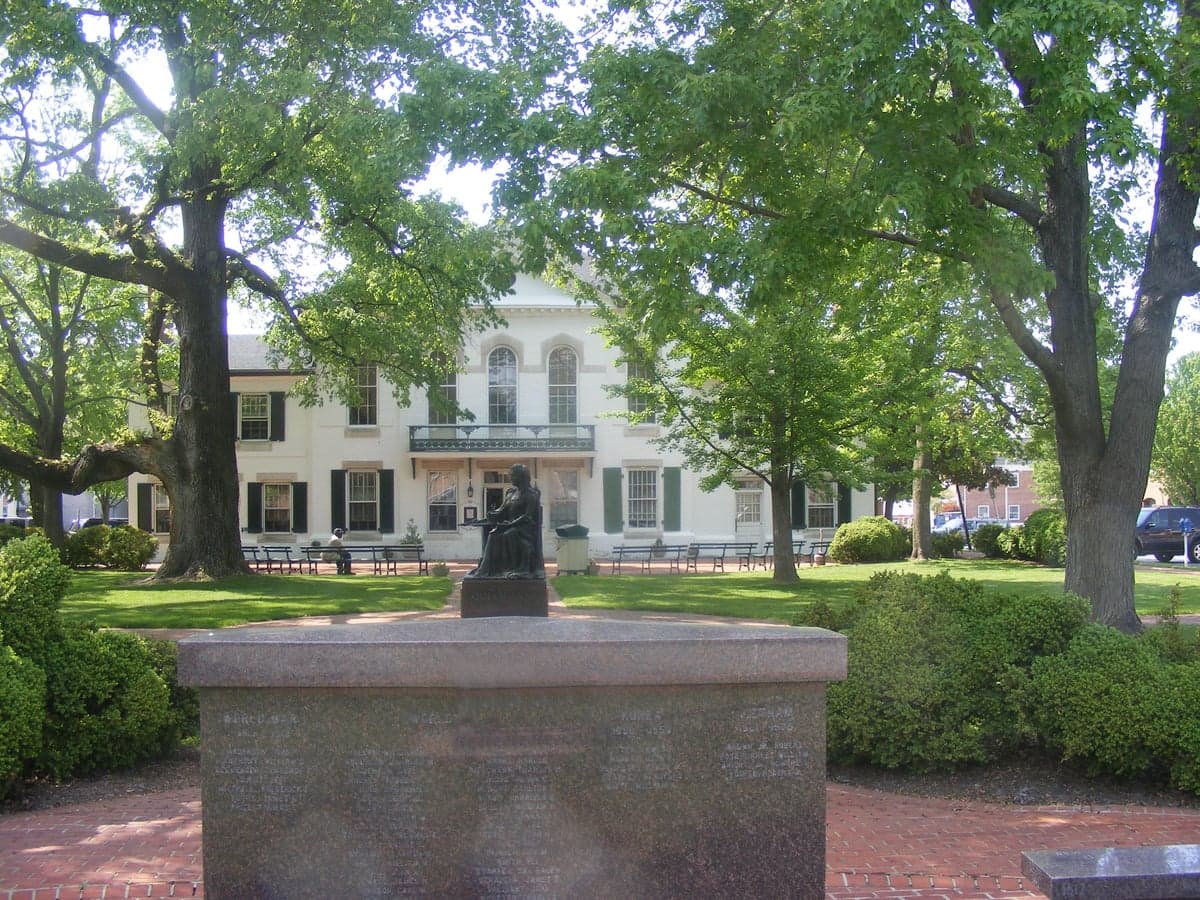
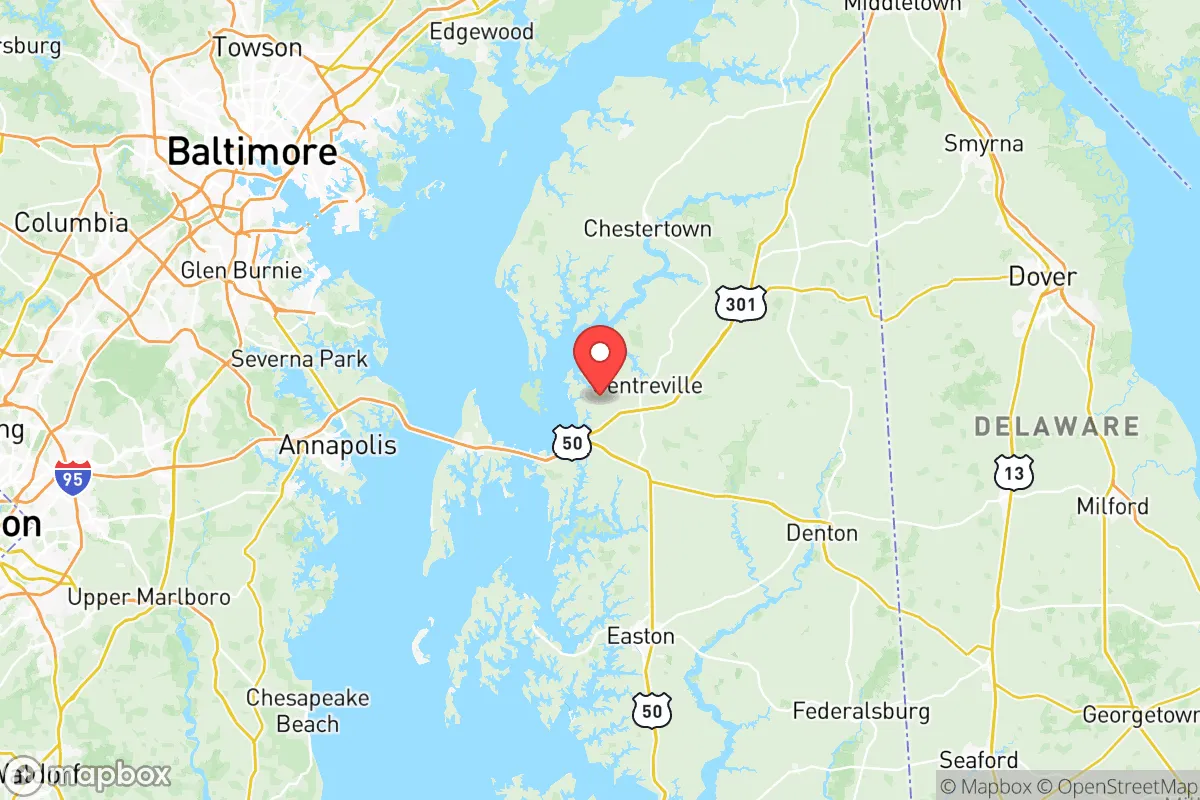
Photo: Wikipedia
Political ClimatePolitical Climate in Queen Annes County
Showing district-level results — no local-only data available.
Local Political AnalysisPolitical Analysis of Queen Annes County
Queen Anne's County is a solidly Republican stronghold in a deeply blue state, carrying a Cook Partisan Voting Index (PVI) of R+8. That means the county consistently votes about eight percentage points more Republican than the nation as a whole, a stark contrast to Maryland's statewide PVI of D+17. While the county has been reliably red for decades, the margins have tightened slightly in recent presidential cycles, reflecting a broader national trend of suburban and exurban areas shifting left even as rural precincts hold firm. The real story, though, is the variation within the county — not every town votes the same way.
How it compares
The political divide between Queen Anne's County and the rest of Maryland is one of the sharpest in the state. The county's R+8 PVI places it among the most Republican-leaning jurisdictions in Maryland, alongside Garrett and Carroll counties. By contrast, the state as a whole is D+17, driven by the massive Democratic majorities in Montgomery and Prince George's counties. This 25-point gap means Queen Anne's is an outlier in state politics — its voters routinely elect Republicans to the county commission and state legislature, but those same voters have little influence in statewide races, which are dominated by the Baltimore-Washington corridor. Within the county, the political geography is not uniform. The town of Centreville, the county seat, tends to be more moderate and has a small but visible Democratic presence, particularly in the historic district and among newer residents commuting to Annapolis or the Eastern Shore. Stevensville, closer to the Bay Bridge and the D.C. exurbs, has seen an influx of former suburbanites, and its precincts have shifted left in recent cycles — some now vote within 5 points of the national average. Meanwhile, Church Hill and Sudlersville in the northern and eastern parts of the county remain deeply conservative, often voting 20-30 points more Republican than the national average. The swing precincts are in the central corridor around Queenstown and Grasonville, where a mix of retirees, watermen, and service workers create a more competitive dynamic.
What this means for residents
For conservative residents, Queen Anne's County offers a rare pocket of political alignment in a blue state. Local government, school board, and law enforcement leadership are reliably Republican, and policy debates — from land use to tax rates — tend to reflect conservative priorities. However, the county's lack of influence in statewide elections means that state-level policies on education funding, environmental regulations, and gun laws are often at odds with local sentiment. For liberal residents, the county can feel isolating, but there are active Democratic clubs and a growing number of like-minded neighbors in the waterfront communities and near the bridge. The practical reality is that most residents, regardless of party, share common concerns: preserving the rural character of the county, managing growth along the Route 50 corridor, and protecting the Chesapeake Bay. These issues often transcend partisan lines in local elections, even as national politics remain sharply divided.
Culturally, Queen Anne's County is distinct from both the urban centers of Maryland and the more rural parts of the Eastern Shore. The county's identity is rooted in agriculture, watermen culture, and a slower pace of life, but it is increasingly shaped by commuters and second-home owners from the D.C. area. This tension plays out in policy debates over development, school funding, and environmental regulations. The county's Republican lean is not just about national politics — it reflects a deep-seated preference for local control, limited government, and a resistance to what many see as overreach from Annapolis. At the same time, the county's proximity to the Chesapeake Bay and its reliance on tourism and seafood mean that environmental stewardship is a bipartisan priority. The result is a political climate that is conservative but pragmatic, where a candidate's stance on the Bay Bridge traffic or the health of the oyster population can matter as much as their party affiliation.

State Political ClimatePolitical Climate in Maryland
State Political AnalysisPolitical Environment in the State
Maryland is one of the most reliably Democratic states in the country, with a Cook Partisan Voting Index of D+17, meaning it votes about 17 points more Democratic than the national average in presidential elections. The state hasn't voted for a Republican presidential candidate since George H.W. Bush in 1988, and Democrats hold supermajorities in both chambers of the General Assembly. Over the last 20 years, the shift has been steady and pronounced — the Washington, D.C. suburbs have grown wealthier and bluer, while the rural western and eastern parts of the state have become more Republican, but not enough to offset the population weight of the Baltimore-Washington corridor.
Urban vs. rural divide
The political map of Maryland is a textbook case of the urban-rural split. The entire Democratic majority is generated by the densely populated Washington, D.C. suburbs — Montgomery County and Prince George's County alone account for roughly a third of the state's vote, and they vote Democratic by margins of 60 to 80 points. Baltimore City is another deep-blue anchor, though its population has been declining for decades. Howard County and Anne Arundel County (home to Annapolis) lean Democratic but are more competitive, with Anne Arundel occasionally electing Republicans at the local level. The rural west — Garrett County, Allegany County, and Washington County — vote Republican by 30 to 40 points, as does the Eastern Shore, where Caroline County and Worcester County are reliably red. The key swing area is Frederick County, which was historically conservative but has been trending purple as D.C. exurbs push north and west; it voted for Joe Biden in 2020 by a slim margin. Harford County, northeast of Baltimore, remains reliably Republican but is seeing slow demographic change.
Policy environment
Maryland's policy environment is shaped by one-party Democratic control, but it's not a uniformly progressive state — the business lobby and rural legislators still exert influence. The state has a progressive income tax structure with rates from 2% to 5.75%, plus local county taxes that push the top combined rate over 8%. Property taxes are set at the county level and vary widely; Montgomery County has some of the highest in the nation, while Garrett County is much lower. Sales tax is 6%, with no local add-ons. The regulatory posture is generally business-friendly in the D.C. suburbs (defense contractors, biotech, federal consulting) but stricter on environmental and labor issues than most states. Education spending is among the highest in the country per pupil, driven by the 2022 Blueprint for Maryland's Future law, which pumps billions into K-12 schools, early childhood education, and teacher pay. Healthcare policy leans left: the state expanded Medicaid under the ACA, has its own health insurance exchange, and passed a law in 2023 to create a public option plan by 2026. Election laws are among the most accessible in the country — no-excuse mail-in voting, same-day registration, automatic voter registration at the DMV, and early voting starting 10 days before Election Day.
Recent policy direction
The last five years have seen a clear acceleration of progressive policy. On gun and self-defense law, Maryland passed the Gun Safety Act of 2023, which bans carrying firearms in a wide range of "sensitive places" (including hospitals, parks, and public transit) and requires a state-approved training course for concealed carry permits — a direct response to the Bruen Supreme Court decision. The law is being challenged in court. On parental and education rights, the state has moved in the opposite direction from many red states: it passed the Trans Health Equity Act in 2023, requiring Medicaid to cover gender-affirming care for minors, and the Blueprint for Maryland's Future mandates comprehensive sex education that includes LGBTQ+ content. There is no parental opt-out for specific curriculum content, only for "family life and human sexuality" lessons. On speech and privacy, Maryland passed the Online Data Privacy Act in 2024, one of the strongest state-level privacy laws, limiting how companies can collect and sell personal data. On medical and bodily autonomy, the state has codified abortion rights into law (the Abortion Care Access Act of 2022), expanded the scope of practice for nurse practitioners and physician assistants, and passed a law allowing physician-assisted suicide for terminally ill patients (the End-of-Life Option Act, effective 2024). On property rights, the state has some of the strongest renters' protections on the East Coast, including a 2024 law requiring "just cause" for evictions statewide. On taxation, the trend is toward higher taxes on high earners: in 2024, the legislature passed a new 6% tax bracket for income over $1 million, and there's perennial discussion of a wealth tax. On voting and ballot access, the state continues to expand access, with automatic voter registration now tied to state IDs and a 2024 law requiring counties to offer at least one drop box per 10,000 registered voters.
Civil unrest & political movements
Maryland has a history of visible political activism, particularly around policing and racial justice. The 2015 death of Freddie Gray in Baltimore police custody sparked days of protests and a state of emergency, and the subsequent consent decree with the Baltimore Police Department remains in effect. The "Defund the Police" movement had some local success — Baltimore City cut its police budget by $22 million in 2020, though most of that was later restored. On the right, the "Keep the Eastern Shore" movement has organized against offshore wind projects and land-use regulations, and there's a small but vocal Second Amendment sanctuary movement in Garrett County and Allegany County, where local sheriffs have declared they won't enforce certain state gun laws. Immigration politics are a flashpoint: Maryland is a sanctuary state, with a 2023 law (the Maryland Values Act) that prohibits state and local law enforcement from cooperating with federal immigration enforcement except in limited circumstances. This has created tension in more conservative counties like Harford County, where the sheriff has publicly opposed the law. Election integrity controversies have been relatively muted compared to other states, though there were scattered protests outside vote-counting centers in Frederick County in 2020. The most visible political movement in recent years has been the fight over the Blueprint for Maryland's Future — rural counties have pushed back against the mandate to consolidate small school districts, arguing it strips local control.
Projection
Over the next 5 to 10 years, Maryland will almost certainly become more Democratic, not less. The D.C. suburbs continue to grow — Frederick County is one of the fastest-growing counties in the state, and its new residents are overwhelmingly from more liberal areas. The Baltimore metro area is stable but aging, and rural counties are losing population. The state's tax and regulatory environment will likely continue to shift left, with potential new taxes on wealth and corporate income, further expansion of healthcare access, and tighter gun laws. The wild card is the Blueprint for Maryland's Future — if it fails to deliver measurable improvements in student outcomes, there could be a backlash from moderate Democrats and suburban parents. But a Republican statewide victory in the next decade is extremely unlikely; the last Republican governor, Larry Hogan, won in 2014 and 2018 by running as a moderate who distanced himself from the national party, and even he couldn't flip the legislature. A conservative moving to Maryland should expect to live in a state where their vote for president and Senate will almost certainly be in the minority, but where local control in Garrett County, the Eastern Shore, or parts of Harford County can still produce Republican representation at the county and state legislative level.
For a new resident, the practical takeaway is this: if you're conservative, you'll find like-minded communities in the western counties, the Eastern Shore, and parts of northern Maryland, but you'll be living under a state government that is actively moving in the opposite direction of your political preferences on nearly every major issue. If you're liberal, you'll find a state that largely aligns with your values, with strong protections for abortion access, LGBTQ+ rights, voting access, and privacy, but you'll pay for it in taxes and cost of living. Either way, Maryland is a state where the political trajectory is clear and unlikely to change course anytime soon.
* Values derived from national, state, county, city and local statistics and may differ in a specific area. Last updated: 2026-07-25T08:52:43.000Z
Narrative content on this page is AI-generated and may contain mistakes. Verify any details that matter before acting on them.
ReloMaps may earn a commission from affiliate links at no extra cost to you.

