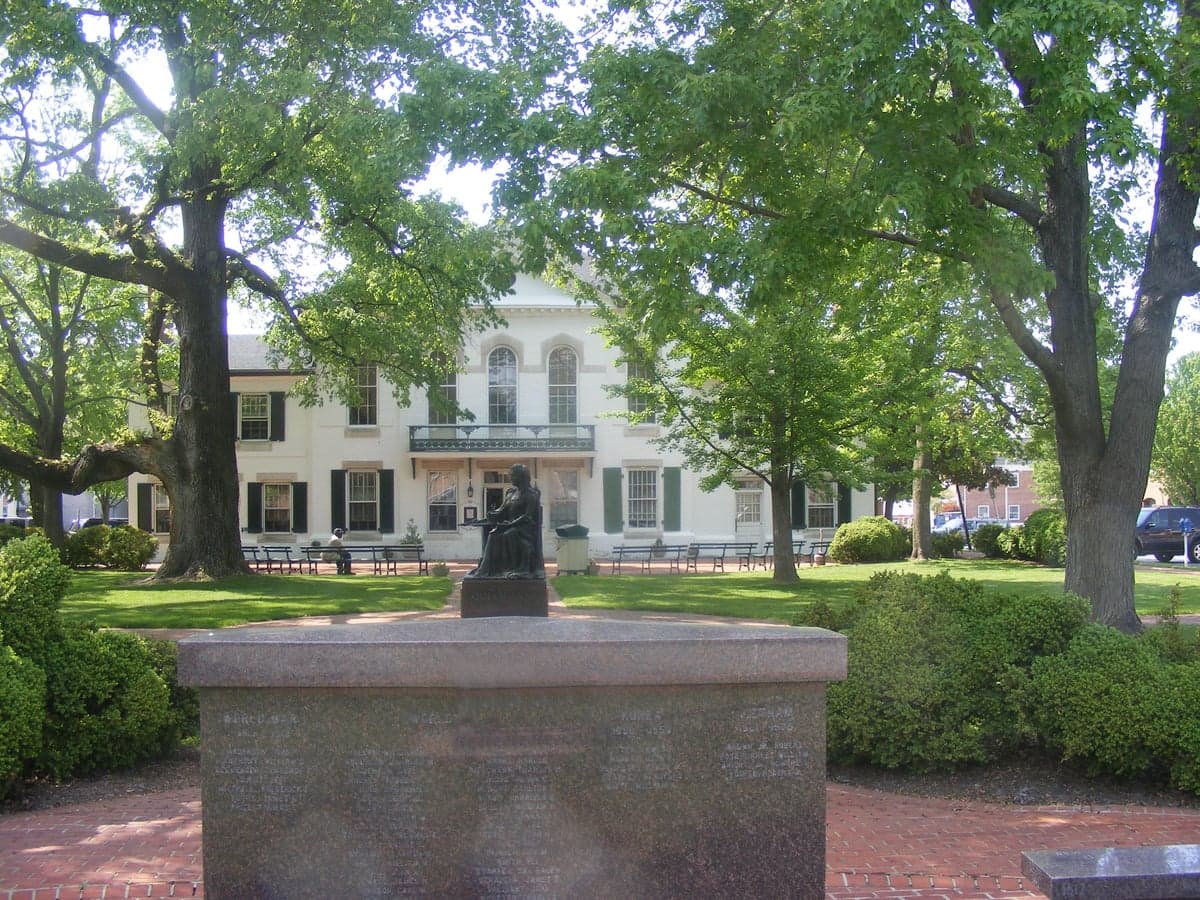
Photo: Wikipedia
Demographics of Queen Annes County
Affluence Level in Queen Annes County
An upper-middle-class area. Household wealth, education levels, and homeownership run ahead of national benchmarks.
People of Queen Annes County
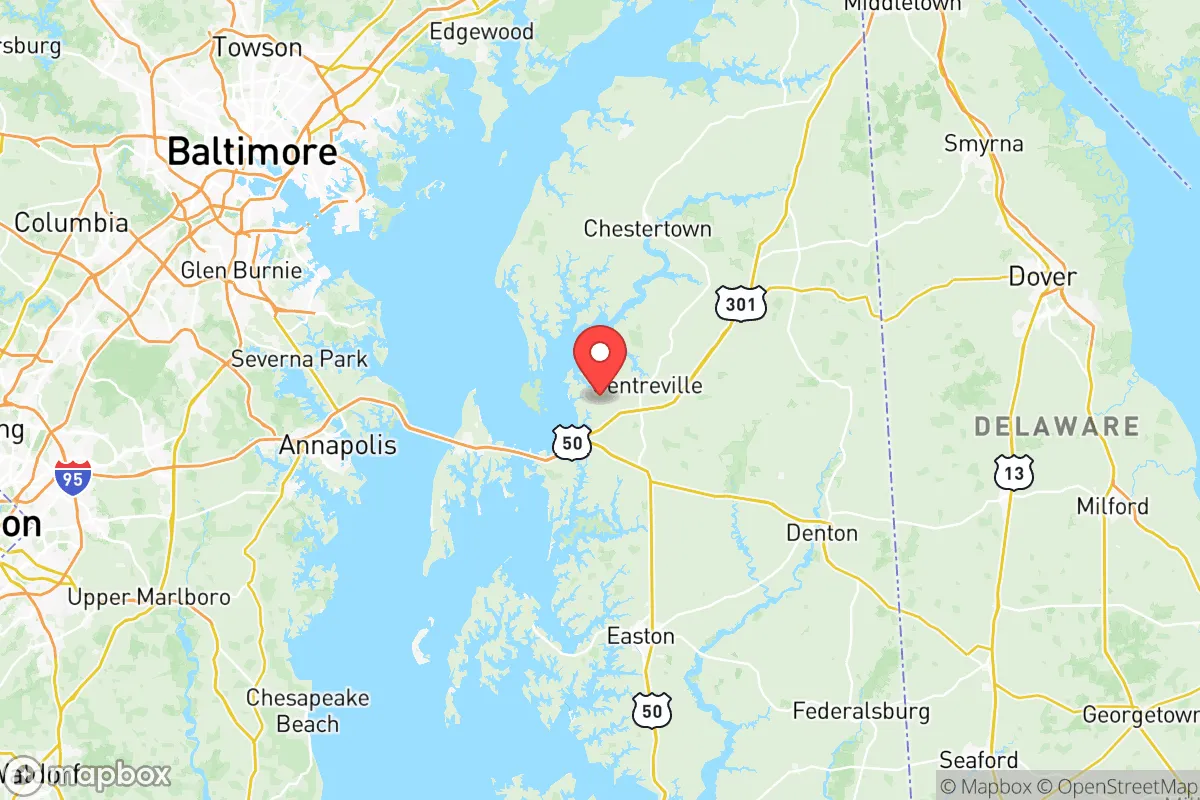
Today, Queen Anne’s County, Maryland, is a predominantly white, family-oriented community of roughly 51,000 residents, characterized by its rural Eastern Shore identity and a growing commuter population linked to the Washington-Baltimore metropolitan corridor. With a population density of just over 100 people per square mile, the county retains a distinctly agricultural and waterfront character, anchored by the Chesapeake Bay Bridge that connects it to the western shore. The population is 83.1% white, with a small but established Black community (6.0%) and a growing Hispanic presence (5.3%), while foreign-born residents make up only 2.9% of the total — a figure well below the national average. The county’s identity is shaped by a blend of historic small towns, working farms, and newer suburban subdivisions, creating a place where traditional values and slow-paced living coexist with proximity to major urban job centers.
Settlement & growth (pre-1960)
Long before European settlement, the area now known as Queen Anne’s County was inhabited by the Nanticoke and Choptank peoples, Algonquian-speaking tribes who lived along the rivers and creeks of the Eastern Shore, fishing, hunting, and farming. English colonists from the Tidewater region of Virginia and Southern Maryland began arriving in the mid-17th century, drawn by the fertile soil and navigable waterways that made tobacco cultivation profitable. The county was formally established in 1706, carved from Talbot County and named for Queen Anne of Great Britain. Early settlers were predominantly of English and Welsh stock, with a smaller number of Scots-Irish families filtering in from Pennsylvania and the Delmarva Peninsula. These groups established the county’s earliest towns — Centreville, the county seat founded in 1794, and Stevensville, a port village on the Chester River — as centers of government, trade, and maritime commerce.
Throughout the 18th and 19th centuries, the economy remained rooted in tobacco, wheat, and shipbuilding, with enslaved African labor forming a significant part of the workforce. By 1860, roughly one-third of the county’s population was enslaved, and the Black population — both enslaved and free — concentrated in rural hamlets and on plantations near Church Hill and Queenstown. After the Civil War, many freed families remained in the area as sharecroppers and farm laborers, establishing small communities such as Sudlersville and Barclay, where descendants still live today. The late 19th and early 20th centuries saw little new immigration to Queen Anne’s County; unlike industrial cities in the North and Midwest, the Eastern Shore attracted few Southern or Eastern European immigrants. The population remained overwhelmingly native-born, white, and rural, with a stable Black minority.
The construction of the Chesapeake Bay Bridge in 1952 was the single most transformative event in the county’s modern history. Before the bridge, the Eastern Shore was isolated from the Baltimore-Washington metropolitan area, accessible only by ferry. The bridge opened the county to suburban development, and the population began to grow steadily — from about 14,000 in 1950 to over 25,000 by 1970. This period saw the first significant influx of white domestic migrants from the western shore, many of them middle-class families seeking larger lots, lower taxes, and a quieter lifestyle. Towns like Stevensville and Grasonville, located near the bridge’s eastern terminus, became the initial landing points for these newcomers, transforming from sleepy fishing villages into bedroom communities.
Modern era (post-1965)
The 1965 Hart-Cellar Act, which reshaped U.S. immigration policy, had a relatively muted effect on Queen Anne’s County compared to urban and suburban areas nationwide. The county’s foreign-born population remains very low at 2.9%, and the immigrant communities that have arrived since the 1970s are small and dispersed rather than concentrated in ethnic enclaves. The most notable post-1965 change has been the growth of the Hispanic population, which now stands at 5.3%. Many of these residents are of Mexican and Central American origin, drawn to the county’s agricultural sector — particularly poultry processing and produce farming — and have settled in and around Sudlersville and Millington, where labor demand is highest. This community remains modest in size but has grown steadily since the 1990s, contributing to the county’s slight diversification.
The East/Southeast Asian population (0.9%) and the Indian subcontinent population (0.1%) are very small, reflecting the county’s limited draw for high-skilled immigration, which tends to concentrate in major metropolitan areas with large tech and professional sectors. The Black population, at 6.0%, has remained relatively stable as a share of the total, though its geographic distribution has shifted somewhat as older rural communities near Church Hill and Barclay have seen outmigration of younger generations to larger cities, while some Black families have moved into newer subdivisions in the Stevensville area.
The most significant demographic force in the post-1965 period has been domestic migration — specifically, the continued suburbanization of the Eastern Shore. The completion of the Chesapeake Bay Bridge’s parallel span in 1973 and ongoing road improvements have made Queen Anne’s County increasingly accessible to commuters working in Annapolis, Baltimore, and even Washington, D.C. The county’s population more than doubled between 1970 and 2020, from roughly 25,000 to over 50,000. Most of this growth has concentrated in the western part of the county, particularly in Stevensville, Chester, and Grasonville, where new subdivisions, shopping centers, and schools have been built to accommodate the influx. These areas have become predominantly white, middle-to-upper-middle-class communities, with a character distinct from the older, more rural eastern towns like Centreville and Church Hill.
The future
Looking ahead, Queen Anne’s County is likely to continue its gradual diversification, though it will remain a predominantly white, native-born community for the foreseeable future. The Hispanic population is expected to grow modestly, driven by continued demand for agricultural labor and by natural increase, as younger Hispanic families have higher birth rates than the county’s aging white population. The Black population share may remain stable or decline slightly, as younger Black residents continue to move toward larger cities for education and employment opportunities. The East/Southeast Asian and Indian subcontinent populations are likely to remain very small, as the county lacks the high-tech job base and urban amenities that attract these groups to places like Montgomery County or Howard County on the western shore.
The biggest demographic wildcard is the pace of suburban development. If the Chesapeake Bay Bridge remains the primary bottleneck, growth may slow as commuting times increase and infrastructure strains. However, if state or federal investments improve cross-bay transit — or if remote work trends persist, reducing the need for daily commutes — the county could see a new wave of domestic migrants from the western shore, particularly families seeking more space and lower housing costs. This would likely accelerate the development of the western corridor from Stevensville to Centreville, while the eastern towns like Sudlersville and Millington may experience slower growth and retain their rural character.
Culturally, the county is becoming more politically and socially diverse, though it still leans conservative relative to the state as a whole. The tension between long-time residents — many of whom are descended from the original English and African American families — and newer commuter families is a recurring theme in local politics, particularly around land use, school funding, and development regulations. The county’s identity is evolving from a purely agricultural and maritime community into a hybrid of rural tradition and suburban convenience.
For someone moving in now, Queen Anne’s County offers a community that is still predominantly white and native-born, with a small but growing Hispanic presence and a stable Black minority. It is a place where family values, outdoor recreation, and a slower pace of life are central, but where the pressures of suburbanization are increasingly visible. The county is becoming more connected to the broader metropolitan region, but it remains distinct in its Eastern Shore character — a place where the past and future coexist, often uneasily, on the same winding country roads.

* Values derived from national, state, county, city and local statistics and may differ in a specific area. Last updated: 2026-07-25T08:52:43.000Z
Narrative content on this page is AI-generated and may contain mistakes. Verify any details that matter before acting on them.
ReloMaps may earn a commission from affiliate links at no extra cost to you.

