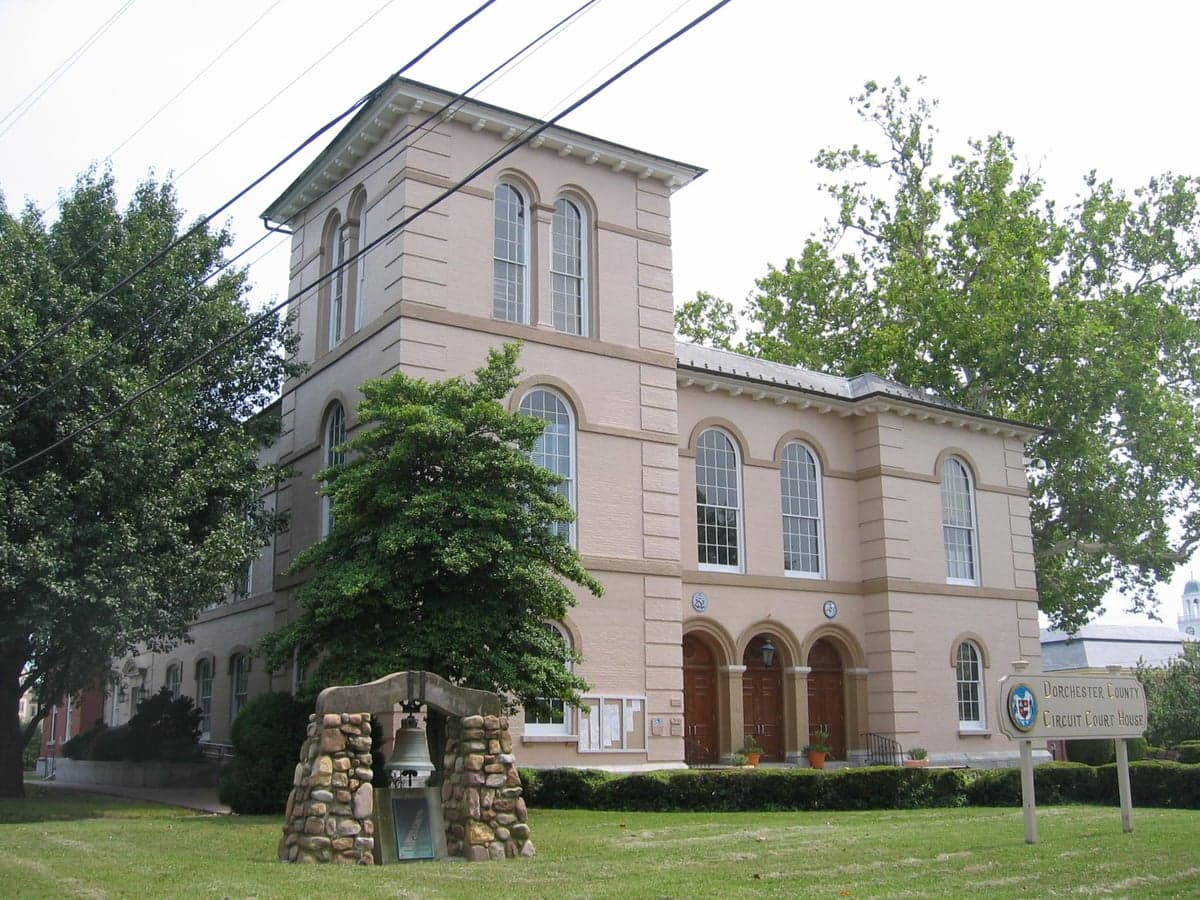
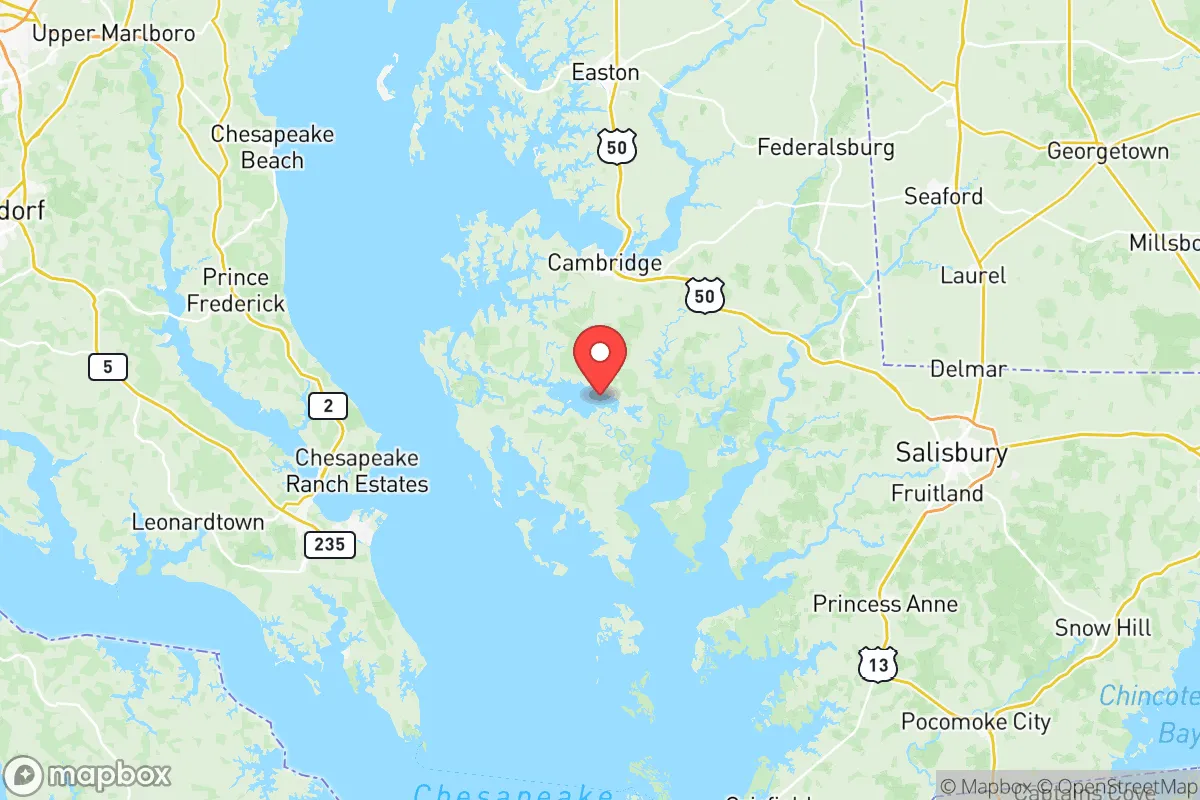
Photo: Wikipedia
Political ClimatePolitical Climate in Dorchester County
Showing district-level results — no local-only data available.
Local Political AnalysisPolitical Analysis of Dorchester County
Dorchester County, Maryland, is a reliably Republican stronghold in a deeply blue state, carrying a Cook Partisan Voting Index of R+8. This stands in stark contrast to Maryland’s overall D+17 rating, making the county one of the most conservative pockets on the Eastern Shore. The political trajectory here has been remarkably stable over the past decade; while the national GOP has shifted, Dorchester’s rural, agricultural, and blue-collar base has only solidified its Republican lean, with no signs of a purple shift in the near term.
How it compares
The gap between Dorchester County and Maryland at large is a chasm. Statewide, Democrats dominate by a 17-point margin, powered by the D.C. suburbs and Baltimore. In Dorchester, the opposite is true: Republicans routinely win county-level races by double digits, and the county has voted for the GOP presidential candidate in every election since 2000. The political geography within the county tells the story. The county seat, Cambridge, is the only real blue dot, with its historic downtown and waterfront precincts often leaning Democratic by 5-10 points. In contrast, the rural towns of Hurlock and East New Market are deep red, often voting Republican by 20 points or more. The swing precincts are found in the unincorporated areas around Secretary and Vienna, where independent voters and a mix of watermen and commuters can tip a close primary but rarely flip a general election. The 2024 presidential results were typical: Trump carried the county with roughly 58% of the vote, while the statewide vote went to Harris by a wide margin.
What this means for residents
For conservative residents, Dorchester County offers a rare sense of political alignment within a blue state. Local government, from the county council to the sheriff’s office, is reliably Republican, meaning policies on taxes, land use, and Second Amendment rights reflect their views. For liberal residents, the reality is more isolating. While Cambridge provides a small progressive bubble with a few Democratic elected officials and active advocacy groups, they are often outvoted on countywide issues like school funding or zoning. The practical effect is that liberal residents tend to focus their political energy on local races in Cambridge or on statewide ballot initiatives, where their votes carry more weight. The county’s R+8 lean means that national Democratic campaigns rarely invest here, but local GOP candidates still face competitive primaries, especially in the more moderate areas near the Choptank River.
Culturally, the political divide mirrors a deeper split between the watermen and farming communities of the rural interior and the more diverse, tourism-driven economy of Cambridge. Gun rights are a defining issue here—open carry is common, and the county has a "Second Amendment Sanctuary" resolution on the books. On the other hand, environmental regulations on the Chesapeake Bay, often championed by the state's Democratic leadership, are a frequent source of tension, as they directly impact the crabbing and oystering industries. The result is a county that feels politically self-contained: conservative in its bones, but with just enough blue in Cambridge to keep the local debates lively and the general elections from being total blowouts. If you're moving here, expect the local news to focus on school board races and county budgets, not national drama—and expect your neighbors to know exactly where you stand on the bay.

State Political ClimatePolitical Climate in Maryland
State Political AnalysisPolitical Environment in the State
Maryland is one of the most reliably Democratic states in the country, with a Cook Partisan Voting Index of D+17, meaning it votes about 17 points more Democratic than the national average. The state hasn’t voted for a Republican presidential candidate since George H.W. Bush in 1988, and Democrats hold supermajorities in both chambers of the General Assembly. Over the past 20 years, the shift has been steady and pronounced: the once-competitive suburbs of Baltimore and Washington, D.C., have moved decisively left, while the rural eastern shore and western panhandle have become even more Republican. For a conservative relocator, this means you’re moving into a state where your vote on the statewide level won’t carry much weight, but your local community may feel very different.
Urban vs. rural divide
The political map of Maryland is a textbook example of the urban-rural split. The entire state’s Democratic margin is driven by the densely populated Washington, D.C., suburbs in Montgomery and Prince George’s counties, plus Baltimore City. Montgomery County alone casts about 15% of the state’s vote and routinely goes 75-80% Democratic. Prince George’s County is even more lopsided, often exceeding 85% Democratic. Baltimore City, despite population loss, still delivers a massive Democratic margin. On the flip side, the rural counties are deeply Republican: Garrett County in the far west votes about 70% Republican, and the Eastern Shore counties like Queen Anne’s, Talbot, and Wicomico are reliably red. The suburbs that used to be swing areas — Anne Arundel County (Annapolis), Howard County (Columbia), and Baltimore County — have all trended blue over the last decade. Anne Arundel, which voted for George W. Bush in 2004, now votes Democratic by about 10 points. The only real exception is Carroll County, northwest of Baltimore, which remains solidly Republican and is a notable conservative enclave. For a conservative, living in Carroll County or the Eastern Shore means you’re in a red bubble; living in Montgomery County means you’re in the heart of the blue machine.
Policy environment
Maryland’s policy environment is consistently progressive. The state has a graduated income tax with rates from 2% to 5.75%, and local counties add their own piggyback tax, pushing the top combined rate over 8% in some areas. Property taxes are relatively high, especially in the D.C. suburbs. The regulatory posture is business-friendly in some sectors (biotech, cybersecurity) but heavily regulated in others (energy, housing, firearms). Education policy is a major focus: Maryland spends over $16,000 per student annually, among the highest in the nation, and has a strong public school system overall, though outcomes vary wildly between wealthy suburbs and poorer rural or urban districts. Healthcare is heavily regulated, with a state-based insurance exchange and expanded Medicaid. Election laws are among the most accessible in the country: same-day voter registration, no-excuse mail-in voting, and early voting for two weeks. For a conservative, the policy environment means higher taxes and more regulation than you’d find in a red state, but also well-funded public services and infrastructure.
Recent policy direction
Maryland’s recent legislative direction has been firmly leftward, with a focus on expanding government programs and individual rights as defined by the Democratic majority. On gun and self-defense law, the state passed the Firearm Safety Act of 2013, which banned assault weapons and limited magazine capacity, and in 2024 it passed a law requiring a permit to purchase a handgun, effectively ending the “Gunshine State” era. Concealed carry is now shall-issue, but the process is expensive and time-consuming. On parental and education rights, the state has moved to expand LGBTQ+ inclusive curricula and has resisted parental opt-out laws for certain materials. Speech and privacy: Maryland has a strong shield law for journalists and passed the Online Data Privacy Act in 2024, giving residents control over how companies use their data. Medical and bodily autonomy: abortion is codified into state law, and in 2023 the state passed a law protecting providers and patients from out-of-state prosecution. Property rights: the state has a strong eminent domain framework and has used it for development projects, but property taxes are a constant complaint. Taxation: the state has not cut income tax rates in recent years, but it did increase the standard deduction. Voting and ballot access: the state expanded mail-in voting permanently after the pandemic, and in 2024 passed a law requiring counties to have at least one drop box per 10,000 registered voters. For a conservative, the direction is clear: more regulation, more taxes, and more government involvement in daily life.
Civil unrest & political movements
Maryland has a history of civil unrest, most notably the 2015 Baltimore protests following the death of Freddie Gray, which led to a state of emergency and National Guard deployment. Since then, organized activist movements have been active, particularly around police reform and racial justice. The state passed the Maryland Police Accountability Act in 2021, which repealed the Law Enforcement Officers’ Bill of Rights and created a statewide use-of-force standard. On the right, there are active but smaller movements, including Second Amendment sanctuary resolutions passed in several rural counties (Garrett, Allegany, Carroll) and a growing homeschooling and private school advocacy network. Immigration politics are a flashpoint: Maryland is a sanctuary state, with a 2019 law limiting local law enforcement cooperation with ICE. This has led to tensions in some suburban counties, particularly in Frederick and Harford, where local officials have pushed back. Election integrity controversies have been minimal compared to other states, but there have been isolated disputes over mail-in ballot processing in 2020 and 2022. For a new resident, the most visible political flashpoints are likely to be the annual gun rights rallies in Annapolis and the pro-choice counter-rallies, both of which draw thousands.
Projection
Over the next 5-10 years, Maryland is likely to become even more Democratic, driven by continued in-migration of professionals to the D.C. suburbs and the out-migration of conservatives to lower-tax states like Florida and Texas. The rural counties will continue to vote Republican, but their share of the state’s population is shrinking. The wild card is the Baltimore region: if the city continues to lose population, the state’s overall Democratic margin could shrink slightly, but the suburbs are growing and trending left. For a conservative moving in now, expect to see more progressive policies on housing (upzoning, rent control), energy (offshore wind, electric vehicle mandates), and education (universal pre-K, expanded public college funding). The tax burden is unlikely to decrease, and gun laws will likely tighten further. The best bet for a conservative is to settle in Carroll County or the Eastern Shore, where local politics will feel more familiar, but you’ll still be subject to state-level policies you disagree with.
For a new resident, the bottom line is this: Maryland offers a high quality of life with excellent schools, strong infrastructure, and proximity to D.C. and Baltimore, but it comes with a high tax burden and a policy environment that leans heavily progressive. If you’re a conservative who values low taxes and limited government, you’ll find the state frustrating. If you’re a conservative who prioritizes good schools, job opportunities, and natural beauty (the Chesapeake Bay, the mountains), you can make it work by choosing your county carefully. Just know that your vote on the statewide level will be a minority one, and the political winds are not blowing your way.
* Values derived from national, state, county, city and local statistics and may differ in a specific area. Last updated: 2026-06-17T23:08:26.000Z
Narrative content on this page is AI-generated and may contain mistakes. Verify any details that matter before acting on them.
ReloMaps may earn a commission from affiliate links at no extra cost to you.

