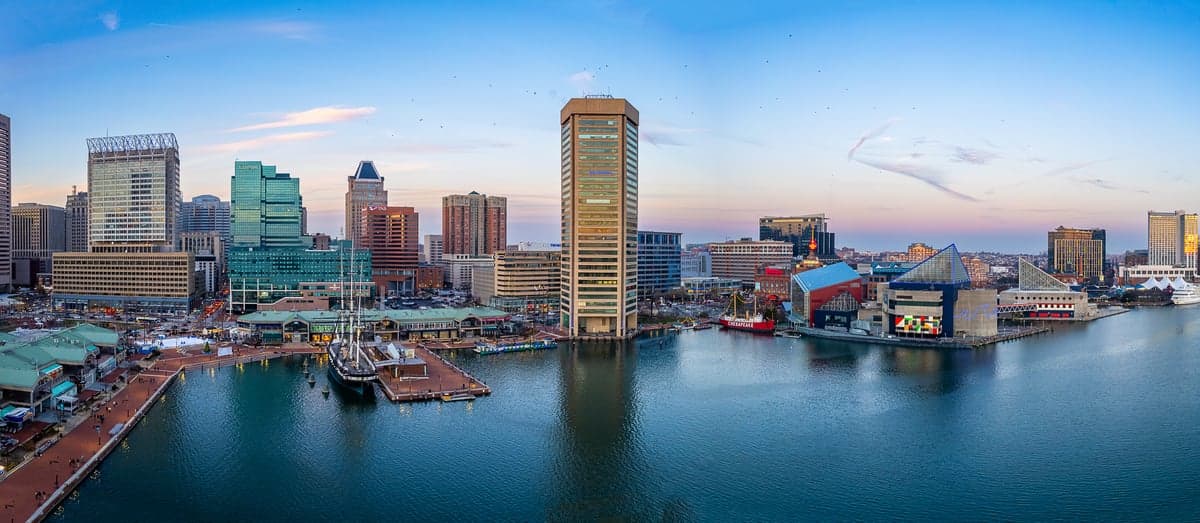
Photo: Wikipedia
Political ClimatePolitical Climate in Baltimore City County
Showing district-level results — no local-only data available.
Local Political AnalysisPolitical Analysis of Baltimore City County
Baltimore City is one of the most reliably Democratic jurisdictions in the entire country, with a Cook Partisan Voting Index (PVI) of D+31—meaning it votes 31 points more Democratic than the national average. That’s a full 14 points bluer than Maryland as a whole (D+17), and it’s been that way for decades. The city hasn’t voted for a Republican presidential candidate since 1956, and in 2024, Kamala Harris carried it with roughly 80% of the vote. The trajectory is only getting more lopsided: as the city’s population has shrunk and suburbanized, the remaining electorate has become overwhelmingly Black, progressive, and Democratic. There’s no real swing territory inside the city limits—every precinct is deep blue—but the intensity of that blue varies by neighborhood.
How it compares
Compared to Maryland’s statewide D+17 lean, Baltimore City is a Democratic stronghold that pulls the state’s overall numbers sharply left. The city’s voting patterns are more akin to Prince George’s County (D+40) than to the rest of the state. Inside the city, the political spectrum is narrow: neighborhoods like Roland Park and Mount Washington lean blue but with a moderate, fiscally cautious tilt—think higher turnout for centrist Democrats in primaries. Meanwhile, Sandtown-Winchester and Cherry Hill are among the most progressive precincts, consistently backing the most left-leaning candidates in local races. There are no red precincts in Baltimore City; the closest thing to a conservative pocket is Locust Point, where a handful of precincts occasionally vote 55-45 Democratic instead of 80-20. The real contrast is with the surrounding Baltimore County, which is D+14—still blue, but with purple suburbs like Timonium and Hereford that can swing Republican in down-ballot races. In the city, that kind of variation simply doesn’t exist.
What this means for residents
For liberal residents, the city’s deep-blue lean means their values are reflected in nearly every level of government—from the city council’s progressive criminal justice reforms to the school board’s equity-focused policies. Local elections are decided in Democratic primaries, so the real political action is in May, not November. For conservative residents, the reality is that they have virtually no representation in city hall or the state legislature districts that cover the city. A Republican voter in Fells Point will find their vote for mayor or city council has no practical impact on the outcome. That said, the city’s political uniformity can breed a certain insularity: debates about policing, taxes, and development often lack the cross-ideological friction you’d see in a swing county. The upside is policy stability—there’s no whiplash from changing administrations. The downside is that dissenting voices, whether on school choice or business regulation, can feel marginalized.
Culturally, Baltimore City’s political climate is inseparable from its identity as a majority-Black city with a deep history of labor organizing and civil rights activism. The city’s government is more interventionist than the state’s—think higher property taxes (the city’s rate is over 2.2%, nearly double the state average) and a more aggressive approach to affordable housing mandates. The state legislature in Annapolis often overrides city policies on issues like policing reform and education funding, creating a constant tension between the city’s progressive ambitions and the state’s more moderate, suburban-influenced agenda. For residents, this means local politics feels more immediate and personal than national politics—your trash pickup, school quality, and property taxes are shaped by a city council that’s uniformly Democratic but divided between establishment and progressive factions. It’s a place where a zoning board meeting can get as heated as a presidential debate, and where the real political divide isn’t left vs. right, but incrementalist vs. transformational.

State Political ClimatePolitical Climate in Maryland
State Political AnalysisPolitical Environment in the State
Maryland is a solidly Democratic state, with a Cook PVI of D+17, meaning it votes about 17 points more Democratic than the nation as a whole. That said, the state’s political reality is far more nuanced than a single number suggests, driven by a deep urban-rural split and a powerful, vote-rich suburban corridor. Over the last 20 years, the state has shifted leftward, driven by rapid growth in the Washington, D.C., suburbs and the Baltimore metro area, while rural and exurban counties have become increasingly Republican strongholds. For a conservative relocator, this means living in a state where state-level politics are dominated by Democrats, but where local control and community character vary dramatically depending on where you land.
Urban vs. rural divide
The political map of Maryland is essentially a tale of two states. The western counties — Garrett, Allegany, and Washington — are deeply conservative, with Garrett County regularly voting 70%+ Republican. The Eastern Shore, including counties like Queen Anne’s, Talbot, and Wicomico, also leans red, though with more moderate pockets around Salisbury and the Chesapeake Bay waterfront. Meanwhile, the Baltimore-Washington corridor is the engine of the state’s Democratic majority. Montgomery County and Prince George’s County, both D.C. suburbs, are among the most reliably Democratic jurisdictions in the entire country, often voting 80%+ for Democratic presidential candidates. Baltimore City is similarly dominant for Democrats. The real battlegrounds are the "collar counties" like Anne Arundel (home to Annapolis), Howard, and Frederick. Frederick County, once reliably red, has flipped blue in recent cycles as D.C. commuters push northward. A conservative moving to Maryland would find a comfortable political home in places like Hagerstown, Cumberland, or the rural parts of the Eastern Shore, but would feel increasingly isolated in the densely populated central corridor.
Policy environment
Maryland’s policy environment is shaped by its Democratic supermajority in the General Assembly and a Republican governor, Larry Hogan, who served from 2015 to 2023. Since Hogan left office, Governor Wes Moore (D) has pushed a more progressive agenda. The state has a progressive income tax structure with rates ranging from 2% to 5.75%, plus a local "piggyback" tax that can push the top combined rate over 7% in places like Baltimore City and Montgomery County. Property taxes are levied at the county level, with rates varying widely — from around 0.5% in Garrett County to over 1.1% in Baltimore City. Sales tax is 6%, with no tax on groceries or prescription drugs. Education policy is a major focus: the Blueprint for Maryland’s Future, a landmark 2021 law, is pouring billions into public schools, with an emphasis on early childhood education, teacher pay, and career pathways. Healthcare is heavily regulated, with a state-based insurance exchange and expanded Medicaid under the ACA. Election laws are among the most accessible in the country: no-excuse mail-in voting, same-day registration, and early voting are all standard. For a conservative, the tax burden and regulatory posture can feel heavy, especially compared to neighboring Virginia or Pennsylvania.
Recent policy direction
Recent legislation in Maryland points toward a continued leftward trajectory on several fronts. In 2023, the state passed the Gun Safety Act, which significantly expanded the list of "sensitive places" where carrying a firearm is prohibited, including public transit, hospitals, and establishments serving alcohol. This law is currently being challenged in court, but it represents a clear tightening of gun laws. On education and parental rights, the state has moved in the opposite direction of many red states: in 2024, the legislature passed a law requiring all public schools to adopt policies that support transgender and nonbinary students, including allowing them to use facilities matching their gender identity. Parental notification for changes in a student’s gender identity was explicitly left out, a flashpoint for conservative families. On property rights, Maryland has some of the strongest environmental regulations in the country, including the Forest Conservation Act and strict stormwater management rules, which can complicate development and renovation projects. Medical and bodily autonomy is broadly protected: abortion is legal up to viability, and the state has a shield law protecting providers who serve out-of-state patients. Voting access has been expanded, with automatic voter registration and mail-in ballot drop boxes now permanent. For a conservative relocator, the direction is clear: the state is becoming more restrictive on gun rights, more protective of LGBTQ+ rights, and more interventionist in education and land use.
Civil unrest & political movements
Maryland has a history of visible political activism, particularly in the Baltimore-Washington corridor. The 2015 Baltimore protests following the death of Freddie Gray were a major flashpoint, leading to a state of emergency and a lasting shift in local policing policy. More recently, the state has seen organized activism around abortion rights, with large rallies in Annapolis and Baltimore following the Dobbs decision. On the right, the Maryland Republican Party has been energized by grassroots movements around parental rights in education and Second Amendment advocacy. The "Parents’ Rights" movement has been particularly active in Frederick and Carroll counties, where school board meetings have seen heated debates over curriculum and library books. Immigration politics are also a live issue: Maryland is a "sanctuary" state in practice, with state law limiting cooperation between local law enforcement and federal immigration authorities. This has been a flashpoint in more conservative counties like Harford and Cecil, where local sheriffs have pushed back. Election integrity controversies have been relatively muted compared to other states, though some Republican activists have raised concerns about mail-in voting procedures. A new resident would notice that political bumper stickers and yard signs are common, especially in the suburbs, and that local news is heavily focused on state politics from Annapolis.
Projection
Over the next 5-10 years, Maryland is likely to become even more Democratic at the state level, driven by continued in-migration to the D.C. suburbs and the gradual leftward shift of once-purple counties like Frederick and Anne Arundel. The Republican Party in Maryland is increasingly concentrated in the rural west and the Eastern Shore, and its influence in statewide races is diminishing. However, the state’s high cost of living and tax burden may slow growth in the central corridor, while more affordable areas like western Maryland and the Eastern Shore could see modest population gains from conservative-leaning movers. The Blueprint for Maryland’s Future will continue to shape education policy, and the state’s environmental regulations are likely to tighten further, particularly around climate goals. For a conservative moving in now, the expectation should be that the state’s political culture will continue to feel more like a northeastern blue state than a mid-Atlantic swing state. Local control will remain the best bet for finding a community that aligns with conservative values, but statewide elections will almost certainly remain out of reach for Republicans.
For a new resident, the bottom line is this: Maryland offers a high quality of life with excellent schools, strong job markets, and beautiful natural landscapes, but it comes with a high tax burden and a political environment that is increasingly progressive at the state level. Conservatives will find welcoming communities in places like Hagerstown, Cumberland, and the Eastern Shore, but will need to accept that state-level policies on guns, education, and taxes will not align with their values. Liberals will find a comfortable home in the D.C. suburbs, Baltimore, and college towns like College Park and Towson. The key is to choose your county carefully — local politics and community character vary more than the state’s overall lean suggests.
* Values derived from national, state, county, city and local statistics and may differ in a specific area. Last updated: 2026-06-28T02:21:05.000Z
Narrative content on this page is AI-generated and may contain mistakes. Verify any details that matter before acting on them.
ReloMaps may earn a commission from affiliate links at no extra cost to you.

