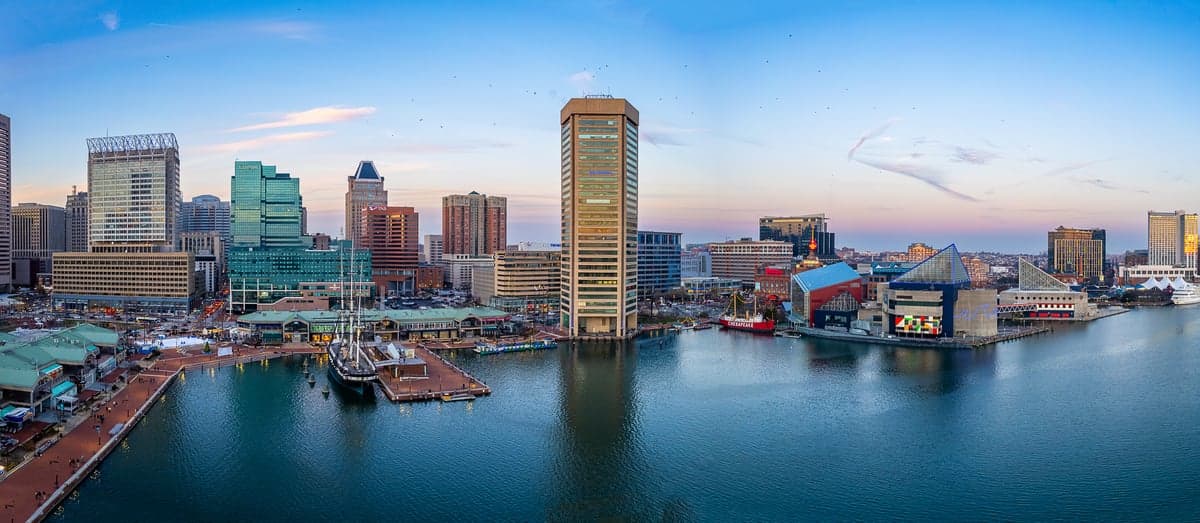
Photo: Wikipedia
Personal Sovereignty in Baltimore City County
Moderate friction. Expect trade-offs in some aspect of personal liberty and independence.
What does Personal Sovereignty tell us?
Personal Sovereignty measures your capacity for self-reliance and independence with minimal government friction. Higher scores mean fewer barriers between you and the way you want to live... but it assumes you have the space you need and good neighbors.
What does this tell us?
Personal Sovereignty measures your capacity for self-reliance and independence with minimal government friction. Higher scores mean fewer barriers between you and the way you want to live... but it assumes you have the space you need and good neighbors.
State Policy
Energy independence: Importer (8% of energy produced in-state)
Personal Liberty
Homesteading

Personal Liberty Analysis
Baltimore City County presents a uniquely constrained environment for personal sovereignty, where state-level preemption and dense urban governance create a regulatory atmosphere markedly different from Maryland's more rural jurisdictions. Residents here operate under one of the highest combined state and local tax burdens in the nation, with property tax rates in the city proper reaching approximately 2.2% of assessed value, and a state income tax that tops out at 5.75% plus a local piggyback tax of 3.2% for city residents. For a relocation audience prioritizing personal freedom and independence, the city's posture is one of active management rather than hands-off autonomy, requiring a strategic approach to navigating housing, business, and daily life choices.
Tax burden and regulatory posture for residents and small businesses
The financial landscape in Baltimore City County is defined by a heavy tax load and a dense web of local regulations. The combined state and local sales tax rate stands at 6%, but the real weight falls on property owners: Baltimore City's property tax rate of $2.248 per $100 of assessed value is the highest among Maryland's 23 counties and Baltimore City itself, more than double the rates found in nearby Carroll County or Harford County. For small business owners and independent contractors, the city imposes a personal property tax on business assets and a relatively high local income tax rate of 3.2% — the maximum allowed by state law. Zoning and permitting processes in the city are notoriously slow and layered, with the Department of Housing and Community Development requiring multiple approvals for even modest home-based businesses. In contrast, areas like Locust Point and Canton have more streamlined processes for certain commercial conversions, while neighborhoods such as Sandtown-Winchester face additional bureaucratic hurdles due to historic district overlays and community benefit agreements. The regulatory posture is decidedly interventionist, with the city government actively shaping land use, business operations, and housing development through a thicket of codes and commissions.
Self-defense rights and gun law specifics in Baltimore City County
Maryland is a "may-issue" state for concealed carry permits, and Baltimore City County operates under the strictest local interpretation of state firearms law. The county sheriff's office and Baltimore City Police Department have historically been among the most restrictive in the state when processing wear-and-carry permits, though the 2022 Supreme Court decision in New York State Rifle & Pistol Association v. Bruen forced a shift toward shall-issue standards. Even so, local application processing remains slow, and the city maintains a patchwork of local ordinances that effectively ban firearms in many public spaces, including parks, recreation centers, and government buildings. Federal Hill and Fells Point have active neighborhood patrols and community safety groups, but open carry is effectively prohibited by local custom and police practice. For residents who prioritize self-defense rights, the city's environment is adversarial: gun ranges are scarce, with only a handful of indoor facilities like the Baltimore County Gun Range just over the county line, and private firearm sales are subject to state-mandated background checks and a 7-day waiting period. The regulatory burden is heavy enough that many gun owners choose to store firearms outside the city limits or maintain memberships at ranges in less restrictive neighboring counties like Harford County or Carroll County.
Self-reliance and homesteading viability: lot sizes, zoning, and off-grid feasibility
Baltimore City County is overwhelmingly urban and suburban, making traditional homesteading or off-grid living nearly impossible within its borders. The median lot size for single-family homes in the city is approximately 0.05 acres — essentially a row house footprint — and zoning codes prohibit keeping livestock, beekeeping, or substantial vegetable gardens in most residential districts. The city's Department of Planning enforces strict building codes that require grid-tied electrical systems, municipal water and sewer connections, and adherence to the International Residential Code, effectively outlawing off-grid infrastructure like composting toilets, rainwater catchment systems, or solar arrays that are not grid-interactive. Neighborhoods like Hampden and Mount Washington have some larger lots with backyard gardens, but even these are subject to city health department regulations on composting and animal keeping. For those seeking genuine self-reliance, the viable option is to look to the county's northern and western fringes — areas like Pikesville or Owings Mills — where lot sizes occasionally reach half an acre and zoning is slightly more permissive, though still far from rural homesteading standards. The city's regulatory environment actively discourages independence from municipal infrastructure, making Baltimore City County one of the least homestead-friendly jurisdictions in the state.
Personal liberties: parental rights, medical autonomy, speech, and property
On personal liberties, Baltimore City County reflects Maryland's generally progressive state-level framework, with some local variations. Parental rights in education are limited: the city's school board, appointed by the mayor and state board of education, has implemented policies on curriculum and student health that leave parents with little formal recourse beyond school choice or private education. Medical autonomy is constrained by state law — Maryland has strict certificate-of-need regulations that limit the opening of new healthcare facilities, and the city's health department enforces vaccine mandates for school attendance with few exemptions. Free speech is protected under the First Amendment, but the city has enacted noise ordinances and parade permit requirements that can be used to restrict public demonstrations, particularly in high-traffic areas like the Inner Harbor and Charles Village. Property rights are heavily circumscribed: the city's historic preservation commission has authority over exterior modifications in dozens of designated districts, and the rental licensing program requires annual inspections and fees for landlords. For a conservative-leaning individual or family, the cumulative effect is a jurisdiction where personal autonomy is consistently secondary to collective regulation, with the most freedom found in the city's less regulated outer neighborhoods or by crossing into adjacent counties.
Overall, Baltimore City County ranks among the most sovereignty-constrained jurisdictions in Maryland, comparable to Montgomery County or Prince George's County in its regulatory density and tax burden. For a relocation audience that prioritizes personal freedom, the city offers a trade-off: dense urban amenities and a vibrant cultural scene in exchange for limited autonomy in housing, self-defense, education, and property use. Those who can navigate the bureaucratic landscape may find pockets of relative independence in neighborhoods like Medfield or Lauraville, where larger lots and less restrictive zoning offer modest room for self-reliance. But for most families and individuals seeking genuine personal sovereignty, the surrounding counties — particularly Carroll, Harford, and northern Baltimore County — provide a far more permissive environment with lower taxes, fewer regulations, and greater respect for individual choice.

* Values derived from national, state, county, city and local statistics and may differ in a specific area. Last updated: 2026-06-28T02:21:05.000Z
Narrative content on this page is AI-generated and may contain mistakes. Verify any details that matter before acting on them.
ReloMaps may earn a commission from affiliate links at no extra cost to you.

