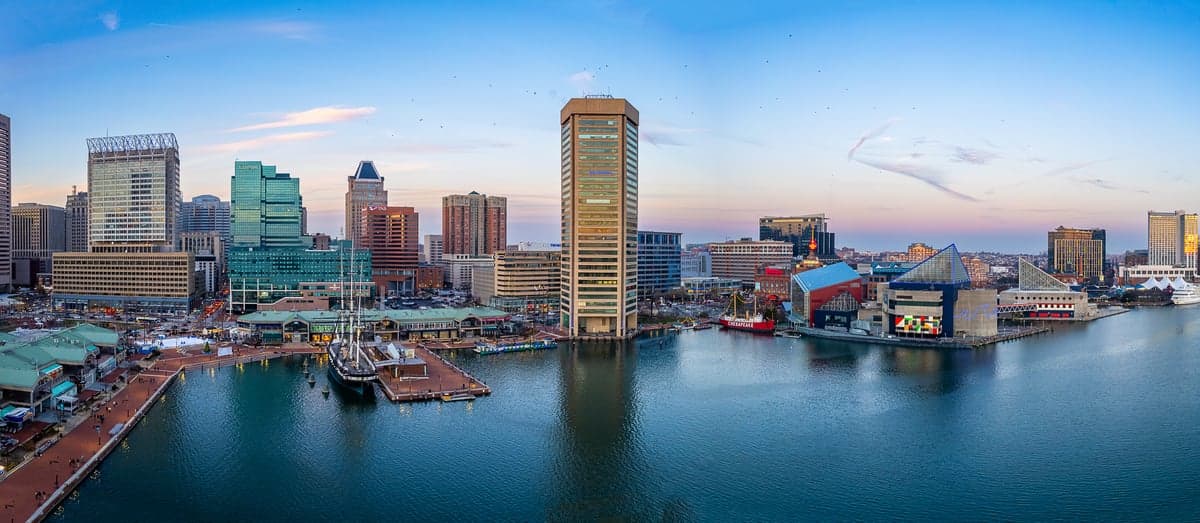
Photo: Wikipedia
Demographics of Baltimore City County
Affluence Level in Baltimore City County
A below-average socioeconomic profile. Incomes, home values, and educational attainment trail the U.S., with higher poverty and unemployment.
People of Baltimore City County
Baltimore City County, Maryland, is a dense, majority-Black urban core of 577,193 residents, characterized by a deeply rooted African American cultural identity, a modest but growing Hispanic population, and a smaller White population that has declined significantly since the mid-20th century. With only 4.7% foreign-born, the city is less immigrant-heavy than many East Coast peers, yet its neighborhoods reflect distinct waves of European, African American, and more recent Latino and Asian settlement. The city’s population has shrunk by roughly one-third since its 1950 peak, but recent stabilization hints at a slow, uneven revival driven by reinvestment in select districts.
Settlement & growth (pre-1960)
Before European colonization, the area now known as Baltimore City was inhabited by the Susquehannock and Piscataway peoples, who used the Patapsco River for fishing and trade. English colonists from the Calvert family’s Maryland colony established the Port of Baltimore in 1706, and the city was formally founded in 1729. The early economy centered on tobacco and shipping, drawing English, Scots-Irish, and German settlers to neighborhoods like Fells Point and Locust Point, where shipbuilding and maritime trades flourished.
The 19th century brought massive Irish immigration during the 1840s Potato Famine, with Irish laborers settling in Fells Point and Federal Hill, working on the docks and the Baltimore & Ohio Railroad. German immigrants followed in the 1850s-1880s, clustering in Highlandtown and Patterson Park, establishing breweries, bakeries, and churches that defined these neighborhoods for generations. By 1900, Baltimore was a major industrial port, attracting Italian immigrants to Little Italy and Polish immigrants to Fells Point and Canton, where they worked in canneries, steel mills, and shipyards.
The Great Migration (1910-1970) transformed Baltimore’s demographics. Hundreds of thousands of African Americans from the rural South—especially Virginia, North Carolina, and South Carolina—arrived seeking industrial jobs in steel, shipbuilding, and manufacturing. They settled in Sandtown-Winchester, Upton, and Cherry Hill, creating a vibrant Black cultural and economic hub along Pennsylvania Avenue. By 1950, Baltimore’s population peaked at 949,708, with African Americans making up about 24% of residents. White flight to suburbs like Dundalk and Towson began accelerating after World War II, fueled by highway construction and federal housing policies that redlined Black neighborhoods.
Modern era (post-1965)
The 1965 Hart-Cellar Act had a modest impact on Baltimore compared to gateway cities like New York or Los Angeles. The city’s foreign-born share remains low at 4.7%, but new immigrant groups have reshaped specific enclaves. Hispanic residents—now 7.9% of the population—began arriving in significant numbers in the 1990s, primarily from Mexico, Central America, and Puerto Rico. They concentrated in Highlandtown and Patterson Park, where Latino-owned bodegas, restaurants, and churches now line Eastern Avenue. East and Southeast Asian communities (1.7% of the population) include Vietnamese and Korean families, many of whom settled in Charles Village and Waverly, often running small businesses. Indian subcontinent residents (0.8%) are a smaller but growing presence, with families drawn to professional jobs in healthcare and tech, living in Mount Washington and Roland Park.
The dominant demographic story since 1965 is the dramatic shift in the Black-White balance. By 1970, African Americans were 47% of the population; by 2020, they were 59.3%, while the White share fell from 53% to 26.2%. This reflects both continued White suburbanization and the arrival of Black families from other Rust Belt cities. The city’s population decline—from 905,787 in 1970 to 577,193 today—has been driven by deindustrialization, crime, and school quality concerns, though recent years show a slight stabilization. Neighborhoods like Canton and Federal Hill have gentrified since the 2000s, attracting younger White and Asian professionals, while historically Black areas like Sandtown remain economically distressed.
The future
Baltimore’s population is projected to continue a slow decline or stabilize near 550,000-570,000 over the next decade, barring a major economic turnaround. The city is becoming slightly more diverse: the Hispanic share is expected to grow to 10-12% by 2035, driven by continued immigration and higher birth rates, with new Latino communities forming in Brooklyn and Cherry Hill. East and Southeast Asian populations may grow modestly as Johns Hopkins University and the medical complex attract international students and professionals, particularly in Charles Village and Mount Vernon. The Black population share is likely to remain stable or decline slightly as some middle-class Black families move to Baltimore County suburbs like Randallstown and Owings Mills.
The city’s cultural identity is evolving from a stark Black-White binary to a more multiethnic, though still predominantly African American, character. Gentrification in waterfront neighborhoods is creating tension between long-term Black residents and newer, wealthier arrivals. The next 10-20 years will likely see continued reinvestment in the Inner Harbor, Hampden, and Remington, while outlying areas like Park Heights and West Baltimore struggle with depopulation and disinvestment. For a mover, this means a city with deep historical roots, strong neighborhood identities, and significant economic disparities—a place where opportunity is highly location-dependent.
Baltimore City County is becoming a smaller, more diverse, and more polarized urban core—rich in culture and history, but still grappling with the legacy of deindustrialization and racial segregation. For someone moving in now, the city offers affordable housing, a vibrant arts scene, and proximity to Washington, D.C., but requires careful neighborhood selection and a tolerance for the challenges of a post-industrial city in transition.

* Values derived from national, state, county, city and local statistics and may differ in a specific area. Last updated: 2026-06-28T02:21:05.000Z
Narrative content on this page is AI-generated and may contain mistakes. Verify any details that matter before acting on them.
ReloMaps may earn a commission from affiliate links at no extra cost to you.

