 Popular
Photo: Wikipedia
Demographics of Marquette, MI
Affluence Level in Marquette, MI
A middle-class area roughly in line with national averages across income, home values, education, and employment.
People of Marquette, MI
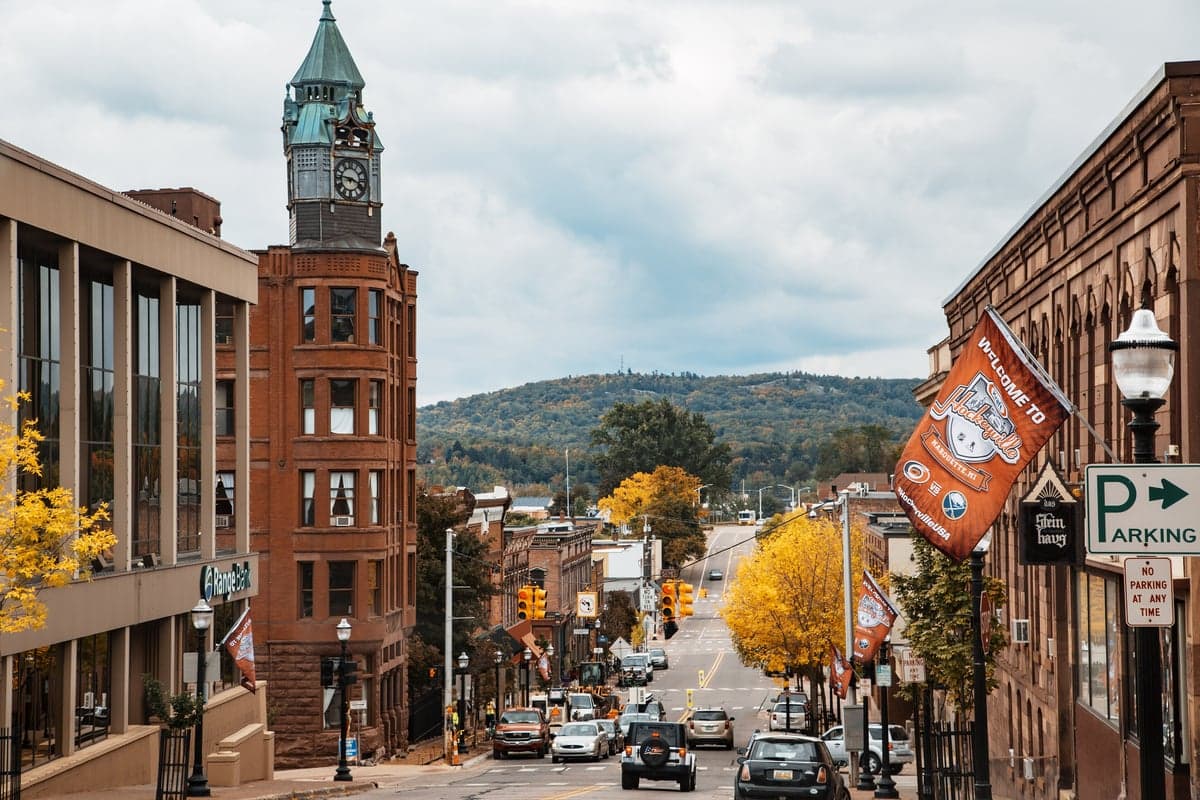
Marquette, Michigan, is a city of roughly 20,700 residents that blends a historic industrial working-class identity with a growing college-educated professional population, anchored by Northern Michigan University. The city is notably less diverse than the national average, with a population that is 88.4% white and only 1.6% foreign-born, though it has seen modest increases in Hispanic and Black residents in recent decades. Its character is shaped by a strong sense of place—a compact, walkable downtown on the Lake Superior shore—and a cultural identity that balances its Finnish, Italian, and Cornish immigrant roots with a newer wave of outdoor-recreation and healthcare-sector transplants.
How the city was settled and grew
Marquette’s original population was drawn by the iron ore boom of the 1840s and 1850s, when the discovery of rich deposits in the Marquette Iron Range turned a remote fur-trading outpost into a mining and shipping hub. The first major wave of settlers were Cornish miners—known locally as "Cousin Jacks"—who arrived in the 1850s and built homes in the South Marquette neighborhood, near the original mines and the ore docks. A second wave of Finnish immigrants began arriving in the 1880s, drawn by mining and lumber jobs; they concentrated in the Pioneer Park and West End areas, where Finnish-language churches, saunas, and cooperative stores still mark the landscape. Italian immigrants followed in the early 1900s, settling in the North Marquette neighborhood near the Cleveland-Cliffs iron furnace, while a smaller wave of French-Canadian and German families spread across the city’s east side. By 1920, Marquette was a majority-immigrant city, with over 40% of residents foreign-born, overwhelmingly from Northern and Southern Europe. The city’s population peaked at roughly 22,000 in the 1960s, then declined as mining mechanization reduced labor demand.
Modern era (post-1965)
After the 1965 Immigration and Nationality Act, Marquette saw very little new foreign immigration compared to larger U.S. cities. The foreign-born share today is just 1.6%, and the city’s racial composition has shifted only modestly. The Black population grew from under 1% in 1970 to 3.2% today, concentrated in the East Marquette and South Marquette neighborhoods, partly driven by students and faculty at Northern Michigan University. The Hispanic population rose to 2.8%, with families settling in the West End and near the Marquette Mall area, often working in healthcare, hospitality, and construction. East and Southeast Asian residents (0.4%) and Indian-subcontinent residents (0.2%) are a very small presence, mostly tied to university positions or medical jobs at UP Health System. The most significant demographic shift has been domestic: a steady in-migration of college-educated professionals from downstate Michigan and the Midwest, drawn by outdoor recreation, lower housing costs relative to the Lower Peninsula, and remote-work flexibility. These newcomers have concentrated in the Downtown and Presque Isle neighborhoods, driving up home prices and reshaping the city’s cultural identity toward a more amenity-oriented, liberal-leaning character.
The future
Marquette’s population is projected to grow slowly—perhaps 5-10% over the next two decades—driven by continued domestic in-migration of remote workers and retirees, rather than foreign immigration. The city is becoming slightly more diverse, but from a very low base: the Hispanic and Black shares may each reach 5-6% by 2040, while the white share will likely remain above 80%. The most notable trend is the geographic concentration of newcomers: the Downtown and Presque Isle areas are becoming denser and more expensive, while older neighborhoods like South Marquette and Pioneer Park are seeing modest reinvestment but still house a larger share of lower-income and longer-term residents. The city’s cultural identity is evolving from a quiet, blue-collar mining town into a regional hub for healthcare, education, and tourism—a shift that attracts younger, more liberal residents but also creates tension with the area’s historically conservative, resource-extraction roots. For someone moving in now, Marquette offers a stable, safe, and increasingly amenity-rich small city, but with limited racial or ethnic diversity and a housing market that is tightening for middle-income buyers.
In short, Marquette is becoming a more educated, more professional, and slightly more diverse place, but its population story remains overwhelmingly one of domestic migration and a slowly aging white base. The city’s future is less about new immigrant waves and more about who chooses to move here from elsewhere in the Midwest—and whether the local economy can sustain enough housing and jobs to keep them.

* Values derived from national, state, county, city and local statistics and may differ in a specific area. Last updated: 2026-06-16T09:16:45.000Z
Narrative content on this page is AI-generated and may contain mistakes. Verify any details that matter before acting on them.
ReloMaps may earn a commission from affiliate links at no extra cost to you.

