Photo: Wikipedia
Political ClimatePolitical Climate in Marana, AZ
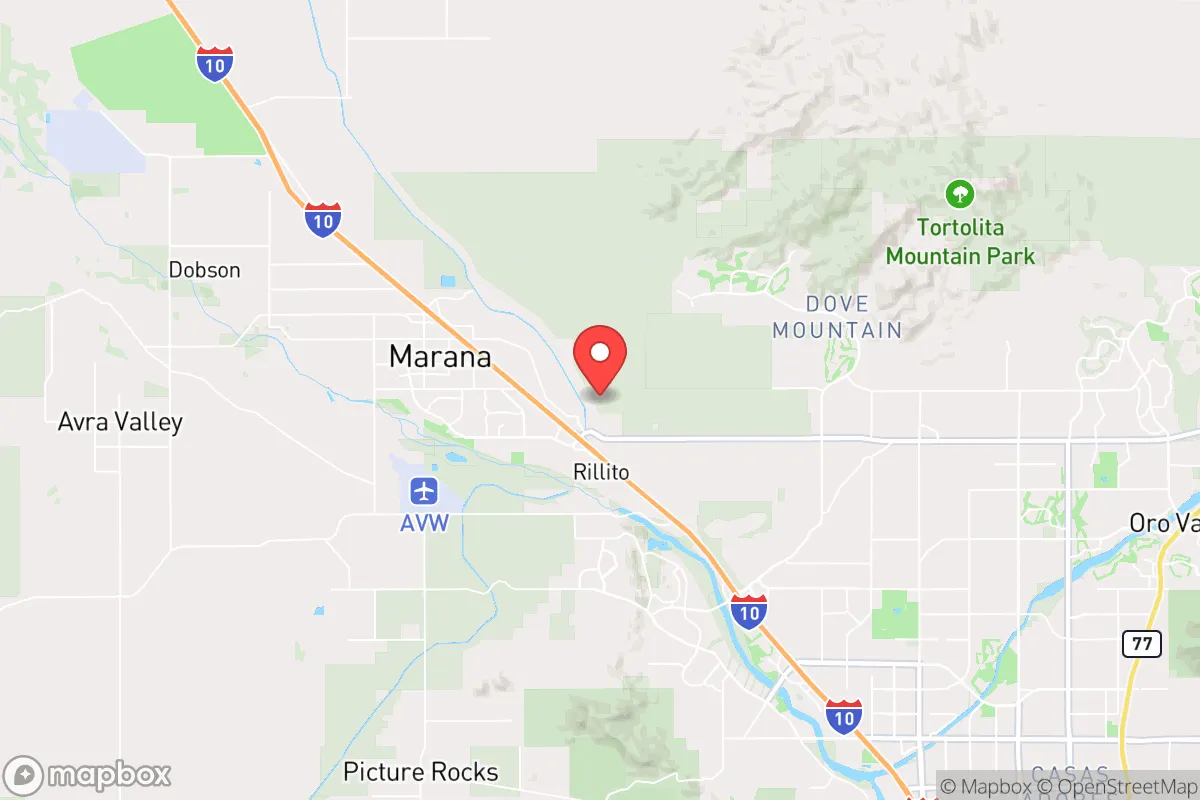
District shown is the primary district for this city’s centroid. Cities may span multiple districts.
Local Political AnalysisPolitical Analysis of Marana, AZ
Marana, Arizona, sits in a fascinating political sweet spot, but if you’ve been around here long enough, you know the winds are shifting. The Cook PVI rating of EVEN tells you the town is a true toss-up, but that’s a recent development. For decades, Marana was a reliably conservative stronghold, a place where folks valued personal responsibility and wanted the government to stay out of their business. Now, with explosive growth from Tucson and Phoenix spillover, you’re seeing a real tug-of-war between that old-school, limited-government mindset and a more progressive, interventionist wave that’s creeping in from the cities.
How it compares
To understand Marana’s political climate, you have to look at its neighbors. Head south into Tucson, and you’re in a deep-blue urban core where government programs and progressive social policies are the norm. Drive north to Oro Valley, and you’ll find a more reliably conservative, retiree-heavy population that leans hard into fiscal restraint and Second Amendment protections. Marana is the buffer zone. It’s where you get the suburban growth without the heavy-handed city regulations, but that’s changing. The new developments along the I-10 corridor are bringing in families from California and other high-tax states who, frankly, don’t always share the local values of low taxes and minimal interference. You can feel the tension at town council meetings, where debates over zoning and public spending are increasingly split between the “keep it small” crowd and the “we need more services and oversight” faction.
What this means for residents
For a long-time resident, the biggest red flag is the slow creep of government overreach into everyday life. We’re seeing more proposals for strict HOA-style regulations on property use, talk of “equity” mandates in local contracting, and a push for higher impact fees that fund pet projects rather than core infrastructure. The real concern is that Marana’s identity as a place where you can live your life without a bureaucrat looking over your shoulder is at risk. If the progressive shift continues, you can expect more restrictions on everything from water usage to short-term rentals, and a tax base that gets funneled into social programs instead of roads and public safety. The local school board is another battleground, with parents fighting to keep curriculum focused on fundamentals and parental rights, not ideological indoctrination.
Culturally, Marana still holds onto its Western, self-reliant roots. You’ll see more pickup trucks than Teslas, and the annual rodeo is a bigger deal than any political rally. But the policy distinctions are where the rubber meets the road. The town has resisted adopting Tucson’s more aggressive environmental regulations and has kept its police department well-funded, which is a relief to those who value public safety over social experiments. The long-term trajectory depends on whether the new arrivals assimilate into the local culture or try to remake Marana in the image of the places they left behind. For now, it’s a fight worth watching, and one that every resident who values personal freedom should be paying close attention to.

State Political ClimatePolitical Climate in Arizona
State Political AnalysisPolitical Environment in the State
Arizona has transformed from a reliably Republican stronghold into a genuine battleground state over the past two decades, with its partisan lean shifting from a comfortable +8-point GOP advantage in 2000 to a razor-thin margin where Democrats now regularly compete. The state’s 11 electoral votes flipped blue for Joe Biden in 2020 by just 10,457 votes, and the 2024 cycle saw Donald Trump narrowly reclaim it by roughly 2 points, underscoring a deeply divided electorate. The dominant coalitions are a fast-growing suburban and exurban population—many from blue states—clashing with a deeply conservative rural base and a rapidly mobilizing Latino electorate, creating a volatile mix that makes Arizona one of the most politically unpredictable states in the country.
Urban vs. rural divide
The political map of Arizona is a study in stark contrasts. Maricopa County, home to Phoenix and its sprawling suburbs, is the epicenter of the state’s swing dynamics—it cast about 60% of all votes in 2024 and has trended leftward as transplants from California and Illinois settle in places like Chandler, Gilbert, and Scottsdale. These once-reliable GOP suburbs now lean purple, with Gilbert’s state legislative districts flipping to Democratic control in 2022. Meanwhile, Tucson (Pima County) is a Democratic stronghold, delivering margins of +15 to +20 points for the party, driven by the University of Arizona and a growing progressive base. The rural counties—Mohave (Kingman), Yavapai (Prescott), and Navajo (Holbrook)—vote Republican by 30 to 40 points, powered by mining, ranching, and a libertarian-leaning culture. The wildcard is Pinal County, a fast-growing exurban corridor between Phoenix and Tucson that voted +11 for Trump in 2024 but is shifting as new subdivisions fill with families fleeing California—many of whom bring moderate or even left-leaning voting habits.
Policy environment
Arizona’s policy landscape is a mixed bag for conservatives. The state has a flat income tax rate of 2.5%, enacted via Proposition 139 in 2022, which is among the lowest in the nation and a clear win for fiscal freedom. Property taxes are relatively low, with an effective rate around 0.62% of home value, and there is no estate tax. However, the regulatory posture is uneven: the state has a right-to-work law and no state-level minimum wage above the federal floor, but local governments in Phoenix and Tucson have imposed their own wage and paid-leave mandates. On education, Arizona was a pioneer in school choice—the Empowerment Scholarship Account (ESA) program, expanded in 2022, gives nearly every family access to public funds for private or homeschool expenses, a model that conservatives elsewhere envy. But the state also saw a major push for progressive education policies in 2023, with the Democratic governor vetoing bills that would have restricted critical race theory and transgender athlete participation in schools. Election laws have been a flashpoint: the 2021 audit of Maricopa County’s ballots (the “Cyber Ninjas” audit) was a national story, and the legislature passed a 2022 law requiring proof of citizenship for voter registration, which is currently tied up in federal court. Healthcare policy is largely market-driven, but the state expanded Medicaid under Obamacare in 2013, a decision that still rankles many conservatives.
Trajectory & freedom
On the freedom front, Arizona is a tale of two trends. The good news: the state passed a constitutional carry law in 2010, allowing permitless concealed carry, and has preempted local gun ordinances, so your Second Amendment rights are solid statewide. Parental rights got a boost in 2023 with a law requiring schools to notify parents of any changes to a student’s mental or physical health (including gender identity), though it’s being challenged in court. Property rights are generally strong, with no state-level rent control and a robust “right to farm” law protecting agricultural operations. The bad news: the state has seen a steady creep of government overreach in the name of “public health.” During COVID, Governor Doug Ducey (a Republican) imposed a statewide stay-at-home order and mask mandates in schools, which many conservatives saw as an overstep. More recently, the Democratic governor Katie Hobbs has used executive orders to expand voting access and restrict “conversion therapy” for minors, moves that critics argue bypass the legislature. The biggest red flag for freedom-minded folks is the growing influence of the Phoenix city council, which has passed sanctuary city policies (limiting cooperation with ICE) and a “clean elections” public financing system that tilts toward progressive candidates. The state’s trajectory is toward a more polarized, less predictably free environment—you’ll have more liberty in rural Yavapai County than in urban Maricopa.
Civil unrest & political movements
Arizona has been a hotbed of political activism on both sides. The 2020 election aftermath saw massive protests in Phoenix, with Trump supporters gathering at the state capitol and counter-protests from groups like Indivisible. The “Stop the Steal” movement was particularly strong here, fueled by the Maricopa County audit and ongoing distrust of the county’s electronic voting machines. On the left, the Dreamers movement has deep roots in Arizona, with regular rallies in Tucson and Phoenix pushing for immigration reform. Immigration politics are front and center: the state’s 2010 SB 1070 law (the “show me your papers” law) was a national flashpoint, and while parts were struck down, the issue remains raw. In 2023, Governor Hobbs ordered the removal of the shipping-container border wall near Yuma, a move that drew both praise and fury. There have been no major secession or nullification movements, but the Green Party and Libertarian Party have a visible presence, especially in Flagstaff and Sedona. Election integrity remains the most divisive issue—many conservatives in rural counties like Mohave have called for hand-counting ballots, and the state legislature has considered bills to ban drop boxes. A new resident will notice the “I Voted” stickers are a point of pride, but the underlying tension is palpable, especially in the months before an election.
Projection
Over the next 5-10 years, Arizona is likely to become more competitive, not less. The demographic trends are clear: the state is adding about 100,000 new residents annually, with the bulk coming from California, Illinois, and other blue states. These newcomers tend to be younger, more diverse, and more moderate-to-liberal on social issues, even if they’re fiscally conservative. The Latino population, now about 32% of the state, is growing and voting increasingly Democratic, especially among younger voters. This will likely push Maricopa County further into the purple column, and could flip Pinal County blue within a decade. The rural counties will remain deeply red, but their share of the vote is shrinking. The wildcard is the state’s independent voters—about 34% of the electorate—who lean slightly right but are volatile. If the GOP can hold the line on school choice and tax cuts while avoiding cultural wars that alienate suburban women, they can keep Arizona competitive. But if the progressive wing of the Democratic Party continues to push policies like rent control, sanctuary cities, and gender ideology in schools, they risk losing the moderate independents who swung to Biden in 2020. Realistically, expect Arizona to be a toss-up state for the foreseeable future, with control of the legislature and governor’s office flipping every few cycles.
For a new resident, the bottom line is this: Arizona offers a low-tax, pro-school-choice environment with strong Second Amendment protections, but you’ll need to pick your county carefully. If you want maximum freedom and minimal government overreach, head to Prescott or Kingman. If you’re moving to Chandler or Gilbert, expect a more politically mixed community where local elections matter more than national ones. The state is not a conservative paradise—it’s a battleground where your vote actually counts, and where the culture war is fought in school board meetings and county commission chambers. Come for the weather and the taxes, but stay engaged if you want to keep it free.
* Values derived from national, state, county, city and local statistics and may differ in a specific area. Last updated: 2026-05-01T09:49:50.000Z
Narrative content on this page is AI-generated and may contain mistakes. Verify any details that matter before acting on them.
ReloMaps may earn a commission from affiliate links at no extra cost to you.

