Quality of Life in Maine
A livable area that tracks near national norms for affordability, walkability, and neighborhood health.
What does Quality of Life tell us?
Quality of Life measures an area by evaluating factors like cost of living, nearby amenities, country club access, airport proximity, socioeconomic signals and neighborhood character. For large states, this is a general average — quality of life can vary dramatically between metro areas, suburbs, and rural communities within the same state.
What does this tell us?
Quality of Life measures an area by evaluating factors like cost of living, nearby amenities, country club access, airport proximity, socioeconomic signals and neighborhood character. For large states, this is a general average — quality of life can vary dramatically between metro areas, suburbs, and rural communities within the same state.
Cost of Living
6% below national average
94%
The Real Cost of Living in Maine for 2026
| Tier | Individual | Family (4) |
|---|---|---|
| Survival | $17k | $33k |
| Comfortable | $52k | $76k |
| Luxury | $130k+ | $201k+ |
| Elite (Top 5%) | $153k+ | $238k+ |
Quality-of-Life Analysis
Maine offers a remarkably broad spectrum of quality-of-life options, from dense urban centers to remote coastal villages and vast inland wilderness, each attracting a distinct type of resident. The state’s overall cost of living index sits at 94 (100 = U.S. average), with a median home value of $266,400 and median rent of $1,084, but these averages mask a wide range between the state’s most expensive enclaves and its most affordable rural areas. The average commute of 24.4 minutes is notably shorter than the national average, reflecting the state’s generally slower pace and smaller scale, even in its largest cities. Whether someone is seeking a vibrant city lifestyle, a quiet college town, or off-grid solitude, Maine provides a distinct option for each preference.
Major metros
Maine’s urban core is centered on the Greater Portland area, which is the state’s only significant metropolitan region. Portland itself is a compact coastal city of roughly 68,000 residents, known for its nationally acclaimed food scene, craft breweries, and walkable Old Port district. It has a distinctly creative and progressive identity, with a strong concentration of tech startups, advertising agencies, and healthcare employers like Maine Medical Center. The city is dense by Maine standards, with a mix of historic brick buildings and new apartment construction, and it attracts young professionals, empty nesters, and culinary tourists. Lewiston and Auburn, the twin cities about 35 miles north of Portland, form the state’s second-largest urban area. Lewiston has a more industrial and working-class character, with a large Somali immigrant community and a lower cost of living than Portland. It offers a grittier, more affordable urban option, anchored by Bates College and a growing arts scene. Bangor, the largest city in eastern Maine, serves as a regional hub for healthcare, education, and retail, with a population around 32,000. It has a quieter, more family-oriented vibe than Portland and is the gateway to the North Woods and Acadia National Park. Augusta, the state capital, is a small government town of about 19,000, with a slow pace and limited nightlife, appealing primarily to state employees and those seeking a low-key, affordable city experience.
Mid-size cities & college towns
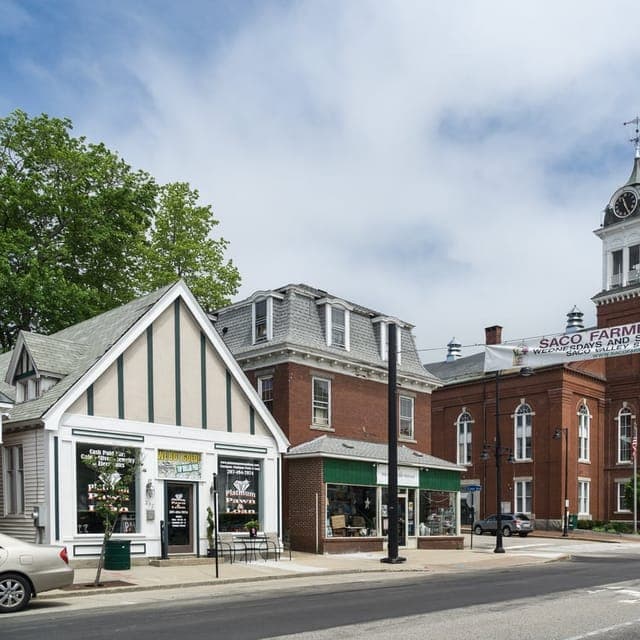
Maine’s mid-size cities and college towns offer a balance of amenities and affordability that attracts families, academics, and remote workers. Brunswick, home to Bowdoin College, is a classic New England college town with a walkable downtown, a strong local food scene, and a historic residential feel. It has a median home value around $350,000, higher than the state average, reflecting its desirability among professionals commuting to Portland 30 minutes south. Orono, adjacent to Bangor, is dominated by the University of Maine, the state’s flagship public university. It has a youthful, seasonal energy with a low cost of living and ample outdoor recreation along the Penobscot River. Waterville, home to Colby College, has undergone a significant revitalization in recent years, with new restaurants, a renovated opera house, and a growing arts district. It offers a more affordable alternative to Brunswick, with median home values around $200,000. Biddeford and Saco, just south of Portland, are former mill towns experiencing a revival, with a growing population of young families and artists drawn by lower housing costs and proximity to the coast. Biddeford’s downtown has seen a surge of new breweries and restaurants, while Saco offers more suburban, family-oriented living with good schools.
Small towns & rural areas
For those seeking solitude, natural beauty, and a slower pace, Maine’s small towns and rural regions offer some of the most distinctive living options in the country. Camden and Rockport, on the midcoast, are picturesque harbor towns with a strong tourism economy, expensive real estate, and a concentration of second homes. They attract retirees, wealthy out-of-staters, and those in the hospitality industry. Rangeley, in the western mountains, is a remote town of about 1,200 people surrounded by lakes and ski areas, appealing to outdoor enthusiasts willing to trade convenience for wilderness access. Millinocket, near Baxter State Park and Mount Katahdin, is a former mill town with a population under 4,500 and some of the cheapest housing in the state — median home values below $100,000. It attracts those seeking extreme affordability and proximity to world-class hiking and hunting, but it lacks many services and has a struggling local economy. Eastport, the easternmost city in the U.S., is a tiny coastal community of about 1,300 on the Canadian border, with a strong sense of isolation and a tight-knit, self-reliant population. The rural interior, including Piscataquis County and Aroostook County, offers vast tracts of forestland, low population density, and a farming and logging economy, attracting those who value privacy and self-sufficiency above all else.
Luxury vs. affordable living
The luxury end of Maine’s housing market is concentrated along the southern and midcoast, particularly in Kennebunkport, Cape Elizabeth, Falmouth, and Northeast Harbor on Mount Desert Island. These areas feature waterfront estates, historic mansions, and second homes for wealthy seasonal residents, with median home values frequently exceeding $700,000 and often topping $1 million. Kennebunkport, the summer home of the Bush family, epitomizes old-money coastal luxury. At the opposite end of the spectrum, the most affordable areas are found in the state’s interior and northern regions. Lincoln, Dover-Foxcroft, and Fort Kent offer median home values well below $150,000, with many properties available for under $100,000. These towns have limited job opportunities and services but provide a low cost of living that can be attractive to retirees on fixed incomes, remote workers, or those willing to commute longer distances. The cost-of-living spread across the state is dramatic: a waterfront home in Kennebunkport might cost 10 times as much as a comparable house in Millinocket, reflecting the extreme variation in desirability and economic opportunity.
The practical reality is that Maine offers a genuine choice between tiers of living, but each comes with trade-offs. Portland and its suburbs provide urban amenities, cultural density, and the strongest job market, but at a cost of living that is significantly above the state average. The mid-size cities and college towns offer a middle ground with good schools, walkable downtowns, and reasonable commutes, appealing to families and professionals. The small towns and rural areas deliver unmatched natural beauty, privacy, and low housing costs, but often at the expense of job opportunities, healthcare access, and services. The average commute of 24.4 minutes reflects the fact that most Mainers live within reasonable driving distance of a regional hub, but those in the most remote areas may face longer drives for basic needs. Ultimately, the choice depends on what a person values most — urban energy, community connection, or wilderness solitude — and how much they are willing to pay for it.

Crime in Maine
Lower crime rates than 81% of comparable U.S. locations.
Violent CrimeViolent Crime Analysis
Property CrimeProperty Crime Analysis
Crime Analysis
Maine is consistently one of the safest states in the U.S., with a violent crime rate of 93.4 per 100,000 residents — roughly one-fifth the national average — and a property crime rate of 946.6 per 100,000, well below the national figure of about 1,954. The state’s rural character, low population density, and tight-knit communities contribute to a baseline of security that many residents cite as a primary reason for living here. However, safety varies sharply between remote towns and the state’s few urban centers, where progressive criminal justice policies have drawn scrutiny from public safety advocates.
Crime in context
Maine’s violent crime rate of 93.4 per 100,000 is the lowest in New England and among the lowest nationally, according to FBI data. Property crime at 946.6 per 100,000 is also well below the national benchmark. These figures place Maine in a tier shared with Vermont and New Hampshire, though Maine’s property crime rate is slightly higher than its neighbor to the west. The state’s largest city, Portland, reports a violent crime rate of roughly 250 per 100,000 — still moderate by national standards but nearly three times the state average. Lewiston and Bangor also report elevated rates relative to the rest of Maine, driven largely by drug-related offenses and property crime. In contrast, towns like Cumberland, Falmouth, and Yarmouth consistently report crime rates near zero for violent offenses and well under 500 per 100,000 for property crime.
What residents experience
For most Mainers, crime is not a daily concern. Property crime — primarily theft from vehicles and burglaries of seasonal homes — is the most common offense residents encounter. Vehicle break-ins are especially prevalent in coastal tourist towns like Bar Harbor, Kennebunkport, and Old Orchard Beach during summer months, when transient populations swell. Drug-related crime, particularly linked to the opioid crisis, concentrates in Portland, Lewiston, and Augusta, where law enforcement agencies have struggled with repeat offenders cycling through a justice system that prioritizes diversion and treatment over incarceration. Critics argue that progressive district attorneys in Cumberland County (Portland) and Androscoggin County (Lewiston) have contributed to a perception of leniency, with some offenders facing minimal consequences for theft or drug possession, eroding public confidence and potentially emboldening property criminals. Rural counties like Washington and Piscataquis report very low violent crime but face challenges with domestic violence and underreporting due to limited law enforcement presence.
Neighborhood-level variation is pronounced in Maine’s few urban areas. In Portland, the Parkside and Bayside neighborhoods see higher rates of theft and drug activity, while the West End and Munjoy Hill remain relatively safe. In Lewiston, the downtown core and Tree Streets area account for a disproportionate share of police calls, while suburban Auburn and Lisbon offer markedly lower crime rates. For families and retirees seeking the safest environments, the Portland suburbs of Scarborough, Gorham, and Cape Elizabeth combine low crime with strong schools and community policing. Overall, Maine’s safety profile is excellent by national standards, but prospective residents should weigh the trade-offs between urban amenities and the progressive justice policies that accompany them, versus the near-zero crime rates of the state’s smaller towns and coastal enclaves.
Top Cities for Quality of Life in Maine


* Values derived from national, state, county, city and local statistics and may differ in a specific area. Last updated: 2026-08-02T00:14:56.000Z
Narrative content on this page is AI-generated and may contain mistakes. Verify any details that matter before acting on them.
ReloMaps may earn a commission from affiliate links at no extra cost to you.

