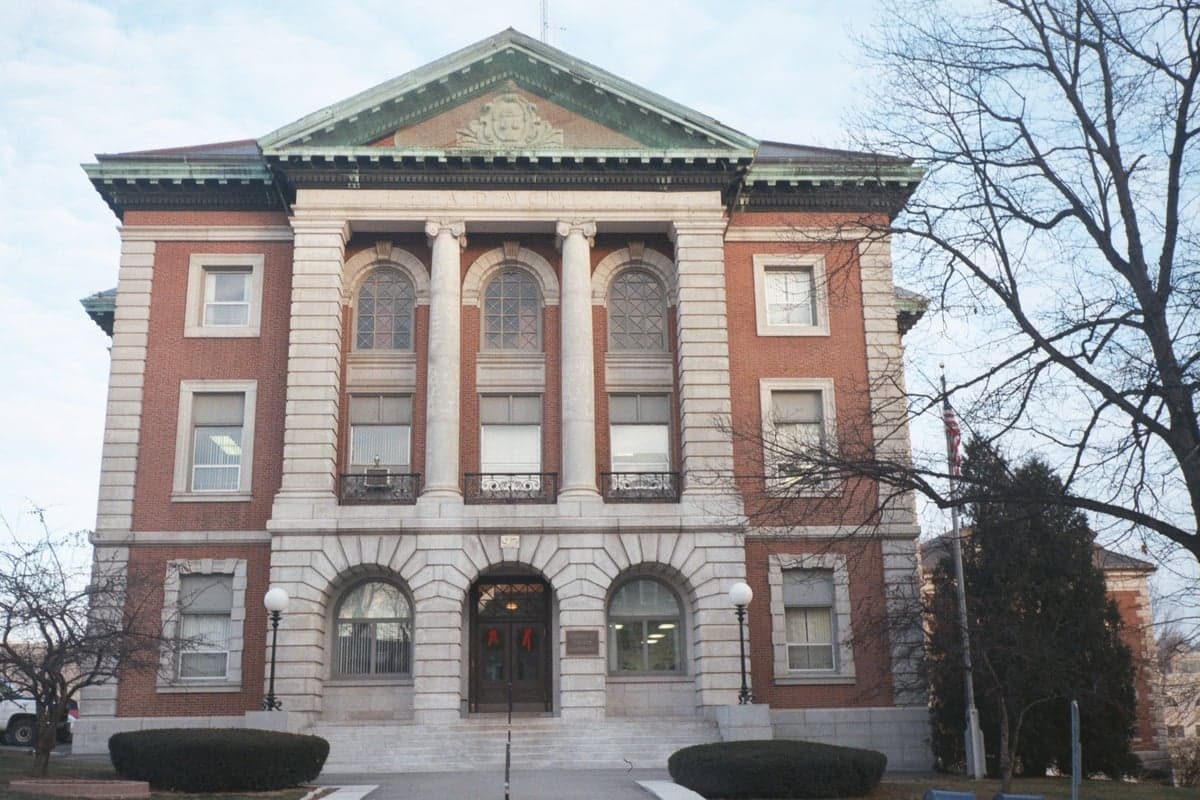
Photo: Wikipedia
Political ClimatePolitical Climate in Penobscot County
Showing district-level results — no local-only data available.
Local Political AnalysisPolitical Analysis of Penobscot County
Penobscot County leans Republican, but in a distinctly Maine way — measured, independent, and split by stark geographic and cultural lines. The county’s Cook Partisan Voting Index (PVI) of R+4 places it about four points more Republican than the nation as a whole, but that number masks a complicated reality: it’s a solid red county that still elects Democrats to local and state office, especially from the Bangor and Orono areas. Over the last three presidential cycles, the county has shifted slightly rightward, driven by rural and small-town voters, but the urban core around Bangor and the university town of Orono remain blue strongholds. What you get is a place where a Trump sign and a pride flag can be seen on the same block in the county seat, and where the political conversation is often more about practicality than party line.
How it compares to the rest of Maine
Statewide, Maine is famously swingy — it splits its electoral votes by congressional district and has a long tradition of independent governors and split-ticket voting. Penobscot County is **significantly redder than the coastal and southern parts of the state**, like Cumberland County (home to Portland), which is the engine of Maine’s Democratic lean. In 2024, Donald Trump carried Penobscot County by about 9 points, even as the state overall gave Joe Biden a narrow win. Within the county, the blue dots are concentrated in **Bangor** (the largest city, with a sizable student population and service economy) and **Orono** (home to the University of Maine). Both towns consistently vote Democratic by 15-20 points. By contrast, **Old Town, Hampden, and Brewer** are more purple, often swinging with the national mood, while towns like **Millinocket, Lincoln, and Enfield** are deep red — often voting 2-to-1 Republican. The swing precincts that decide close county races tend to be in the suburban ring around Bangor — places like **Holden and Orrington**, where voters are more moderate and issue-driven.
What this means for residents
For a conservative resident, Penobscot County feels like a place where your values are the norm in most public settings — gun rights, property rights, and limited government are the default assumptions in town halls and county commission meetings. You’ll find strong support for law enforcement, local business, and traditional family structures. But you also live alongside a vocal, organized progressive minority, especially in Bangor and Orono, so debates over land use, school funding, and social policy are real and can get loud. For a liberal resident, you’ll find your community — the Bangor Area Democratic Socialists have a visible presence, and the university brings in a steady flow of young, left-leaning voters — but you’ll also feel outnumbered in the rural parts of the county. The practical upshot: nobody gets to coast. Local elections are competitive, and activists on both sides have to organize, knock on doors, and show up. That keeps the county’s politics more pragmatic and less ideological than in deep-blue or deep-red places.
Culturally, Penobscot County is defined by its working-class roots — logging, paper mills, and the Penobscot Nation’s reservation along the river — and that history shapes policy debates. There’s genuine grassroots resistance to policies perceived as coming from Portland or Washington, whether it’s zoning rules, environmental regulations, or carbon taxes. At the same time, the county’s reliance on tourism, healthcare (Northern Light Health is the largest employer), and education means that most voters are pragmatic about infrastructure and broadband. You’ll hear people grumble about taxes, but they’ll also vote for school bonds and library expansions. The long-term trajectory likely sees continued slow reddening in the rural east and west, while Bangor’s growth and student population keep the county competitive — it’s the kind of place where the closest thing to a safe bet is that the next election will be closer than you expect.

State Political ClimatePolitical Climate in Maine
State Political AnalysisPolitical Environment in the State
Maine has a reputation as a moderate, independent-minded state, but its political reality is more nuanced than the "Maine is a blue state" shorthand suggests. Over the past 20 years, the state has shifted from a classic swing state — voting for George W. Bush in 2000 and then flipping to John Kerry in 2004 — to a reliably Democratic lean in presidential races, with Joe Biden winning by 9 points in 2020. However, that top-of-the-ticket blue tint masks a deeply divided electorate: the state’s two congressional districts tell very different stories, with the 1st District (coastal and southern) voting heavily Democratic while the 2nd District (northern and rural) has split tickets and even given an electoral vote to Donald Trump in both 2016 and 2020. For a conservative relocator, Maine offers a mixed bag — a state where you can find like-minded communities in the rural interior and northern reaches, but where state-level policy is increasingly shaped by the progressive Portland metro area.
Urban vs. rural divide
The political map of Maine is essentially a story of two Maines. The southern coast, anchored by Portland and its suburbs like South Portland and Scarborough, is the Democratic stronghold. These areas are dense, educated, and economically tied to tourism, healthcare, and tech — and they vote like a New England suburb. Drive an hour north or west, and the landscape — and the politics — changes fast. Towns like Bangor, Lewiston, and Augusta are more working-class and politically mixed, often swinging between parties depending on the candidate. The real conservative heartland is in the vast 2nd Congressional District — places like Presque Isle, Caribou, and the rural towns of Aroostook County, where hunting, logging, and potato farming dominate. These areas vote Republican by wide margins, driven by gun rights, opposition to energy regulations, and a deep distrust of Portland’s influence. The divide isn't just cultural — it's geographic and economic, and it’s growing.
Policy environment
Maine’s state-level policy leans left, but with a pragmatic streak. The state has a progressive income tax system with rates from 5.8% to 7.15%, and a 5.5% corporate tax rate. Property taxes are high — among the highest in the nation as a percentage of home value — which is a real shock for newcomers from low-tax states. There is no sales tax on most groceries, but the general sales tax is 5.5%. On education, Maine has a strong public school system, but school choice is limited compared to states with robust charter or voucher programs. Healthcare is a major issue: Maine expanded Medicaid under the Affordable Care Act via a 2017 ballot initiative, and the state runs its own exchange. Election laws are among the most accessible in the country — same-day voter registration, no-excuse absentee voting, and ranked-choice voting for federal and state primaries and general elections (the first state to adopt it statewide). For conservatives, the policy environment can feel restrictive, particularly on taxes and school choice, but the state’s independent streak means that ballot initiatives — like the 2016 marijuana legalization vote — often bypass the legislature entirely.
Recent policy direction
Over the past five years, Maine’s legislature has moved decisively left on several fronts. In 2023, Governor Janet Mills signed a sweeping gun safety package that included a 72-hour waiting period for firearm purchases and expanded background checks for private sales — a direct response to the 2023 Lewiston mass shooting. This was a flashpoint for gun owners, who see it as an infringement on the state’s long hunting tradition. On education, the state passed a law requiring schools to allow students to use restrooms and locker rooms matching their gender identity, and it expanded LGBTQ+ curriculum requirements — moves that have energized conservative parental rights groups. On energy, Maine has aggressively pursued wind power and a 2021 law set a goal of 100% renewable electricity by 2040, which has driven up electricity costs and sparked backlash in rural areas. On the libertarian side, Maine legalized recreational marijuana in 2016 and has a robust medical cannabis program. Property rights are generally strong, but environmental regulations — particularly around shoreland zoning and wetland protection — can be strict. For a conservative relocator, the recent direction is a mixed picture: more regulation on guns and energy, but a live-and-let-live attitude on personal choices like cannabis.
Civil unrest & political movements
Maine is not a hotbed of street-level political violence, but it has seen its share of organized activism. The 2023 Lewiston shooting — the deadliest in state history — led to massive gun control rallies in Augusta and Portland, as well as counter-protests from gun rights groups. The state has a vocal Second Amendment movement, with groups like the Maine Gun Owners Association and the Sportsman’s Alliance of Maine actively lobbying and organizing. On the left, the Portland chapter of the Democratic Socialists of America is active, and the state has seen protests over Indigenous land rights (the Wabanaki tribes have long pushed for sovereignty and land return). Immigration politics are less heated than in border states, but there have been tensions in Lewiston, which has a significant Somali immigrant community — a 2023 city council meeting over a proposed shelter drew hundreds of protesters on both sides. Election integrity has been a minor issue: Maine’s ranked-choice voting system has been challenged in court by both parties at different times, but it remains in place. There is no serious secession movement, but the "2nd District vs. 1st District" divide has fueled periodic talk of splitting the state — a conversation that flares up every few years but never gains real traction.
Projection
Over the next 5-10 years, Maine is likely to continue its slow drift leftward at the state level, driven by in-migration to the southern coast and the Portland metro area. Remote work has brought a wave of new residents from Massachusetts, New York, and California — people who tend to vote Democratic and support progressive policies on climate, healthcare, and education. The rural 2nd District will remain Republican, but its population is stagnant or declining, meaning its political weight will shrink relative to the growing southern counties. For a conservative moving in now, the realistic expectation is that state-level policy will become more progressive on guns, energy, and social issues, but that local control — particularly in rural towns — will remain strong. The state’s independent streak and tradition of split-ticket voting may moderate the pace of change, but the demographic trend is clear. A decade from now, Maine will likely look more like Vermont — a small-state progressive enclave with a conservative rural minority — than the swing state it was in the 1990s.
For a new resident, the bottom line is this: Maine is a beautiful, safe, and community-oriented state where you can find a political home whether you lean left or right — but you have to choose your town carefully. If you want a conservative environment, look to the rural north and west — places like Oxford County or Washington County. If you want a purple mix, consider Bangor or Augusta. If you want a progressive coastal hub, Portland is your spot. The state’s politics are real and consequential, but they rarely dominate daily life the way they do in more polarized states. For a conservative relocator, the key is to understand that you’re moving to a state where your vote will matter most at the local level — and where the state government will often be at odds with your values, but the quality of life and community may still win you over.
* Values derived from national, state, county, city and local statistics and may differ in a specific area. Last updated: 2026-07-01T12:43:00.000Z
Narrative content on this page is AI-generated and may contain mistakes. Verify any details that matter before acting on them.
ReloMaps may earn a commission from affiliate links at no extra cost to you.

