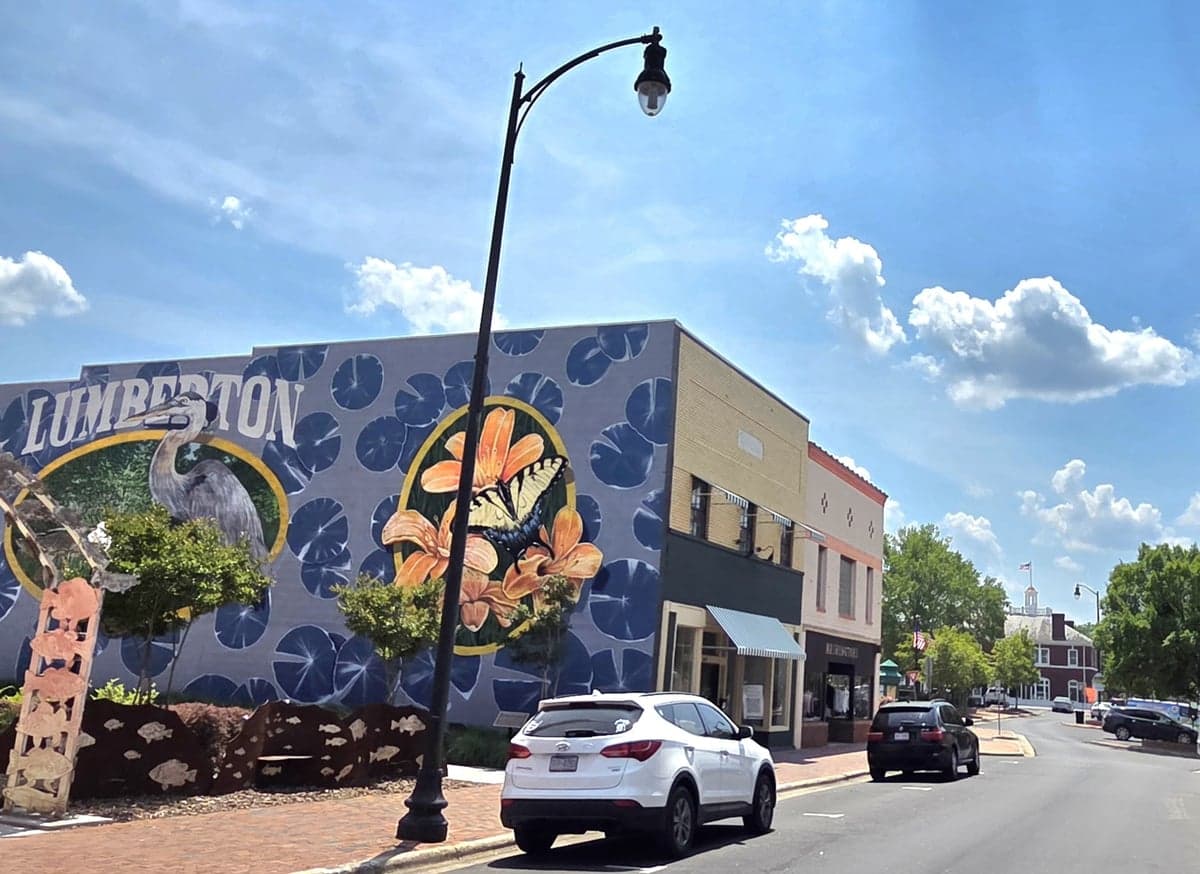
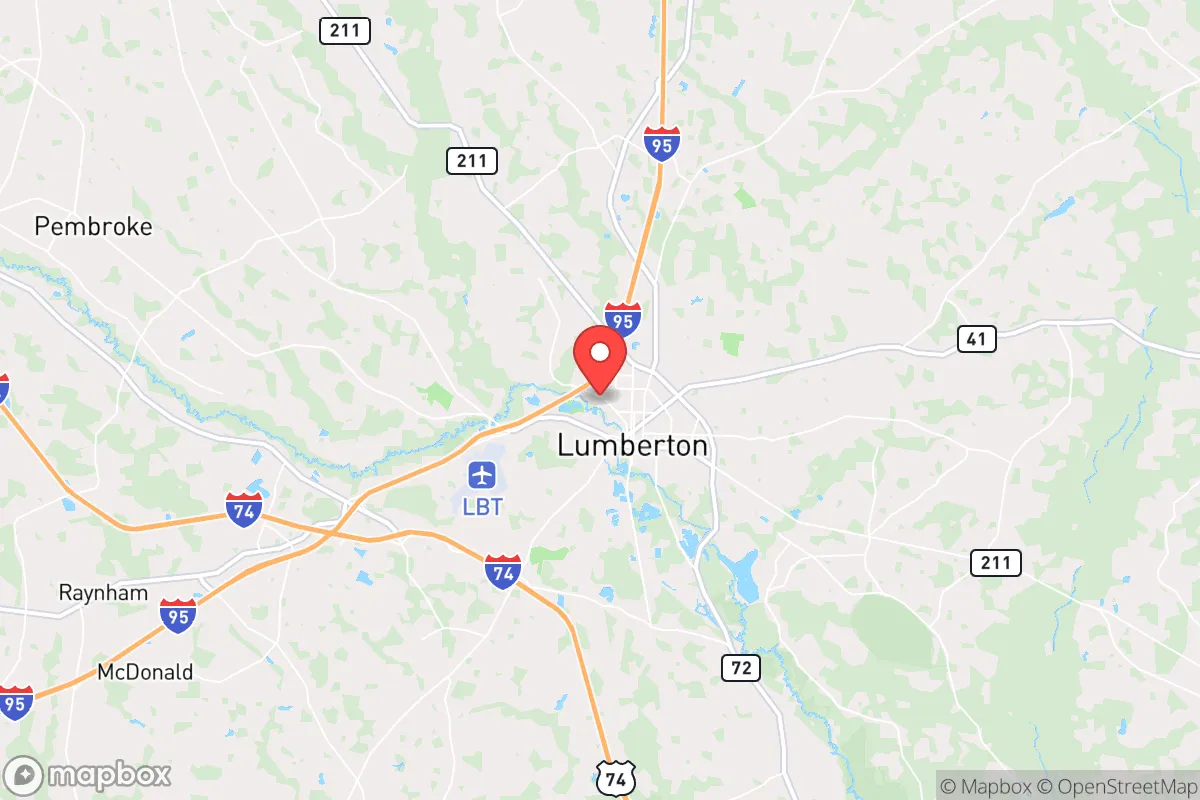
Photo: Wikipedia
Political ClimatePolitical Climate in Lumberton, NC
District shown is the primary district for this city’s centroid. Cities may span multiple districts.
Inherited from parent county — no local data available.
* Lean and PVI are calculated from the surrounding county’s 2020 and 2024 presidential results, Cook-style — a finer measure here than its congressional district (NC-8).
Political rankings in North Carolina
- Most Conservative Cities in North Carolina
- Most Liberal Cities in North Carolina
- Best Liberal-Leaning Towns in the South
- Best Liberal-Leaning Towns in Appalachia
- Safest Liberal-Leaning Towns in the South
- Safest Conservative-Leaning Towns in the South
- Safest Conservative-Leaning Towns on the East Coast
- Affordable Small Towns for Conservatives
- Most Conservative Counties in North Carolina
- Most Liberal Counties in North Carolina
Local Political AnalysisPolitical Analysis of Lumberton, NC
Lumberton leans heavily Republican, with a Cook Partisan Voting Index (PVI) of R+12, making it one of the more conservative pockets in a state that is itself a pure toss-up at R+1. This isn't a recent shift—the area has been reliably red for decades, driven by a strong rural and evangelical base, though the margins have tightened slightly in the last two cycles as younger voters and some newcomers from Fayetteville and Raleigh have trickled in. Locals will tell you that the county courthouse and city council have been dominated by conservative Democrats for generations, but in practice, those officials vote and govern like moderate Republicans on most fiscal and social issues. The real story is how Lumberton's deep red leans contrasts with the broader state's purple swing, and what that means for daily life.
How it compares
North Carolina as a whole is a classic battleground, with a PVI of R+1 that flips between parties every few election cycles. Lumberton, by contrast, is about as reliably red as you'll find east of I-95. Drive 30 minutes north to Fayetteville, and you'll hit a more competitive area thanks to the military and younger demographics; head 45 minutes south to Florence, SC, and you're in a similar conservative stronghold but with a different flavor of Southern politics. Within Robeson County itself, the city of Pembroke—home to the Lumbee Tribe and UNC Pembroke—leans more Democratic, creating a local political patchwork. The practical effect is that Lumberton's representatives in the state legislature and Congress are almost always Republicans, while statewide races (governor, Senate) are genuinely competitive and often decided by margins of 1-2 points. This means Lumberton's voice is amplified in GOP primaries but somewhat muted in general elections, where the state's urban centers like Charlotte and Raleigh carry more weight.
What this means for residents
For conservative residents, Lumberton is a comfortable place to live politically. Local ordinances tend to favor low taxes and limited regulation, and you'll find plenty of churches, gun shops, and "Trump 2024" signs in yards. The city council and county commission are reliably conservative, so zoning, school funding, and law enforcement policies generally align with traditional values. For liberal residents, it can feel isolating. There's no active Democratic Party office in the city, and progressive candidates rarely bother to campaign here. That said, the Lumbee Tribe's influence and the presence of UNC Pembroke create a small but visible counterweight—you'll find pockets of activism around indigenous rights, environmental justice, and public education funding. Most residents, regardless of party, agree on practical matters like improving the local economy and infrastructure, but the cultural divide is real and can be felt in conversations at the grocery store or at family gatherings.
One cultural distinction worth noting: Lumberton's political identity is deeply tied to its rural, agricultural roots and the Lumbee community's unique history. Unlike the suburban sprawl of Wake County or the coastal tourism of Wilmington, Lumberton's politics are shaped by poverty, opioid addiction, and a sense of being left behind by the state's economic boom. This creates a pragmatic, survival-first mindset that sometimes transcends party lines—most folks here care more about jobs and healthcare than national culture wars. The trajectory is toward a slow, modest diversification as more people move in from Fayetteville and the I-95 corridor, but don't expect Lumberton to turn purple anytime soon. It's a place where the local diner's morning coffee crowd will argue about property taxes and school boards, not presidential tweets, and that's the kind of political reality that feels both old-fashioned and refreshingly grounded.

State Political ClimatePolitical Climate in North Carolina
State Political AnalysisPolitical Environment in the State
North Carolina is a classic purple state that has been trending rightward in recent cycles, with a Cook PVI of R+1 that masks a deeply competitive landscape. The state has voted Republican in every presidential election since 2012, but by margins of less than 4 points in three of those four contests, and Democrats still hold the governorship and several Council of State seats. Over the past 10-20 years, the dominant story has been the collision of rapid in-migration—especially into the Charlotte and Raleigh-Durham metros—with a deeply entrenched rural conservative base, producing a state that is simultaneously more diverse, more educated, and more polarized than ever before.
Urban vs. rural divide
The political map of North Carolina is a textbook case of the urban-rural chasm. The state's three major metros—Charlotte (Mecklenburg County), Raleigh-Durham (Wake and Durham Counties), and the Triad (Greensboro, Winston-Salem, High Point)—are Democratic strongholds that together account for roughly half the state's population. Mecklenburg and Wake alone cast about 25% of all votes, and both have been trending bluer with each cycle. Meanwhile, the rest of the state is overwhelmingly Republican, with rural counties in the east (like Robeson, Columbus, and Duplin) and the west (like Watauga, Ashe, and Avery) voting R by 30-50 points. The suburbs are the real battleground: places like Union County (southeast of Charlotte) and Johnston County (southeast of Raleigh) were reliably red a decade ago but are now competitive, while Wake Forest and Apex are shifting left. The I-40 corridor from Raleigh to Wilmington is a microcosm of the whole state—purple, fast-growing, and unpredictable.
Policy environment
North Carolina's policy environment is a mix of conservative governance and pragmatic moderation. The state has a flat income tax rate of 4.5% (down from 7% in 2013), with a scheduled phase-down to 3.99% by 2027, making it one of the more tax-friendly states in the Southeast. There is no state-level property tax, but local rates vary widely—expect 0.6-0.8% in rural counties and 1.0-1.2% in urban ones. The regulatory posture is generally business-friendly, with a right-to-work law and a relatively low minimum wage ($7.25, matching the federal floor). Education policy is a flashpoint: the state has a robust charter school sector and a growing private school voucher program (the Opportunity Scholarship Program), but teacher pay remains below the national average and school funding lawsuits are ongoing. Healthcare is a mixed bag—the state did not expand Medicaid until 2023, leaving a coverage gap for roughly 500,000 low-income adults for a decade. Election laws have been contentious: the state requires voter ID (with some exceptions), has strict absentee ballot rules, and has seen repeated redistricting battles that have gone to the U.S. Supreme Court.
Recent policy direction
The last five years have seen a clear conservative shift on several fronts. In 2023, the Republican supermajority overrode Governor Roy Cooper's veto to pass a 12-week abortion ban (down from 20 weeks), with exceptions for rape, incest, and fetal anomalies. The same session saw the enactment of a permitless carry law for handguns, making North Carolina the 25th state to allow concealed carry without a permit. On education, the General Assembly expanded the Opportunity Scholarship Program to all income levels, effectively creating universal school choice. On property rights, the state has strengthened eminent domain protections and passed a law limiting local governments' ability to regulate short-term rentals. On voting, the 2023 omnibus election bill tightened absentee ballot rules, shortened the early voting period, and banned private funding of election administration. On speech and privacy, the state has not passed a comprehensive data privacy law, but it has enacted a ban on TikTok on government devices and a law requiring parental consent for minors to create social media accounts. The overall direction is toward lower taxes, fewer gun restrictions, more school choice, and tighter election laws—a package that appeals to conservative relocators but may give pause to liberal ones.
Civil unrest & political movements
North Carolina has a history of organized political activism on both sides. The Moral Monday protests of 2013-2014, led by the NAACP, drew thousands to the state legislature to oppose voting restrictions and education cuts. More recently, the 2020 protests in Charlotte and Raleigh over George Floyd's death were large but largely peaceful, though there were isolated incidents of property damage. On the right, the state has a strong gun rights movement (Grass Roots North Carolina is a major force) and a growing parental rights movement that successfully pushed for the Parents' Bill of Rights in 2023. Immigration politics are less heated than in border states, but there are sanctuary city controversies: Durham and Orange County have declared themselves sanctuary jurisdictions, while the state legislature has passed laws prohibiting such policies and requiring local law enforcement to cooperate with ICE. Election integrity remains a live issue: the 2020 election saw a recount in the presidential race and a series of lawsuits over absentee ballot procedures, and the 2024 cycle is expected to be similarly contentious. A new resident would notice that political bumper stickers and yard signs are common, and that local news is saturated with state-level politics year-round.
Projection
Over the next 5-10 years, North Carolina is likely to remain a competitive purple state, but the trajectory is toward a more conservative policy environment even as the electorate becomes more diverse. The key demographic driver is in-migration: the state is adding roughly 100,000 new residents per year, many of them from blue states like New York, California, and New Jersey. These newcomers tend to be moderate to liberal on social issues but are often attracted by the state's low taxes and business climate, creating a complex political profile. The rural population is shrinking and aging, while the urban and suburban populations are growing and diversifying—but the rural vote is so lopsidedly Republican that it still offsets the urban advantage. The wild card is the suburbs: if places like Union, Johnston, and Cabarrus counties continue to shift left, the state could become a genuine toss-up by 2030. If they hold steady, the R+1 lean could harden into R+3 or R+4. For a new resident, the practical implication is that the state will likely continue to have divided government—Republican legislature, Democratic governor—with all the gridlock and compromise that entails.
For someone moving to North Carolina, the bottom line is this: you are entering a state where your political views will be challenged, no matter which side you lean toward. Conservatives will find a friendly policy environment on taxes, guns, and school choice, but they will have to share power with a Democratic governor and a growing urban population. Liberals will find vibrant cities, a strong university system, and a competitive political landscape, but they will face a legislature that is consistently more conservative than the state as a whole. The practical takeaway is to choose your location carefully—your experience in Durham will be radically different from your experience in Lincolnton or Lumberton—and to expect that the state's politics will remain a source of lively debate for the foreseeable future.
* Values derived from national, state, county, city and local statistics and may differ in a specific area. Last updated: 2026-11-17T17:49:59.000Z
Narrative content on this page is AI-generated and may contain mistakes. Verify any details that matter before acting on them.
ReloMaps may earn a commission from affiliate links at no extra cost to you.

