
Photo: Wikipedia
Political ClimatePolitical Climate in Lucedale, MS
District shown is the primary district for this city’s centroid. Cities may span multiple districts.
Local Political AnalysisPolitical Analysis of Lucedale, MS
How it compares to the rest of Mississippi
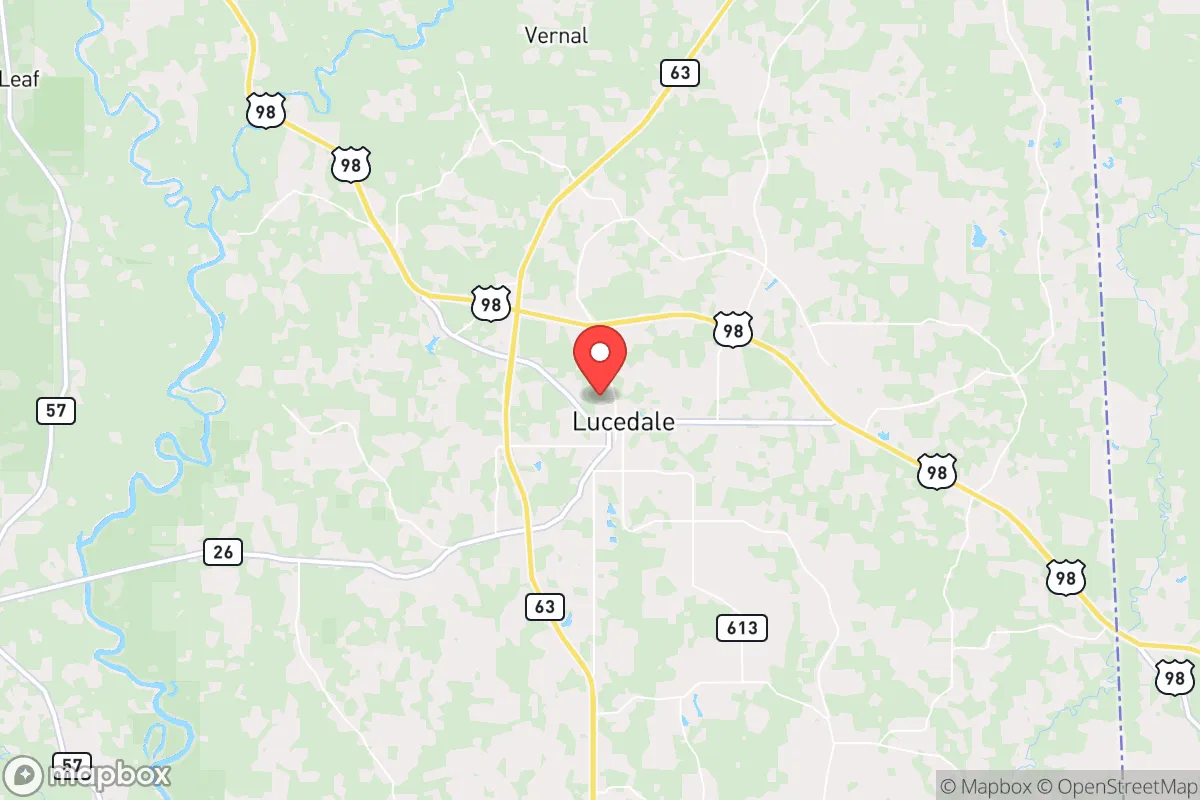
Mississippi is already one of the most reliably Republican states in the country, so an R+21 rating puts Lucedale in the deeper end of an already red pool. The contrast sharpens when you look west toward Hattiesburg and Forrest County, where the University of Southern Mississippi and a larger Black population keep Democrats competitive in city races and push the county closer to even. Jackson, up in Hinds County, is solidly Democratic and sends Democrats to the legislature every session. Lucedale sits in a different world: George County hasn't backed a Democratic presidential candidate in decades, and the county's statehouse delegation—currently Republican—faces little serious opposition. The nearest genuinely competitive territory is the Gulf Coast around Biloxi and Gulfport, where tourism, military families, and a more transient population make Harrison County more of a mixed bag.
What this means for residents
For conservative residents, the practical upside is access. Local officials, county supervisors, and the sheriff are usually reachable, and the politics of the courthouse square tend to match the politics of the pews and the ballfields. For liberal or moderate newcomers—and there are some, often retirees or people transferred in for work at the Ingalls shipyard in Pascagoula or the Chevron refinery—the reality is quieter than you might expect. You won't face hostility in daily life, but you also won't find much of a organized Democratic presence, and your vote in a general election will rarely change an outcome. Most people I know in that position treat local politics as something to observe rather than participate in, and they focus their civic energy on churches, schools, and volunteer fire departments instead.
The cultural distinctions matter as much as the ballot. George County is dry in places, church attendance runs high, and the county's politics are shaped by agriculture, timber, and a strong sense of local control—school board and supervisor races often turn on personality and family ties more than party. That's the part that surprises outsiders most: the ideology is national, but the machinery is intensely local. Looking ahead, I don't see the lean shifting much. The county's population is stable and its electorate is older and white, and the growth that is happening—modest subdivision building along Highway 98—tends to attract people who already fit the profile. The one wildcard is the statewide trend of younger, more diverse voters in the cities slowly changing Mississippi's margins; if that reaches George County at all, it'll be a generation out, not a cycle.

State Political ClimatePolitical Climate in Mississippi
State Political AnalysisPolitical Environment in the State
Mississippi is one of the most reliably Republican states in the country, and it has gotten more so over the past two decades. The state's Cook Partisan Voting Index sits at R+11, and the last Democratic presidential candidate to carry Mississippi was Jimmy Carter in 1976. Donald Trump won the state by roughly 16 points in 2020 and widened that to about 17 points in 2024, while Republicans hold both U.S. Senate seats, three of four U.S. House seats, and supermajorities in both chambers of the Legislature. The dominant coalition is white rural and small-town voters, evangelical church networks, and the Gulf Coast business community, with Black voters — about 38% of the population — forming the Democratic base concentrated in the Delta and in Jackson.
Urban vs. rural divide
The political map breaks cleanly along geography. Jackson, the capital and largest metro, is the Democratic anchor — Hinds County votes blue by wide margins, and the city itself is around 80% Black. Clarksdale and the broader Delta counties (Coahoma, Bolivar, Leflore) are overwhelmingly Democratic and have been for generations. The Gulf Coast tells a different story: Gulfport and Biloxi in Harrison County are competitive-to-leaning-Republican, driven by military families tied to Keesler Air Force Base and a large tourism and shipbuilding workforce, while Pascagoula in Jackson County leans Republican on the strength of Ingalls Shipbuilding employment. The fast-growing suburban counties around Jackson — Madison and Rankin — are the state's Republican power centers, home to the state's wealthiest and fastest-growing populations. Oxford (Lafayette County) is the state's most interesting outlier: a university town that votes Democratic locally but sits inside a conservative region. Tupelo and Hattiesburg are middle-ground small cities that lean Republican but with competitive local races.
Policy environment
Mississippi's tax structure is among the most regressive in the nation. The state levies a 7% general sales tax — one of the highest in the country — plus local add-ons, and relies heavily on it because there is no broad property tax at the state level and the income tax is being phased down. In 2022 the Legislature passed the largest tax cut in state history, cutting the income tax from 5% to 4% and eliminating the 4% bracket on the first $10,000 of income, with further reductions scheduled. Regulatory posture is light: right-to-work law, low union density (around 5%), and a business-recruitment approach built on incentives and low operating costs. Education is the state's most contested policy arena — Mississippi adopted the Literacy-Based Promotion Act in 2013, which produced real gains in early reading scores, and the state has a charter school law and a private school voucher-style program (the Equal Opportunity for Students with Special Needs Act) that has expanded incrementally. Medicaid was expanded under the Affordable Care Act only after years of legislative fighting — a 2024 compromise expanded coverage to working adults up to 138% of the poverty line, though implementation has been rocky. Election law is strict: voter ID required since 2011, no early voting beyond absentee, and a photo ID mandate upheld by the courts.
Recent policy direction
The last several legislative sessions have moved decisively on cultural and rights questions. On guns, Mississippi is a constitutional carry state (permitless concealed carry since 2016) with strong castle-doctrine protections and no waiting periods. On parental and education rights, the state passed a 2021 law requiring schools to notify parents of curriculum materials and a 2023 measure expanding charter school authorization; the state also bans instruction on gender identity in early grades. On speech and privacy, Mississippi has no state-level data privacy law and has not joined the interstate privacy compact movement, though it does have a breach-notification statute. On medical and bodily autonomy, Mississippi enacted a near-total abortion ban in 2022 triggered by the Dobbs decision — the law that produced the Supreme Court case — and the state has restricted gender-affirming care for minors since 2023. On property rights, the state has strong agricultural and timber protections and a relatively streamlined eminent-domain process. On voting, the state requires photo ID, limits absentee voting to specific excuses, and has no online registration. The overall direction is toward lower taxes, lighter regulation, and tighter social policy — a consistent small-government-on-economics, active-government-on-culture pattern.
Civil unrest & political movements
Mississippi has a long and visible protest history, from the civil rights movement through the 2020 Black Lives Matter demonstrations in Jackson and Oxford, which were largely peaceful but drew counter-protests. The state has an active conservative movement centered on church networks and the Mississippi Center for Public Policy, and an organized progressive presence through the NAACP, the Mississippi Poor People's Campaign, and labor groups in the Delta. Immigration politics are live: Mississippi passed a 2008 law requiring employers to verify work eligibility and has cooperated with federal immigration enforcement, though it has no sanctuary jurisdictions. Nullification and secession rhetoric surfaces occasionally in rural counties but has no institutional traction. Election integrity is a recurring theme — the state's voter ID law and absentee rules are frequently litigated, and the 2023 gubernatorial race saw Republican Tate Reeves defeat Democrat Brandon Presley by about 5 points, closer than many expected, which energized Democratic organizing in the Delta and Jackson.
Projection
Over the next five to ten years, Mississippi will likely remain solidly Republican at the state level, but the margins may narrow slightly as the Gulf Coast and suburban counties grow and the Delta continues to lose population. In-migration is modest and mostly retirees and remote workers drawn by low costs, which tends to reinforce the conservative lean. The bigger wildcard is the state's demographic trajectory: Mississippi is one of the few states losing population overall, and the out-migration of young people could weaken the Democratic base in Jackson while also shrinking the tax base. Expect continued tax cuts, incremental school-choice expansion, and no reversal on abortion or gun policy. Local politics in Oxford, Hattiesburg, and the Coast will stay more competitive than the statewide picture suggests.
For a new resident, the practical takeaway is straightforward: if you are conservative, Mississippi offers low taxes, light regulation, strong gun rights, and a policy environment that aligns with traditional values — but you will pay for it with a high sales tax, limited public services, and a weak healthcare safety net. If you are liberal, you can find like-minded communities in Jackson, Oxford, and parts of the Delta, but you will be in a minority at the state level and should expect the state's social policy to run against your preferences. Either way, the state is stable, predictable, and unlikely to surprise you — which, for many relocators, is exactly the point.
* Values derived from national, state, county, city and local statistics and may differ in a specific area. Last updated: 2026-11-03T10:23:38.000Z
Narrative content on this page is AI-generated and may contain mistakes. Verify any details that matter before acting on them.
ReloMaps may earn a commission from affiliate links at no extra cost to you.

