
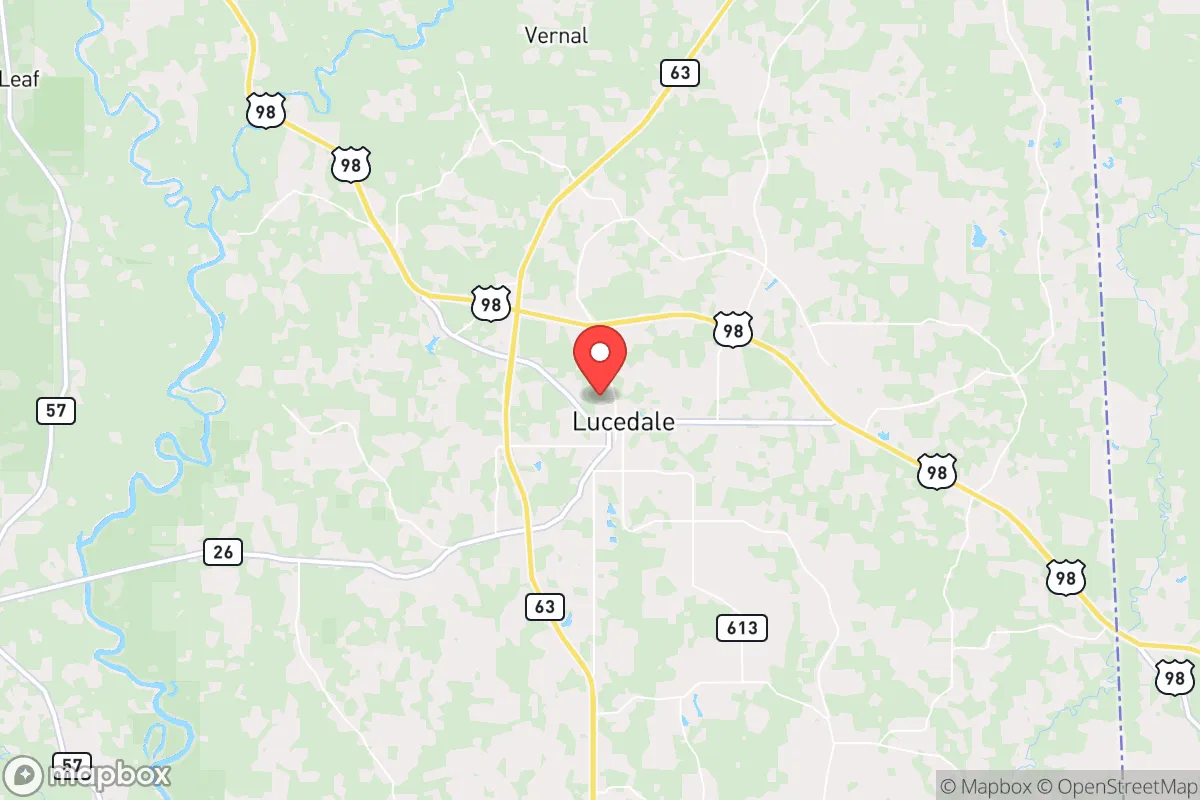
Photo: Wikipedia
Personal Sovereignty in Lucedale, MS
Viable for self-reliance. Generally workable, though some barriers may limit total independence.
What does Personal Sovereignty tell us?
Personal Sovereignty measures your capacity for self-reliance and independence with minimal government friction. Higher scores mean fewer barriers between you and the way you want to live... but it assumes you have the space you need and good neighbors.
What does this tell us?
Personal Sovereignty measures your capacity for self-reliance and independence with minimal government friction. Higher scores mean fewer barriers between you and the way you want to live... but it assumes you have the space you need and good neighbors.
State Policy
Energy independence: Importer (28% of energy produced in-state)
Personal Liberty

Personal Liberty Analysis
Lucedale sits in George County in southeast Mississippi, roughly 30 miles north of the Gulf Coast, and it inherits one of the more freedom-friendly policy environments in the country. Mississippi levies no state property tax, has no state-level income tax on the first $10,000 of earnings (with a scheduled phase-down of the remainder), and its gun laws are among the most permissive in the nation. For a reader who prioritizes personal autonomy, Lucedale offers a light-touch regulatory baseline paired with a rural, low-density setting where self-reliance is practical rather than theoretical.
How heavy is the tax and regulatory burden in George County?
Mississippi's tax posture is one of the lightest in the region. The state collects no property tax at the state level; property taxes are assessed locally, and George County's millage rates are modest by national standards, with effective property tax rates typically landing well under 1% of assessed value. The state income tax has been on a downward glide path — the 2022 reform cut the rate and set a schedule toward eventual elimination, with the top rate now in the low single digits. The general sales tax sits at 7%, with local add-ons in some municipalities. For a household or solo operator, the practical effect is that take-home pay stretches further and the compliance overhead is thin. Mississippi is also a right-to-work state, which matters if you run a small business or contract labor. Regulatory touch on small enterprise and land use is comparatively light: the state has no statewide zoning mandate, and George County's land-use controls are limited outside municipal boundaries. Building permits and septic approvals still apply, but the layers of review common in metro counties are largely absent. The trade-off is the usual rural one — fewer services, longer drives to specialized permitting offices, and infrastructure that reflects the county's small tax base.
What Mississippi's self-defense and gun laws mean for Lucedale residents
Mississippi is a constitutional-carry state. Since the 2016 permitless carry law (and its 2021 clarification via the enhanced-carry framework), a resident 18 or older who is not prohibited can carry a concealed handgun without a state permit. The state issues enhanced concealed carry permits for reciprocity with other states, which is worth obtaining if you travel. Mississippi has a strong castle doctrine and a stand-your-ground statute (Miss. Code § 97-3-15), meaning there is no duty to retreat in a place you have a right to be. Long guns and handguns face no state registration, no waiting period, and no magazine or "assault weapon" restrictions. NFA items are legal with federal tax stamps. For a reader who treats the Second Amendment as a core autonomy marker, George County delivers: the sheriff's office issues permits promptly, local gun culture is mainstream, and there is no municipal ordinance in Lucedale that meaningfully restricts lawful carry. As always, federal law and the usual prohibited-person categories still apply.
Is homesteading and off-grid living viable around Lucedale?
This is where Lucedale's geography does a lot of work. George County is timber and pasture country — piney woods, small farms, and plenty of unincorporated land. Parcel sizes outside the city limits commonly run from 3 to 5 acres up to 40-plus, and per-acre prices are a fraction of what comparable acreage costs in Tennessee or the Carolinas. Because most of the county is unincorporated, zoning is minimal to nonexistent on rural tracts, which means keeping livestock, running a shop, storing equipment, and building outbuildings face far fewer hurdles than in zoned suburbs. Mississippi has no statewide septic mandate beyond county health department approval, and well water is common and generally reliable in the area. Off-grid feasibility is real but not effortless: the climate is hot and humid, which raises cooling loads and demands serious attention to insulation, ventilation, and moisture control; solar works but summer air-conditioning drives system sizing up. Rainfall is abundant, so rainwater catchment is practical, though county and state rules on potable use should be checked. The main constraints are practical rather than regulatory — distance to suppliers, the need for a reliable vehicle, and the reality that rural broadband is uneven, so satellite internet is often the fallback for remote work.
How personal liberties play out for families and individuals
Mississippi's policy framework leans toward parental authority and individual discretion. The state's education savings account and school choice programs have expanded, giving families alternatives to the local district, and homeschooling is lightly regulated — no state notification requirement beyond what local districts may request, and no mandated standardized testing for home-schooled students. On medical autonomy, Mississippi has been among the states pushing back on federal vaccine mandates, and the state's religious and philosophical exemption framework for childhood vaccines is narrower than some freedom-leaning readers might expect — Mississippi has historically been one of the strictest on school vaccine exemptions, so families should verify current rules rather than assume. Speech and property rights follow the general Southern rural pattern: low interference in day-to-day life, strong property protections, and a local culture that expects people to handle their own affairs. Lucedale itself is small enough that local government is accessible — you can show up at a board of supervisors meeting and be heard — which is its own form of sovereignty.
Weighed against other relocation targets, Lucedale lands on the high-autonomy end of the spectrum. It pairs a low tax burden, permitless carry, and stand-your-ground protections with genuinely affordable rural acreage and minimal zoning — a combination that is increasingly hard to find within a reasonable drive of a Gulf Coast job market. It is not a libertarian utopia: school vaccine rules are stricter than many freedom-first families assume, rural infrastructure has gaps, and the humid climate raises the cost of true off-grid living. But for a reader who wants to own land, keep their own counsel, and deal with a government that mostly leaves them alone, George County is a credible and concrete option — one that rewards a visit and a careful look at specific parcels before committing.

* Values derived from national, state, county, city and local statistics and may differ in a specific area. Last updated: 2026-11-03T10:23:38.000Z
Narrative content on this page is AI-generated and may contain mistakes. Verify any details that matter before acting on them.
ReloMaps may earn a commission from affiliate links at no extra cost to you.

