

Photo: Wikipedia
Demographics of Lucedale, MS
Affluence Level in Lucedale, MS
A below-average socioeconomic profile. Incomes, home values, and educational attainment trail the U.S., with higher poverty and unemployment.
People of Lucedale, MS
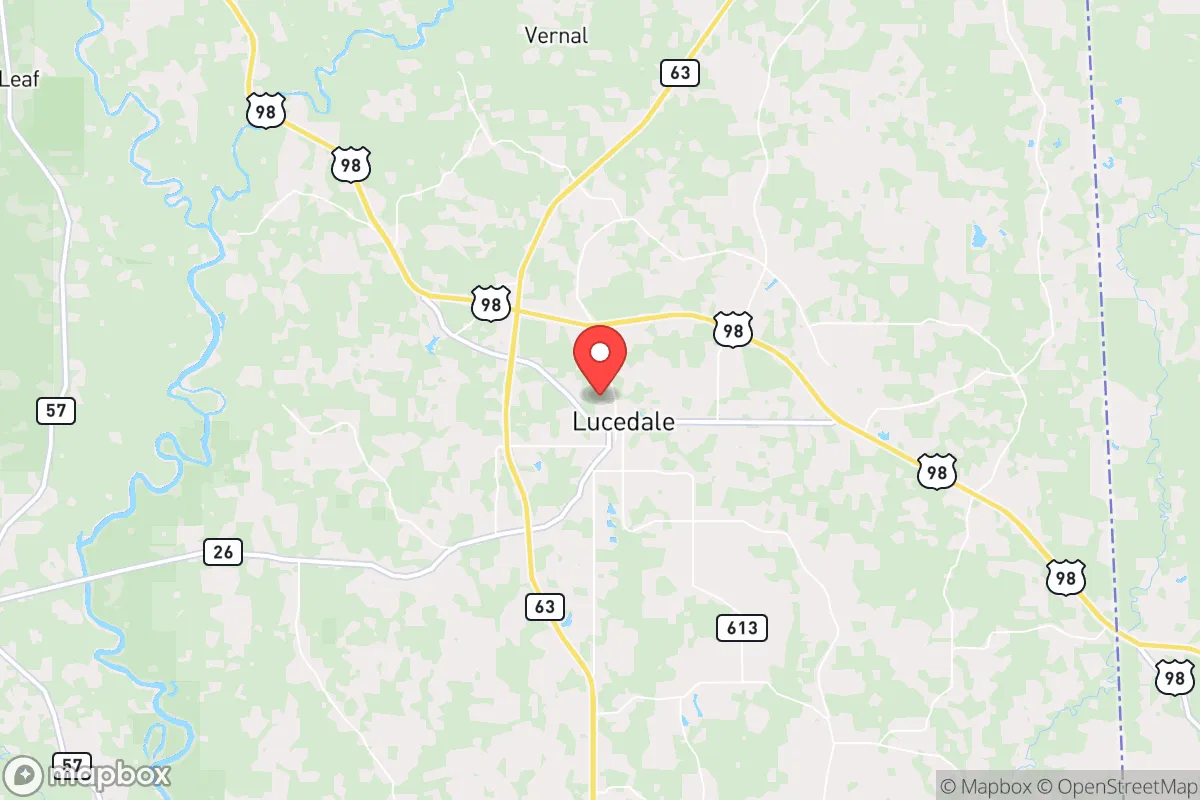
Lucedale is the seat of George County, a small Pine Belt town of 2,944 residents where 60.7% of the population is white and 33.9% is Black, a biracial balance shaped by the timber and sawmill economy that built the town and the plantation agriculture that preceded it. The city is overwhelmingly native-born — only 0.3% of residents are foreign-born — with a Hispanic share of 1.3% and no measurable East/Southeast Asian or Indian-subcontinent population. Its identity is rooted in lumber, livestock, and the railroad, and its people remain concentrated in and around the old grid streets near downtown and the surrounding rural precincts of George County.
How the city was settled and grew
Lucedale is a post-1900 railroad town, not a colonial settlement. George County was carved out of Greene and Jackson counties in 1910, and Lucedale was incorporated the same year as its county seat, built along the Gulf, Mobile and Northern Railroad line that made the longleaf pine belt commercially accessible. The first substantial wave of residents arrived between 1900 and 1920 as lumber companies moved in to harvest the virgin pine; sawmill crews, timber cutters, and railroad workers settled the blocks closest to the depot and along the main commercial spine of downtown Lucedale, where the courthouse square and Winter Street anchored early business. A second wave through the 1920s and 1930s brought farm families into the surrounding countryside as the cutover land was converted to cattle pasture, truck crops, and later poultry houses; these families concentrated in rural communities like Rocky Creek and Salem on the county's outskirts, which remain the most heavily agricultural and least densely settled parts of the Lucedale trade area. Black residents, descended largely from enslaved laborers brought into the region during the antebellum cotton era, settled in and around the historically Black neighborhoods on Lucedale's east and north sides, near the churches and schools that became the institutional center of Black community life. By mid-century the town had stabilized as a small county-seat service center — courthouse, schools, feed stores, a livestock auction — with a population that grew slowly and remained almost entirely native to the Pine Belt.
Modern era (post-1965)
The 1965 Hart-Celler Act reshaped immigration nationally but barely touched Lucedale: the foreign-born share remains 0.3%, and the city has no meaningful immigrant enclave in any neighborhood. What changed after 1965 was domestic, not international. School desegregation in the late 1960s and early 1970s, followed by white flight from the older in-town blocks, shifted the racial geography of the city: the historic Black neighborhoods east and north of downtown retained and consolidated their Black majority, while white families moved toward the newer subdivisions and manufactured-home developments along the Highway 98 corridor and out toward Agricola and the Barton community to the north. The 1980s and 1990s brought a modest suburbanization as commuters began working at the Ingalls shipyard in Pascagoula, the Chevron refinery, and other Gulf Coast employers, choosing Lucedale for its lower housing costs and school system. That commuting pattern, more than any immigration stream, defines the modern population: a stable, largely native-born, working- and middle-class county-seat town with a persistent white-Black split and a college-educated share of just 17.0%, well below state and national averages.
The future
Lucedale's population is likely to remain small, native-born, and biracial, with slow growth at best. The city's demographic profile shows no sign of the immigrant-driven diversification seen in larger Sun Belt metros — the foreign-born share is too small and the Hispanic and East/Southeast Asian populations too thin to generate the kind of neighborhood change that reshapes larger cities. The more consequential trend is likely to be continued dispersal of white residents into the rural fringe around Rocky Creek, Agricola, and the Highway 98 corridor, while the in-town Black neighborhoods east and north of downtown hold their share. If the Gulf Coast shipyard and refinery economy continues to draw commuters, Lucedale may see modest in-migration of working families priced out of Jackson County, but the college-educated share is unlikely to rise sharply without new employers. The town's cultural identity — courthouse-square civic life, church-centered community, high school football, and a strong sense of county-seat continuity — is likely to persist largely intact over the next 10 to 20 years.
For someone moving in now, Lucedale is a stable, low-diversity, low-cost Pine Belt town where the population is not being remade by immigration or rapid growth, and where neighborhood identity still tracks the racial and agricultural geography laid down a century ago. Buyers should expect a native-born, working-class community with a modest tax base, a small but real Black middle class centered in the east-side neighborhoods, and a future defined more by continuity than by change.

* Values derived from national, state, county, city and local statistics and may differ in a specific area. Last updated: 2026-11-03T10:23:38.000Z
Narrative content on this page is AI-generated and may contain mistakes. Verify any details that matter before acting on them.
ReloMaps may earn a commission from affiliate links at no extra cost to you.

