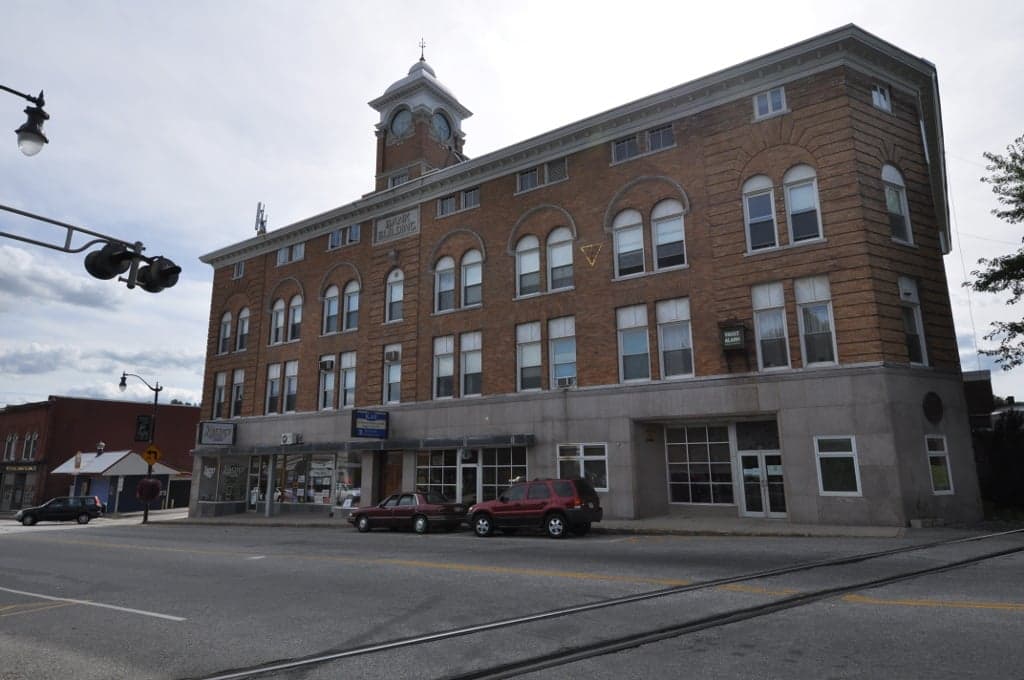
Photo: Wikipedia
Political ClimatePolitical Climate in Livermore Falls, ME
District shown is the primary district for this city’s centroid. Cities may span multiple districts.
Inherited from parent county — no local data available.
* Lean and PVI are calculated from the surrounding county’s 2020 and 2024 presidential results, Cook-style — a finer measure here than its congressional district (ME-2).
Political rankings in Maine
- Most Conservative Cities in Maine
- Most Liberal Cities in Maine
- Best Conservative-Leaning Towns in New England
- Best Conservative-Leaning Towns in the Northeast
- Safest Liberal-Leaning Towns on the East Coast
- Safest Conservative-Leaning Towns on the East Coast
- Most Affordable Liberal-Leaning Small Towns in the U.S.
- Safest Liberal-Leaning Cities in the U.S.
- Most Conservative Counties in Maine
- Most Liberal Counties in Maine
Local Political AnalysisPolitical Analysis of Livermore Falls, ME
Livermore Falls has long been a reliably conservative pocket in western Maine, with a Cook Partisan Voting Index of R+3 that places it noticeably to the right of the state as a whole. This isn't a recent shift — the town has voted Republican in every presidential election since at least 2000, often by margins of 10 to 15 points. But the real story is how that lean has deepened over the past decade, even as Maine's Second Congressional District has trended more competitive. Walk into the Livermore Falls town office on a Tuesday morning, and you'll hear folks talking about property taxes and logging regulations, not national culture wars — though those national currents have certainly made their way up Route 4.
How it compares
Compared to Maine's statewide average — which leans Democratic thanks to the Portland suburbs and college towns like Orono and Brunswick — Livermore Falls is a clear outlier. The town sits in Androscoggin County, which voted for Donald Trump by 8 points in 2020, while Maine overall went for Joe Biden by 9 points. That's a 17-point gap between Livermore Falls and the state. Drive 20 minutes south to Auburn, and you'll find a more mixed political landscape — Auburn has swung between parties in recent elections, while Livermore Falls has stayed steady red. Head east to Jay, and you'll see a similar conservative bent, though Livermore Falls tends to be a bit more consistent in its Republican turnout. The contrast is sharpest with towns like Farmington (25 miles north), where the University of Maine at Farmington pulls the electorate left, or with coastal communities like Camden, where liberal leanings are more pronounced.
What this means for residents
For conservative residents, Livermore Falls feels like a comfortable fit — local government tends to favor low taxes and limited regulation, and you'll find plenty of "Don't Tread on Me" flags on pickup trucks at the IGA parking lot. The town's Republican lean means that local offices — select board, school committee, planning board — are often held by conservatives, which shapes decisions on everything from road maintenance budgets to zoning for new development. For liberal residents, the reality is more about finding your people. There's a small but active Democratic committee in town, and the nearby cities of Lewiston and Auburn offer more progressive spaces for organizing and socializing. Politically, Livermore Falls is a place where you can live comfortably regardless of your affiliation, but you'll need to drive 20 minutes for a Democratic town hall meeting or a progressive book club. The practical impact: property taxes are relatively low compared to liberal-leaning towns in southern Maine, but public services like broadband and public transit are less robust.
Culturally, Livermore Falls has a distinct "live and let live" vibe that's common in rural Maine — people are more concerned with whether you help your neighbor plow their driveway than with your voting record. That said, the area has seen some policy distinctions that reflect its conservative lean: the town has been slower to adopt plastic bag bans or renewable energy mandates compared to more liberal municipalities, and there's a strong local resistance to state-level gun control measures. Looking ahead, the political trajectory seems stable — Livermore Falls isn't likely to flip blue anytime soon, but it's also not becoming a hotbed of partisan activism. The real change will come from demographic shifts: if more remote workers move in from southern Maine or out of state, the town could see a slow drift toward the center. For now, it remains a place where the biggest political argument is often about the cost of heating oil, not the latest cable news controversy.

State Political ClimatePolitical Climate in Maine
State Political AnalysisPolitical Environment in the State
Maine has long been known as a politically independent state, but its overall lean has shifted noticeably leftward over the past two decades. While it voted for Bill Clinton in 1992 and 1996, it backed George W. Bush in 2000, then swung hard for Barack Obama in 2008 and has stayed reliably Democratic in presidential elections since, with Joe Biden winning by 9 points in 2020. The real story, though, is the state’s deep internal split: the coastal, southern, and Portland-anchored metro areas drive the blue lean, while vast northern and inland regions remain deeply red. For a conservative relocator, the practical reality is that Maine offers a mix of libertarian-leaning local governance in many rural towns, but a state-level policy environment that has become increasingly progressive.
Urban vs. rural divide
The political map of Maine is essentially two states. The Portland metro area, including Portland, South Portland, and Brunswick, is the Democratic engine, producing margins of 30-40 points in recent elections. Augusta and Bangor are more moderate but still lean blue. Meanwhile, Aroostook County in the far north, along with towns like Presque Isle and Caribou, vote Republican by wide margins. The Second Congressional District, which covers most of the state outside the southern coast, has flipped between parties in recent cycles—it went for Trump in 2016 and 2020, and for a Republican House candidate in 2022. This district is one of the few in the nation where a presidential candidate won a single electoral vote (Trump in 2016 and 2020) due to Maine’s unique district-based allocation. The rural-urban divide is stark: Lewiston, a former mill city, is a swing area that has trended rightward in recent years, while coastal towns like Camden and Rockland are reliably liberal.
Policy environment
Maine’s state-level policy leans progressive, but with notable exceptions. The state has a progressive income tax with rates up to 7.15%, and a 5.5% sales tax. Property taxes are high, averaging about 1.3% of home value, which is above the national median. The regulatory environment is generally business-friendly for small enterprises, but environmental regulations are strict, especially along the coast. Education policy is centralized, with a strong teachers’ union and a state-funded universal pre-K program. Healthcare is a major issue: Maine expanded Medicaid under the Affordable Care Act in 2019 via a ballot initiative, and the state runs its own health insurance exchange. Election laws are among the most accessible in the nation: same-day voter registration, no-excuse absentee voting, and ranked-choice voting for federal and state primaries and general elections. Gun laws are relatively moderate: no permit is required for open carry, but a permit is needed for concealed carry, and the state has a “yellow flag” law allowing temporary confiscation of firearms from individuals deemed a danger to themselves or others.
Recent policy direction
The last five years have seen a clear progressive push. In 2023, the legislature passed a law requiring a 72-hour waiting period for firearm purchases, overriding a veto from Governor Janet Mills. A 2021 law banned “conversion therapy” for minors. On abortion, Maine has no gestational limit, and in 2023, the state expanded access to include late-term abortions when deemed medically necessary by a physician. Parental rights have been a flashpoint: a 2024 law requires schools to notify parents if a student requests a name or pronoun change, but it was watered down from an earlier version. On property rights, the state has a strong “right to farm” law protecting agricultural operations from nuisance lawsuits, but coastal development is heavily regulated. Privacy and surveillance laws are relatively weak; Maine does not have a comprehensive data privacy law like California’s. Voting access has been expanded: ranked-choice voting was implemented in 2018 after a citizen initiative, and automatic voter registration was passed in 2023. The state has no voter ID law, which is a point of contention for conservatives.
Civil unrest & political movements
Maine is not known for large-scale civil unrest, but there have been notable flashpoints. The 2020 Black Lives Matter protests in Portland were large and mostly peaceful, but led to some property damage. The state has a small but vocal Second Amendment movement, with regular rallies at the State House in Augusta. Immigration politics are relatively quiet, but the influx of asylum seekers to Portland—especially from African nations—has strained city services and sparked local tensions. There is no sanctuary city policy at the state level, but Portland has a “Welcoming City” ordinance. The secession movement is mostly rhetorical, with a few towns in northern Maine periodically floating the idea of joining New Hampshire or forming a new state, but it has never gained serious traction. Election integrity controversies have been minimal, though some rural counties saw calls for audits after the 2020 election. The most visible political movement is the “Maine Way” libertarian streak, which manifests in strong support for local control and opposition to state mandates, especially around land use and school curriculum.
Projection
Over the next 5-10 years, Maine’s political trajectory is likely to continue its slow leftward drift, driven by in-migration from Massachusetts and other northeastern states. The Portland metro area is growing faster than the rest of the state, and new arrivals tend to be younger and more liberal. However, the Second Congressional District will remain competitive, and rural areas may become more conservative as they feel increasingly alienated from state policy. The state’s aging population—Maine has the oldest median age in the nation—could shift priorities toward healthcare and property tax relief. A conservative relocator moving to a rural town like Dover-Foxcroft or Madawaska will find a community that votes red and values local autonomy, but they will still be subject to state-level policies on taxes, education, and gun laws that are increasingly progressive. The wildcard is ranked-choice voting, which could amplify third-party candidates and make elections less predictable.
For a new resident, the bottom line is that Maine offers a genuine split-screen experience. If you move to a rural town in the north or west, you’ll live in a conservative community with low crime, strong local schools, and a libertarian ethos. But you’ll pay state income tax, face strict environmental rules, and live under a state government that is likely to remain Democratic for the foreseeable future. If you’re a conservative who values local control and can tolerate a blue state government, Maine can work well. If you’re looking for a reliably red policy environment, you’ll want to look at the northern reaches of the Second District—or consider New Hampshire just across the border.
* Values derived from national, state, county, city and local statistics and may differ in a specific area. Last updated: 2026-11-22T13:56:18.000Z
Narrative content on this page is AI-generated and may contain mistakes. Verify any details that matter before acting on them.
ReloMaps may earn a commission from affiliate links at no extra cost to you.

