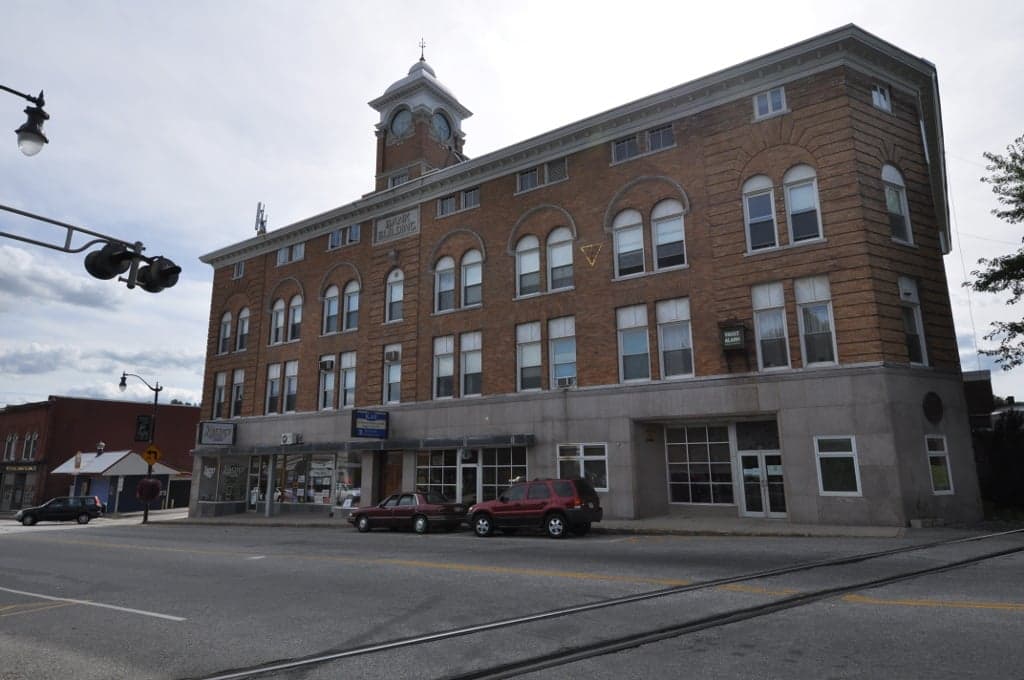
Photo: Wikipedia
Demographics of Livermore Falls, ME
Affluence Level in Livermore Falls, ME
A below-average socioeconomic profile. Incomes, home values, and educational attainment trail the U.S., with higher poverty and unemployment.
People of Livermore Falls, ME
The roughly 1,250 residents of Livermore Falls, Maine form a remarkably homogeneous, predominantly white community rooted in the town’s industrial past. With 96.9% of the population identifying as white and a foreign-born share of just 2.6%, the town is one of the least ethnically diverse in Androscoggin County. A low college attainment rate of 17.3% reflects a workforce historically tied to manufacturing and trades, giving the community a blue-collar, self-reliant character that aligns with the broader rural Maine identity.
How the city was settled and grew
Livermore Falls was originally part of the larger Livermore plantation, granted to settlers after the American Revolution. The town’s population grew slowly through the early 1800s as farmers cleared land along the Androscoggin River. The real turning point came in the mid-19th century with the construction of the Rumford Falls and Buckfield Railroad and the harnessing of the river’s water power. The Otis Falls dam and the subsequent establishment of paper mills—most notably the International Paper Company mill—drew waves of French-Canadian immigrants from Quebec between 1880 and 1920. These families settled in the Mill Village district, a dense cluster of company-built tenements and single-family homes along the riverbank. A smaller wave of Irish and Scottish workers arrived during the same period, forming the East Livermore neighborhood, where their descendants still live today. By 1920, the town’s population peaked near 2,500, driven entirely by mill employment.
Modern era (post-1965)
The post-1965 era brought no significant influx of foreign-born residents to Livermore Falls. The 1965 Hart-Cellar Act, which reshaped U.S. immigration, had virtually no effect here: the town’s foreign-born share remains negligible. Instead, the dominant demographic story has been domestic out-migration. The International Paper mill, once the town’s economic anchor, began downsizing in the 1980s and eventually closed in 2008, triggering a steady population decline from 1,900 in 1990 to 1,250 today. The North Livermore neighborhood, once a thriving middle-class area of mill supervisors and small business owners, has seen the most visible population loss, with several blocks of homes now vacant or converted to seasonal use. The South Main Street corridor, historically home to the town’s few non-white families (largely Black and multiracial households), has remained stable but small—the 1.6% Black population today is concentrated in a handful of extended families who have lived there for generations. No measurable East/Southeast Asian, Indian, or Hispanic communities exist in the town.
The future
Livermore Falls is likely to continue its slow population decline over the next 10–20 years. The town’s age structure is older than the state average, with a median age near 47, and few young families are moving in to replace retirees. The lack of rental housing and the poor condition of many mill-era homes in the Mill Village district deter in-migration. There is no sign of increasing diversity: the white share has held steady at 96–97% for two decades, and the foreign-born rate has not budged. The only potential growth vector is remote workers priced out of Portland or Lewiston, who may buy cheap properties in the Upper Main Street area, but this inflow is too small to reverse the demographic trend. The town’s cultural identity—French-American, Catholic, and union-oriented—remains intact but is aging out.
For someone moving in now, Livermore Falls offers a quiet, affordable, and culturally stable environment, but one with a shrinking tax base and limited economic opportunity. The community is best suited for those seeking low-cost rural living and a tight-knit, predominantly white social fabric, rather than diversity or urban amenities. The town is becoming smaller and older, not more diverse or dynamic.

* Values derived from national, state, county, city and local statistics and may differ in a specific area. Last updated: 2026-11-22T13:56:18.000Z
Narrative content on this page is AI-generated and may contain mistakes. Verify any details that matter before acting on them.
ReloMaps may earn a commission from affiliate links at no extra cost to you.

