
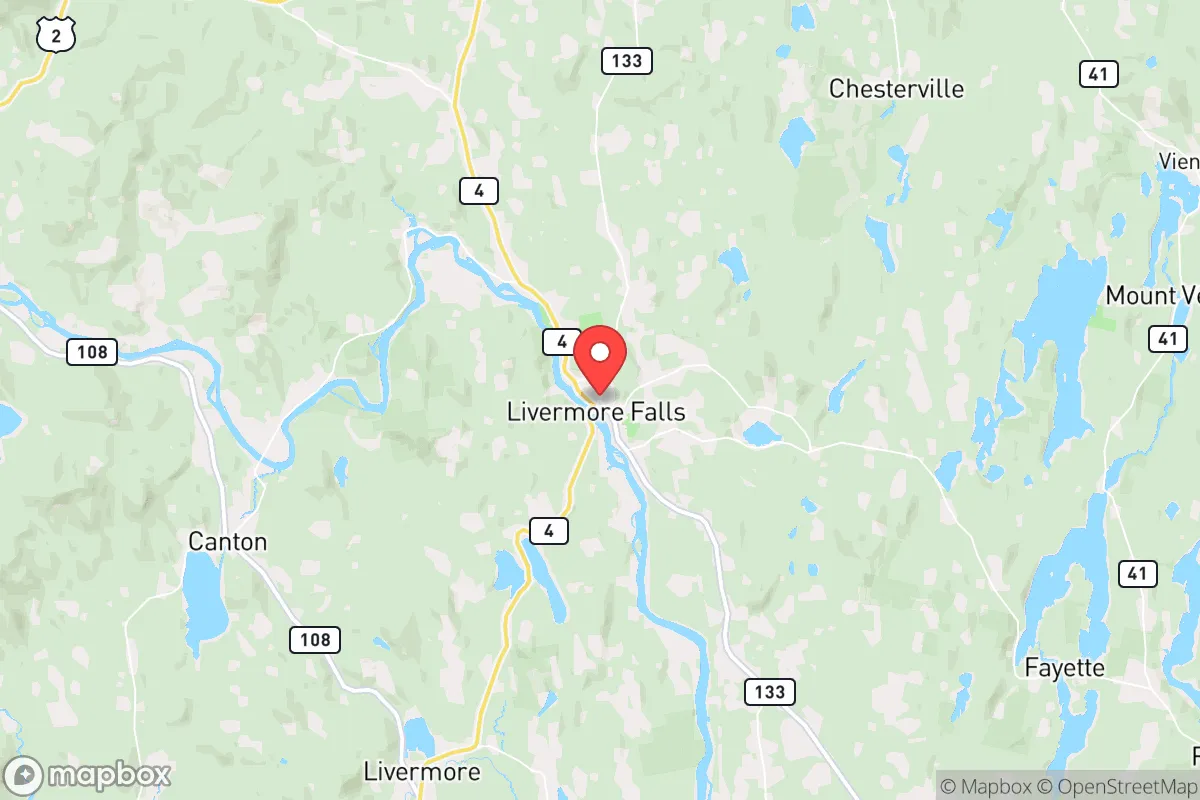
Photo: Wikipedia
Personal Sovereignty in Livermore Falls, ME
Viable for self-reliance. Generally workable, though some barriers may limit total independence.
What does Personal Sovereignty tell us?
Personal Sovereignty measures your capacity for self-reliance and independence with minimal government friction. Higher scores mean fewer barriers between you and the way you want to live... but it assumes you have the space you need and good neighbors.
What does this tell us?
Personal Sovereignty measures your capacity for self-reliance and independence with minimal government friction. Higher scores mean fewer barriers between you and the way you want to live... but it assumes you have the space you need and good neighbors.
State Policy
Energy independence: Importer (27% of energy produced in-state)
Personal Liberty
Homesteading

Personal Liberty Analysis
Livermore Falls, Maine, offers a personal sovereignty environment that leans heavily on the state's longstanding tradition of local control and individual liberty, tempered by a modest tax burden and a regulatory framework that is generally permissive but not libertarian. For a relocation reader prioritizing autonomy, the town sits within a state that ranks in the middle of the pack for overall freedom according to indices like the Cato Institute's, but its rural character and small population (roughly 3,100 residents) mean that day-to-day interference from local government is minimal. The key trade-off is that while Maine's state-level policies on taxes and land use are moderate, its gun laws and medical autonomy protections are among the strongest in New England, making Livermore Falls a viable option for those who value self-defense rights and personal healthcare decisions without the high costs or regulatory density of southern Maine.
Tax burden and regulatory posture in Livermore Falls
Maine's overall tax burden is relatively high compared to the national average—ranking 11th highest in the nation according to the Tax Foundation's 2025 State Business Tax Climate Index—but Livermore Falls benefits from a lower property tax rate than many coastal communities. The town's mill rate hovers around 18.5 mills, meaning a home valued at $150,000 would incur roughly $2,775 in annual property taxes, which is manageable for a rural area. There is no local sales tax, though the state levies a 5.5% sales tax on most goods. Income taxes are progressive, with a top marginal rate of 7.15% on income over $62,550 for single filers, which is higher than neighboring New Hampshire but lower than Vermont. The regulatory posture in Livermore Falls is light-touch: the town has no zoning ordinance for most residential parcels, relying instead on a comprehensive plan that guides development without heavy permitting. Building permits are required for new structures but are processed quickly, typically within two weeks. The state's environmental regulations, particularly around shoreland zoning and wetlands, can add complexity for waterfront properties, but for standard rural lots, the permitting process is straightforward and inexpensive.
Self-defense rights and Maine gun law specifics
Maine is a "shall issue" state for concealed carry permits, and Livermore Falls residents can obtain a permit from the local sheriff's office with a background check and a $35 fee, typically issued within 30 days. The state also permits constitutional carry (permitless carry) for anyone 21 or older who is legally allowed to possess a firearm, which took effect in 2015. There is no state-level assault weapons ban, no magazine capacity limit, and no waiting period for firearm purchases. Private sales between individuals do not require a background check, though federal law applies to licensed dealers. Stand-your-ground laws are not explicitly codified in Maine statute, but the state's Castle Doctrine provides a strong presumption that a person using deadly force in their home or vehicle acted in self-defense, and there is no duty to retreat in those locations. Outside the home, Maine law requires a duty to retreat if safely possible before using deadly force, which is a notable difference from more permissive states like Texas or Florida. For a conservative-leaning reader, Livermore Falls offers a gun-friendly environment that is among the most permissive in New England, though not as expansive as states in the South or Mountain West.
Self-reliance and homesteading viability in Livermore Falls
Livermore Falls is well-suited for self-reliant living, with large rural lots and minimal zoning restrictions that make homesteading feasible. The median lot size in the town's outlying areas is 2 to 5 acres, and parcels of 10 to 20 acres are common and affordable, with raw land prices ranging from $2,000 to $5,000 per acre as of 2025. There is no town-wide zoning ordinance for agricultural use, so keeping chickens, goats, or even a small herd of cattle is permitted without special permits, provided the property meets basic setback requirements from neighbors. Off-grid living is legally viable: Maine has no state law requiring connection to municipal water or sewer, and many rural homes rely on private wells and septic systems. Solar panels are allowed without restriction, and net metering is available through Central Maine Power, though the state's net metering cap is 60% of a customer's average annual usage. Rainwater collection is legal and unregulated. The growing season is short (roughly 120 days between last and first frost), but cold-hardy crops like potatoes, kale, and root vegetables thrive. Wood heat is common, with firewood available locally for $200 to $300 per cord. The main constraint for full self-reliance is the relatively high cost of land compared to the Midwest or South, but for a New England setting, Livermore Falls offers a realistic path to a semi-self-sufficient lifestyle.
Personal liberties: parental rights, medical autonomy, speech, and property
Maine's legal framework generally supports personal liberties, though with some notable state-level constraints. Parental rights are strong: Maine law requires parental consent for minors to receive most medical treatments, and the state's "Parents' Bill of Rights" (enacted in 2023) affirms that parents have the fundamental right to direct the upbringing, education, and care of their children. However, Maine does not have a school voucher or education savings account program, and the state's public school curriculum is set by the Maine Department of Education, which limits local control over content. Medical autonomy is robust: Maine was one of the first states to legalize physician-assisted suicide (under the Maine Death with Dignity Act), and it has no state-level restrictions on gender-affirming care for adults. Vaccine mandates are limited to healthcare workers and school attendance, though religious and philosophical exemptions are available for school immunization requirements. Free speech is protected under the Maine Constitution, and the state has no hate speech laws that criminalize protected speech, though it does have a "malicious harassment" statute that can enhance penalties for crimes motivated by bias. Property rights are well-protected: eminent domain is limited to public uses, and the state has a "right to farm" law that shields agricultural operations from nuisance lawsuits if they follow generally accepted practices. For a conservative-leaning reader, Livermore Falls offers a solid baseline of personal liberties, with the main trade-offs being higher taxes than some alternatives and less local control over education policy.
Overall, Livermore Falls provides a personal sovereignty environment that is strong by New England standards but moderate compared to the most permissive states in the South or West. The combination of constitutional carry, low property taxes for rural land, minimal zoning, and viable off-grid options makes it a practical choice for someone who values self-reliance and wants to avoid the regulatory density of urban areas. The main drawbacks are Maine's relatively high income tax and the state's duty-to-retreat law outside the home, which may be dealbreakers for those accustomed to more libertarian jurisdictions. For a family or individual willing to accept a moderate tax burden in exchange for a rural lifestyle with strong gun rights and medical autonomy, Livermore Falls ranks favorably among small-town New England options.

* Values derived from national, state, county, city and local statistics and may differ in a specific area. Last updated: 2026-11-22T13:56:18.000Z
Narrative content on this page is AI-generated and may contain mistakes. Verify any details that matter before acting on them.
ReloMaps may earn a commission from affiliate links at no extra cost to you.

