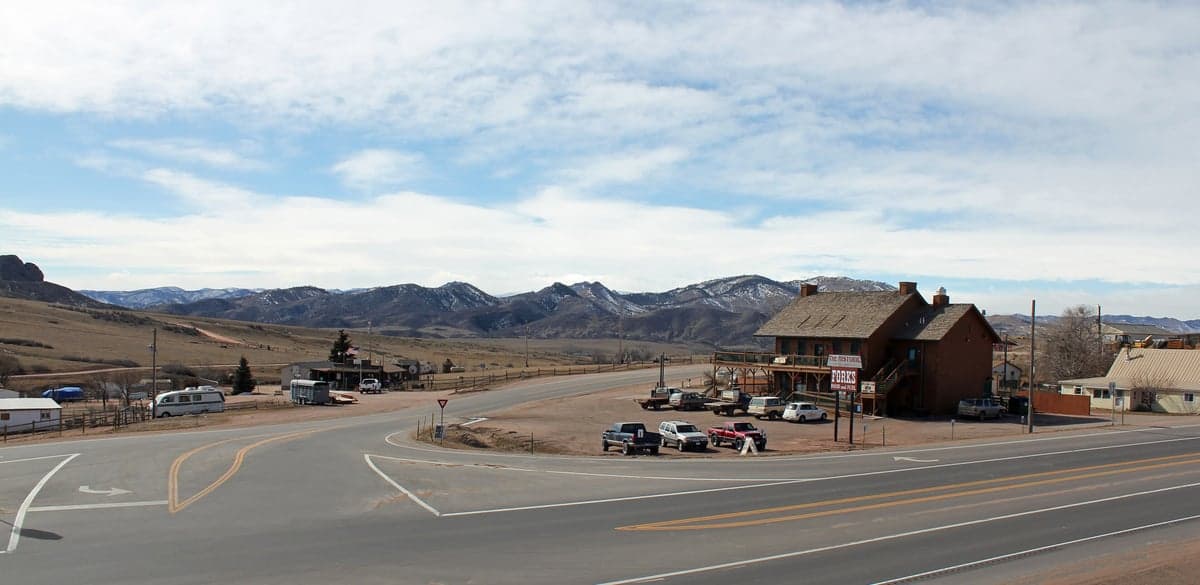
Photo: Wikipedia
Political ClimatePolitical Climate in Livermore, CO
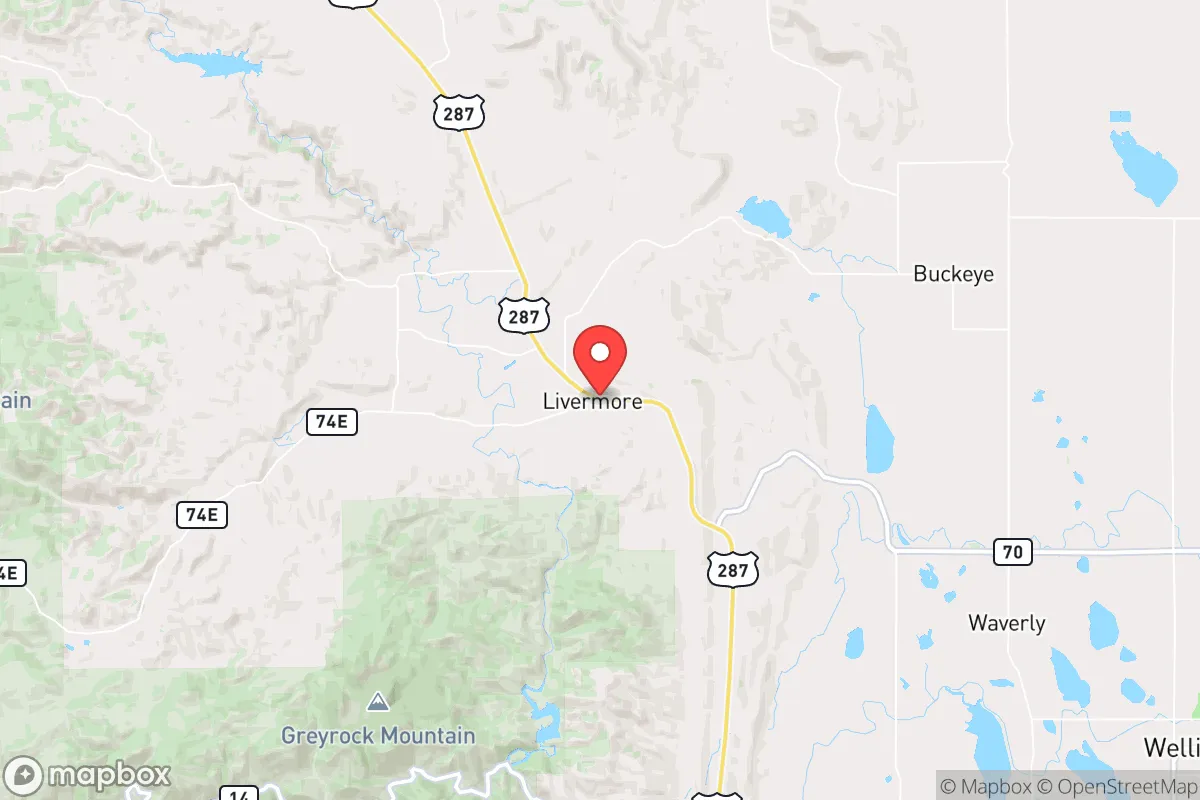
District shown is the primary district for this city’s centroid. Cities may span multiple districts.
Local Political AnalysisPolitical Analysis of Livermore, CO
Livermore, Colorado, is a deep blue island in a sea of red, carrying a Cook Partisan Voting Index of D+20 that makes it one of the most reliably Democratic communities in the state. This isn't a purple swing town; it's a place where Democrats routinely win by double digits, and the local political conversation leans heavily progressive on everything from land use to energy policy. That said, the surrounding Larimer County has been trending bluer over the last decade, especially in the Fort Collins corridor, but once you get north and west of Livermore into the unincorporated ranchlands, the politics shift hard right. The contrast between Livermore's D+20 lean and the deep-red precincts just a few miles up the road in places like Red Feather Lakes or the Wyoming border country is about as stark as it gets in Colorado.
How it compares
Compared to Colorado as a whole, Livermore is significantly more liberal. The state overall is a light blue battleground — it voted for Biden by about 13 points in 2020 and has a Democratic trifecta in state government — but Livermore's D+20 rating puts it in the same league as Boulder or Denver's core neighborhoods. That's a far cry from the rest of Larimer County's rural north, where precincts often vote +20 to +30 Republican. If you drive 20 minutes east to Wellington or 30 minutes south to Fort Collins, you'll find a more mixed political environment, with Fort Collins leaning left but not as overwhelmingly as Livermore. The real contrast is with the small towns to the north and west: places like Walden (Jackson County) vote reliably red, and the Wyoming border counties are deep Republican territory. So Livermore isn't just blue for a rural town — it's an outlier even within its own county.
What this means for residents
For liberal residents, Livermore offers a rare experience in rural Colorado: you can talk local politics without feeling like a minority. The town's progressive lean means local government, school board decisions, and community priorities tend to reflect environmental stewardship, renewable energy investments, and inclusive social policies. Conservative residents, however, aren't shut out — they just have to drive a few miles to find their political tribe. The practical reality is that Livermore's small population means most political disagreements stay civil, and the shared challenges of rural life — wildfire risk, water rights, wildlife management — tend to override partisan divides. Property taxes and land-use regulations in Livermore are shaped by Larimer County's more progressive board, which can frustrate ranchers and landowners who feel overregulated compared to their counterparts in Jackson or Weld counties.
Culturally, Livermore feels more like a mountain town than a plains community, and that identity shapes its politics. The area attracts people who value open space, outdoor recreation, and a slower pace of life, which tends to pull the electorate left on environmental issues but keeps it pragmatic on fiscal matters. There's a noticeable absence of the culture-war intensity you see in suburban Denver or Colorado Springs; people here are more concerned with keeping the roads plowed and the elk population healthy than with national political drama. Looking ahead, Livermore's D+20 lean is likely to hold or even deepen as more Front Range refugees move north seeking affordable land and mountain views, bringing their urban voting habits with them. The long-term trajectory points toward Livermore becoming even more of a progressive stronghold in an otherwise conservative corner of the state.

State Political ClimatePolitical Climate in Colorado
State Political AnalysisPolitical Environment in the State
Colorado has shifted from a classic purple swing state to a solidly blue-leaning state over the past two decades, but it’s a far cry from the monolithic liberalism of the coasts. The state’s overall partisan lean is now roughly D+5 to D+7 in statewide elections, driven almost entirely by the explosive growth of the Denver-Boulder-Aurora metroplex and the I-25 Front Range corridor. While Democrats have won every presidential election here since 2008 and control both legislative chambers and the governorship, the state still harbors deep conservative pockets in the eastern plains, the Western Slope, and the southern mountain valleys. For a conservative-leaning relocator, the reality is that you can find a politically comfortable home here, but you’ll be living in a state where state-level policy is increasingly progressive.
Urban vs. rural divide
The political map of Colorado is a story of two starkly different Colorados. The urban core — Denver, Boulder, and the inner-ring suburbs like Lakewood and Aurora — is overwhelmingly Democratic, often voting 65-75% for the party’s candidates. This is where the state’s population and economic engine live, and it’s why the state has turned blue. The I-25 corridor from Fort Collins down through Denver to Colorado Springs is a political gradient: Fort Collins and Boulder are deep blue, Denver is blue, Colorado Springs is a red island (home to Focus on the Family and the Air Force Academy), and Pueblo is a working-class blue-collar town that has trended redder in recent cycles. Outside the Front Range, the state flips hard. The Eastern Plains (counties like Yuma, Kit Carson, and Prowers) vote 80% Republican. The Western Slope — places like Grand Junction, Montrose, and Delta — is reliably red, though the resort towns of Aspen, Telluride, and Summit County are blue enclaves. The most politically interesting county in recent years is Douglas County, south of Denver. Once a Republican stronghold, it has been trending purple, flipping to Biden in 2020 by a slim margin, a canary in the coal mine for suburban Colorado’s rightward drift stalling out.
Policy environment
Colorado’s policy environment is a mixed bag that reflects its purple-to-blue trajectory. The state has a flat income tax rate of 4.4% (recently reduced from 4.55% via a voter-approved TABOR refund mechanism), and property taxes are relatively low compared to Texas or the Northeast, though they vary significantly by county. The Taxpayer’s Bill of Rights (TABOR) remains a uniquely Colorado check on government growth, requiring voter approval for tax increases and capping revenue growth — a structural restraint conservatives appreciate. On regulation, Colorado is business-friendly in many sectors (especially aerospace, tech, and outdoor recreation) but has aggressive environmental regulations, including a strict oil and gas permitting regime (SB 19-181) that has effectively limited new drilling in the Front Range. Education policy is a flashpoint: the state has a robust school choice system with charter schools and open enrollment, but the Denver Public Schools system has been a battleground over school board control, with progressive candidates winning recent elections. Healthcare is heavily regulated, with a state-based insurance exchange and a public option law (HB 21-1232) that took effect in 2022. Election laws are among the most accessible in the nation: universal mail-in ballots, same-day registration, and automatic voter registration — a system conservatives often criticize for security concerns, though fraud rates are statistically negligible.
Recent policy direction
The last five years have seen Colorado’s legislature push aggressively left on several fronts that matter to relocators weighing personal liberties. On guns, Colorado passed a series of restrictions: a 2021 law requiring universal background checks for private sales (already on the books since 2013), a 2023 law raising the purchase age for all firearms to 21 (HB 23-1219), and a 2024 law banning so-called “assault weapons” (HB 24-1292), which is currently tied up in litigation. Magazine capacity limits of 15 rounds have been in place since 2013. For self-defense, Colorado is a “shall issue” state for concealed carry permits, but permitless carry (constitutional carry) has not passed. On education and parental rights, the state has moved in the opposite direction from many red states: a 2023 law (SB 23-276) prohibits school boards from banning books based on “controversial” content, and the state has expanded LGBTQ+ protections in schools. On medical and bodily autonomy, Colorado has some of the most permissive laws in the country: abortion is legal without gestational limits, the state has a “safe haven” law for out-of-state abortion seekers, and it legalized psychedelic mushrooms (psilocybin) for therapeutic use via Proposition 122 in 2022. Property rights are a mixed bag: the state has strong eminent domain protections, but local zoning battles (especially around ADUs and density) are intense. On privacy and surveillance, Colorado passed one of the nation’s strongest data privacy laws (CPA) in 2021, giving residents control over their personal data. Voting access remains expansive, with no voter ID requirement at the polls (though mail ballots require a signature match).
Civil unrest & political movements
Colorado has a visible and active protest culture, particularly in Denver. The 2020 George Floyd protests were large and occasionally violent, leading to property damage downtown and a lasting tension between city leadership and law enforcement. The state has seen organized activist movements on both sides: left-wing groups like the Colorado Freedom Fund (bail reform) and Showing Up for Racial Justice are active, while right-wing groups like the Colorado Republican Party’s more populist wing and various county-level “liberty” groups have been vocal, especially on election integrity and land use issues. Immigration politics are a flashpoint: Denver has been a “sanctuary city” since 2017, and the 2023-2024 surge of migrants from the southern border overwhelmed the city’s shelter system, causing a political crisis that saw the mayor and governor clash over funding. The state has also seen secessionist rhetoric from the Eastern Plains and Western Slope — the “State of Jefferson” movement and “51st state” talk — but it remains fringe. Election integrity controversies have been less intense here than in states like Arizona or Georgia, but the 2020 election did see a handful of county-level GOP officials question Dominion voting machines, and a 2022 audit of Mesa County (Grand Junction) gained national attention when the clerk was indicted for security breaches. For a new resident, the most visible flashpoint is likely the homeless encampments in Denver and the ongoing tension between urban progressive policies and rural conservative values.
Projection
Over the next 5-10 years, Colorado is likely to continue its slow leftward drift at the state level, but the pace may moderate. The key demographic driver is the continued influx of out-of-state migrants, primarily from California, Texas, and the Midwest. These newcomers tend to be younger, more educated, and more liberal-leaning, reinforcing the Front Range’s blue tilt. However, there are countervailing forces: the high cost of housing in Denver and Boulder is pushing some families to exurban and rural areas, potentially injecting more conservative-leaning voters into red districts. The state’s Republican Party is in disarray, struggling to find a message that appeals to both suburban moderates and rural conservatives. A realistic projection is that Colorado remains a D+5 to D+8 state for the next decade, with occasional Republican wins in down-ballot races (like the 2022 governor’s race, which was closer than expected). The most likely scenario for a conservative relocator is that state-level policy continues to trend left on guns, environmental regulation, and social issues, but that local control in conservative counties and the TABOR tax restraint provide meaningful buffers. The wildcard is the 2026 gubernatorial race — if a moderate Republican wins, the trajectory could shift.
For a new resident, the bottom line is this: Colorado is a blue state with red pockets. If you’re a conservative moving here, you’ll find like-minded communities in Colorado Springs, Grand Junction, Douglas County (for now), and the rural plains and mountains. You’ll pay moderate taxes, benefit from TABOR protections, and have access to excellent schools in many suburbs. But you’ll also live under a state government that is actively expanding gun control, protecting abortion access, and regulating energy development. The practical takeaway is to choose your county carefully — local government in Colorado still matters a great deal, and the difference between living in Douglas County and Boulder County is night and day. If you can tolerate a blue state government while living in a red community, Colorado offers a high quality of life. If you want a state government that reflects your values, you may want to look at Wyoming or Texas instead.
* Values derived from national, state, county, city and local statistics and may differ in a specific area. Last updated: 2026-10-21T19:15:22.000Z
Narrative content on this page is AI-generated and may contain mistakes. Verify any details that matter before acting on them.
ReloMaps may earn a commission from affiliate links at no extra cost to you.

