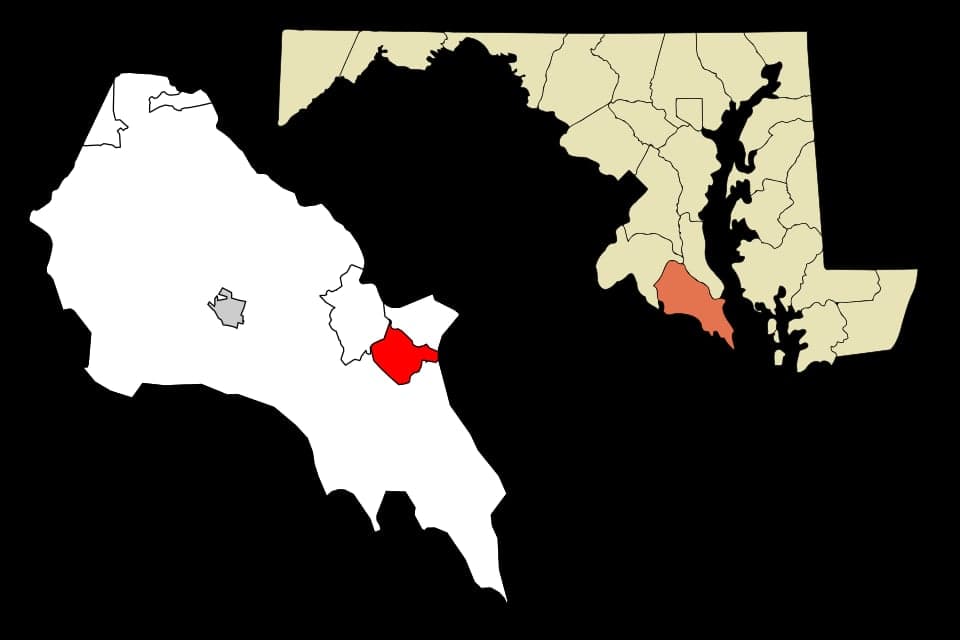
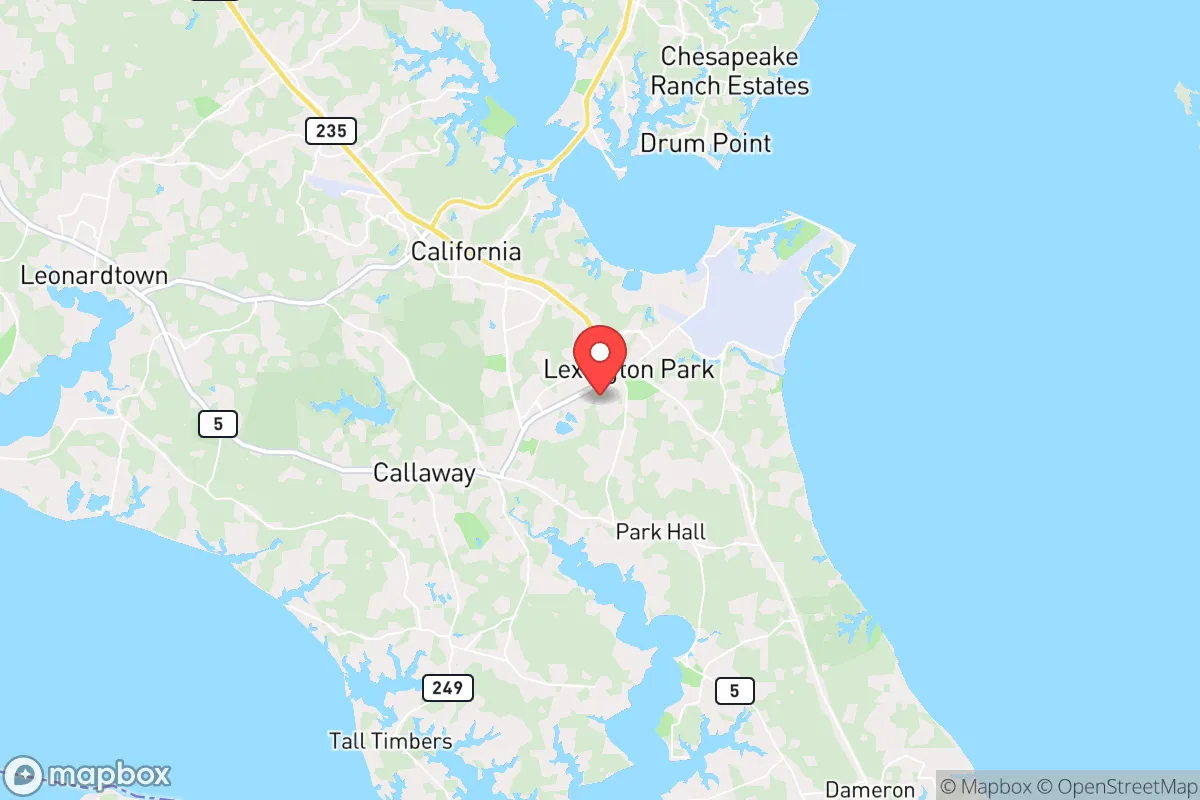
Photo: Wikipedia
Political ClimatePolitical Climate in Lexington Park, MD
District shown is the primary district for this city’s centroid. Cities may span multiple districts.
Inherited from parent county — no local data available.
* Lean and PVI are calculated from the surrounding county’s 2020 and 2024 presidential results, Cook-style — a finer measure here than its congressional district (MD-5).
Political rankings in Maryland
- Most Conservative Cities in Maryland
- Most Liberal Cities in Maryland
- Best Conservative-Leaning Towns in the Mid-Atlantic
- Safest Liberal-Leaning Towns on the East Coast
- Safest Conservative-Leaning Towns on the East Coast
- Affordable Small Towns for Conservatives
- Most Affordable Liberal-Leaning Small Towns in the U.S.
- Safest Liberal-Leaning Cities in the U.S.
- Most Conservative Counties in Maryland
- Most Liberal Counties in Maryland
Local Political AnalysisPolitical Analysis of Lexington Park, MD
Lexington Park is a solidly conservative pocket in a deep blue state, with a Cook PVI of R+9 that makes it one of the most reliably Republican areas in Maryland. That R+9 rating means the district votes about 9 points more Republican than the national average, a stark contrast to Maryland’s statewide PVI of D+17. This isn’t a recent flip, either—the area has leaned right for decades, driven largely by the military and defense contractor workforce at Naval Air Station Patuxent River. If you’re coming from somewhere like Bethesda or Baltimore, the shift in yard signs and bumper stickers is immediate and unmistakable.
How it compares
The gap between Lexington Park and the rest of Maryland is one of the widest in the state. While Maryland as a whole hasn’t voted for a Republican presidential candidate since 1988, St. Mary’s County—where Lexington Park sits—has gone red in every election this century. In 2024, the county backed Trump by roughly 18 points, even as the state went for Harris by 23. For context, drive 30 minutes north to Prince Frederick in Calvert County, and you’ll find a more purple area (R+4). Head east across the Chesapeake Bay Bridge to Anne Arundel County, and you’re in D+7 territory. The closest politically similar town of any size is probably California, MD, just south of Lexington Park, which shares the same R+9 lean. The divide isn’t just about presidential races either—local school board and county commission elections here are dominated by Republicans, whereas in most of Maryland, Democrats hold those seats comfortably.
What this means for residents
For conservative residents, Lexington Park feels like a safe haven. You’ll find plenty of local Republican clubs, conservative churches, and gun-friendly policies that are rare in the rest of the state. The county government is reliably red, so zoning, taxes, and school funding tend to reflect small-government priorities. For liberal residents, it’s a different story. You’re in the minority, but not isolated—there’s a visible Democratic club in the county, and the base itself is heavily military, which tends to be socially moderate on some issues. You won’t see many “Defund the Police” signs here, but you will find a pragmatic, live-and-let-live attitude among many neighbors. The real friction comes on state-level issues: Lexington Park residents often feel overruled by Annapolis on things like gun laws, environmental regulations, and education mandates. That tension is baked into daily life, but it rarely boils over into open conflict.
One cultural distinction worth noting: the area’s politics are heavily shaped by the base’s presence. Pax River employs over 20,000 people, many of whom are veterans or active-duty personnel. That gives the local conservatism a practical, mission-focused flavor rather than a culture-war edge. You’re more likely to hear someone argue about defense spending than about school library books. Looking ahead, the trajectory is stable—the base isn’t going anywhere, and the surrounding population is growing slowly but steadily. If anything, the area may become slightly more Republican as retirees from other parts of the state move here for the lower cost of living and conservative governance. For anyone moving to Lexington Park, the political reality is simple: you’ll be living in a red island in a blue state, and that shapes everything from your property taxes to your commute to Annapolis.

State Political ClimatePolitical Climate in Maryland
State Political AnalysisPolitical Environment in the State
Maryland is one of the most reliably Democratic states in the country, with a Cook Partisan Voting Index of D+17, meaning it votes about 17 points more Democratic than the national average in presidential elections. The state hasn’t voted for a Republican presidential candidate since George H.W. Bush in 1988, and Democrats hold supermajorities in both chambers of the General Assembly. Over the last 10-20 years, the state has shifted further left, driven by explosive growth in the Washington, D.C. suburbs and a steady exodus of conservative-leaning voters from rural areas and the Eastern Shore. That said, the state is far from a monolith—there are deep red pockets, a strong moderate streak in some counties, and a political culture that often feels like two different states depending on where you stand.
Urban vs. rural divide
The political map of Maryland is a textbook case of the urban-rural split. The entire Democratic majority is generated by the Washington, D.C. suburbs—Montgomery County and Prince George’s County—along with Baltimore City and, to a lesser extent, Howard County and Anne Arundel County. Montgomery County alone, with over a million residents, votes about 80% Democratic in presidential races. Prince George’s County, the wealthiest majority-Black county in the U.S., is even more lopsided. Baltimore City, despite population decline, remains a Democratic stronghold. Meanwhile, the rest of the state votes Republican. Western Maryland—Garrett, Allegany, and Washington counties—is deeply red, with Garrett County often voting 70%+ Republican. The Eastern Shore, including counties like Wicomico, Talbot, and Queen Anne’s, is reliably conservative, though the shore’s growth is slowly moderating it. The key swing area is the Baltimore suburbs: Baltimore County and Harford County. Baltimore County has trended blue over the past decade, while Harford remains a Republican holdout. The divide is stark: drive 30 minutes west of D.C. into Frederick County, and you’ll find a purple-to-red area that’s been slowly shifting left as D.C. commuters move in.
Policy environment
Maryland’s policy environment is solidly progressive, with high taxes, strong regulations, and expansive government services. The state has a progressive income tax structure with rates from 2% to 5.75%, and localities add their own piggyback tax—Montgomery County’s combined rate can exceed 8%. Property taxes are moderate but vary wildly by county. Sales tax is 6%, with no local add-ons. The regulatory posture is business-friendly in some sectors (biotech, cybersecurity) but burdensome for small businesses and manufacturing. Education policy is a mixed bag: Maryland consistently ranks near the top nationally for K-12 outcomes, but that’s driven almost entirely by the wealthy D.C. suburbs. Rural schools in Western Maryland and the Eastern Shore struggle with funding and performance. The state has a strong public university system, led by the University of Maryland, College Park. Healthcare is heavily regulated, with a state-run insurance exchange and Medicaid expansion under the ACA. Election laws are among the most accessible in the country: no-excuse mail-in voting, same-day registration, early voting, and automatic voter registration. Gun laws are among the strictest nationally, requiring a permit to purchase a handgun, a background check for all sales, and a “good and substantial reason” for a concealed carry permit—though the Supreme Court’s Bruen decision in 2022 forced the state to loosen that last requirement.
Recent policy direction
Over the last five years, Maryland has moved decisively left on nearly every front. In 2023, the legislature passed the Maryland Reproductive Health Protection Act, which expanded abortion access and protected providers from out-of-state lawsuits. The same year, the Maryland Gun Safety Act banned firearms in certain public places and required a state police-issued handgun qualification license. In 2024, the state enacted a parental rights in education law that requires school districts to notify parents of changes to a student’s services or mental health—but it’s weaker than similar laws in Florida or Texas. On privacy, Maryland passed the Maryland Online Data Privacy Act in 2024, giving residents the right to opt out of data collection and request deletion. Property rights are generally strong, though the state’s Blueprint for Maryland’s Future education funding plan has led to property tax increases in some counties. On voting, the state expanded mail-in voting permanently after the pandemic and now allows same-day registration. On taxation, the trend is upward: in 2024, the legislature passed a digital advertising tax (currently tied up in court) and a wealth tax on capital gains over $350,000. For a conservative relocator, the practical takeaway is that the state’s policy direction is unambiguously progressive, with no sign of reversal.
Civil unrest & political movements
Maryland has a history of visible political activism, particularly in the D.C. suburbs and Baltimore. The 2020 George Floyd protests were large and occasionally violent in Baltimore, with property damage and clashes with police. The state is home to a strong progressive activist infrastructure, including groups like CASA de Maryland (immigrant rights) and Maryland Working Families Party. On the right, the Maryland Republican Party is fractured between moderates and Trump-aligned conservatives, but there are active grassroots groups like Moms for Liberty chapters in several counties. Immigration politics are a flashpoint: Maryland is a sanctuary state, with a 2023 law prohibiting state and local law enforcement from cooperating with federal immigration enforcement in most circumstances. This has led to tensions in more conservative counties like Harford and Carroll, where local officials have tried to push back. Election integrity controversies have been relatively muted compared to other states, though some Republican county officials have raised concerns about mail-in ballot security. The most visible flashpoint for a new resident would likely be the Blueprint for Maryland’s Future—a massive education funding plan that has driven up property taxes in some areas and sparked local school board battles. Overall, the state is not a hotbed of civil unrest, but the political divide is real and visible in local elections and school board meetings.
Projection
Over the next 5-10 years, Maryland will likely become even more Democratic. The D.C. suburbs continue to grow, with Montgomery and Prince George’s counties adding population while rural areas decline. In-migration is heavily from other blue states (Virginia, New York, California) and from abroad, not from red states. The state’s high cost of living and tax burden are pushing some conservative-leaning residents to Delaware, Pennsylvania, or Florida, but the net effect is a slow leftward drift. The Republican Party in Maryland is increasingly confined to the rural west and Eastern Shore, with little chance of winning statewide office—the last Republican governor, Larry Hogan, was a moderate who won in 2014 and 2018 by distancing himself from the national party. His departure in 2023 left the state GOP without a clear leader. The next decade will likely see continued expansion of progressive policies: a public option for health insurance, further gun restrictions, and possibly a state-level wealth tax. For a conservative moving in now, expect to be in a permanent minority at the state level, though local control in places like Frederick, Carroll, or Harford counties can provide a more conservative environment.
For a new resident, the bottom line is this: Maryland offers a high quality of life with excellent schools, strong infrastructure, and proximity to D.C., but it comes with high taxes, strict regulations, and a political environment that is unapologetically progressive. If you’re conservative, you’ll find like-minded communities in Western Maryland, the Eastern Shore, and parts of the Baltimore suburbs, but you’ll have little influence on state policy. If you’re liberal, you’ll find a state that largely aligns with your values, especially in the D.C. suburbs. The key is to choose your county carefully—your experience in Montgomery County will be radically different from one in Garrett County. The state’s trajectory is clear, and it’s not changing direction anytime soon.
* Values derived from national, state, county, city and local statistics and may differ in a specific area. Last updated: 2026-11-12T16:37:17.000Z
Narrative content on this page is AI-generated and may contain mistakes. Verify any details that matter before acting on them.
ReloMaps may earn a commission from affiliate links at no extra cost to you.

