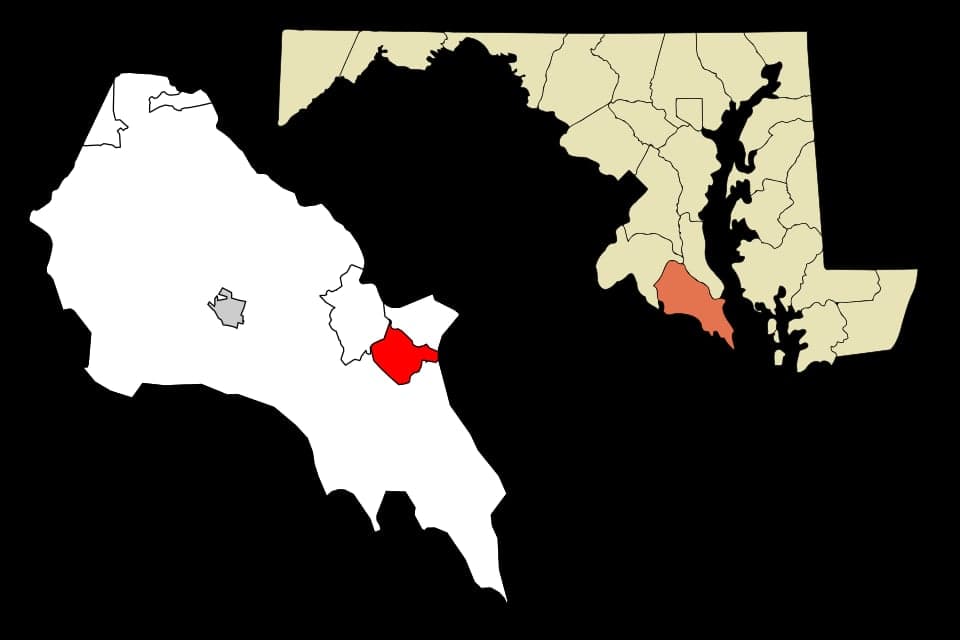
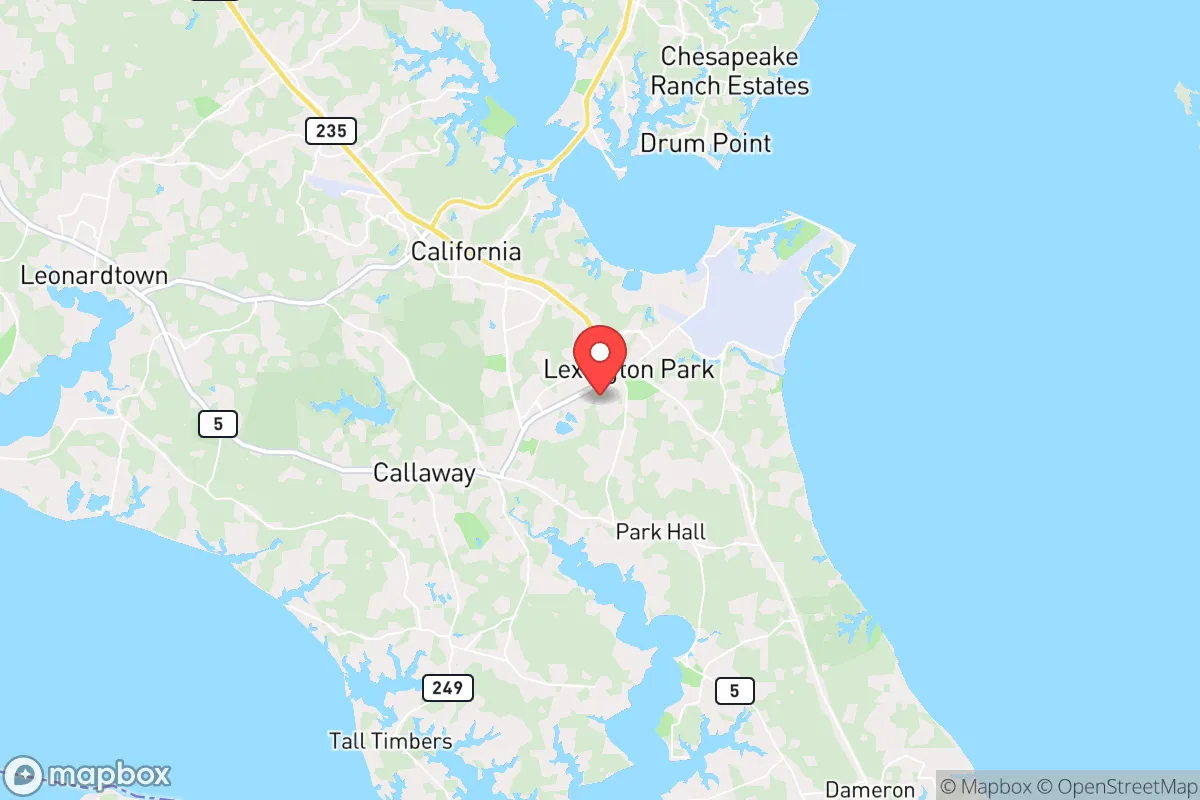
Photo: Wikipedia
Demographics of Lexington Park, MD
Affluence Level in Lexington Park, MD
A middle-class area roughly in line with national averages across income, home values, education, and employment.
People of Lexington Park, MD
Lexington Park, Maryland, is a community of roughly 13,400 residents shaped overwhelmingly by the U.S. Navy and the Patuxent River Naval Air Station (NAS Pax River). The population is distinctly biracial — 51.7% White and 34.1% Black — with a small but growing East/Southeast Asian presence at 3.9% and a very low foreign-born share of just 2.3%. This is a dense, working-to-middle-class suburb where military and civilian defense careers define daily life, and where the population's character is less about deep historical roots and more about transient, career-driven migration tied to the base.
How the city was settled and grew
Lexington Park did not exist as a settlement before the 20th century. The area was rural tobacco and timber land in St. Mary's County, with a sparse population of mostly English-descended farmers and enslaved African Americans working the plantations. The modern city was born in 1942 with the establishment of the Patuxent River Naval Air Station, which drew an immediate wave of military personnel, civilian engineers, and construction workers from across the country. The first neighborhoods to rise were modest government-built housing projects like Essex Estates and Village Green, built to house the influx of White officers and enlisted men and their families. Black workers, initially excluded from these developments, settled in older, unincorporated pockets like Great Mills and along Three Notch Road, where segregation-era housing patterns concentrated African American families in separate, often less developed areas. By 1960, the population had reached roughly 5,000, almost entirely tied to the base.
Modern era (post-1965)
The post-1965 period brought two major shifts. First, the end of official segregation and the expansion of civil rights opened previously White-only neighborhoods to Black families. Second, the 1970s and 1980s saw NAS Pax River grow into a major center for naval aviation testing, drawing a new wave of highly educated engineers and officers. This era saw the development of newer, more suburban subdivisions like Chancellor's Run and Hickory Hills, which attracted a mix of White and Black middle-class families, though informal clustering persisted. The 1990s and 2000s brought a small but notable influx of East/Southeast Asian professionals — particularly Filipino and Vietnamese families — many of whom worked as contractors or in technical roles on the base. These families concentrated in newer developments like Ridgewood and parts of Chancellor's Run, drawn by good schools and proximity to base gates. The Indian-subcontinent population remains negligible at 0.2%, and the Hispanic share is just 3.1%, reflecting the area's limited draw for immigrant labor outside the defense sector. The Black population share has remained remarkably stable at roughly one-third since the 1990s, while the White share has declined slightly from about 60% to 51.7% as the Asian and Hispanic shares have inched upward.
The future
The population of Lexington Park is likely to remain stable in size but slowly diversify. The foreign-born share, at just 2.3%, is far below the national average and is unlikely to surge, as the local economy offers few jobs outside the defense sector. The East/Southeast Asian share may grow modestly as more military and contractor families rotate through, but the area lacks the ethnic enclaves or chain migration patterns that drive rapid growth elsewhere. The Black and White shares will likely remain the dominant groups, with the population becoming slightly more mixed as younger, college-educated families (37.6% hold a bachelor's degree or higher) move into newer subdivisions like Chancellor's Run and Ridgewood, while older neighborhoods like Essex Estates and Village Green continue to house a higher proportion of longer-term, lower-income residents. The overall cultural identity will remain that of a Navy town — transient, patriotic, and career-focused — rather than evolving into a diverse, immigrant-rich community.
For someone moving in now, Lexington Park offers a stable, safety-conscious environment where the population is shaped by the base's rhythms rather than by broader demographic currents. The community is becoming slightly more diverse and more educated, but it remains fundamentally a biracial, middle-class suburb with a strong military ethos. New arrivals will find a place where neighbors come and go with deployments, and where the shared identity of service and support for NAS Pax River outweighs deeper ethnic or cultural divisions.

* Values derived from national, state, county, city and local statistics and may differ in a specific area. Last updated: 2026-11-12T16:37:17.000Z
Narrative content on this page is AI-generated and may contain mistakes. Verify any details that matter before acting on them.
ReloMaps may earn a commission from affiliate links at no extra cost to you.

