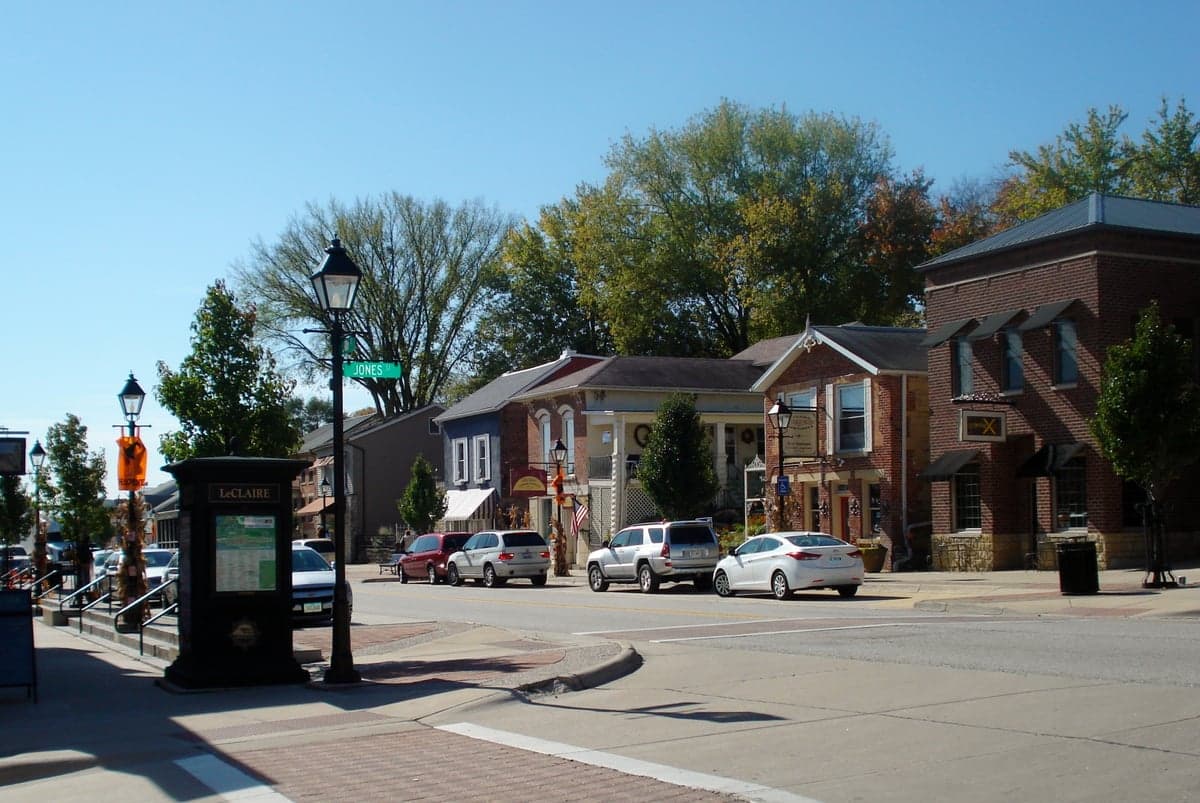
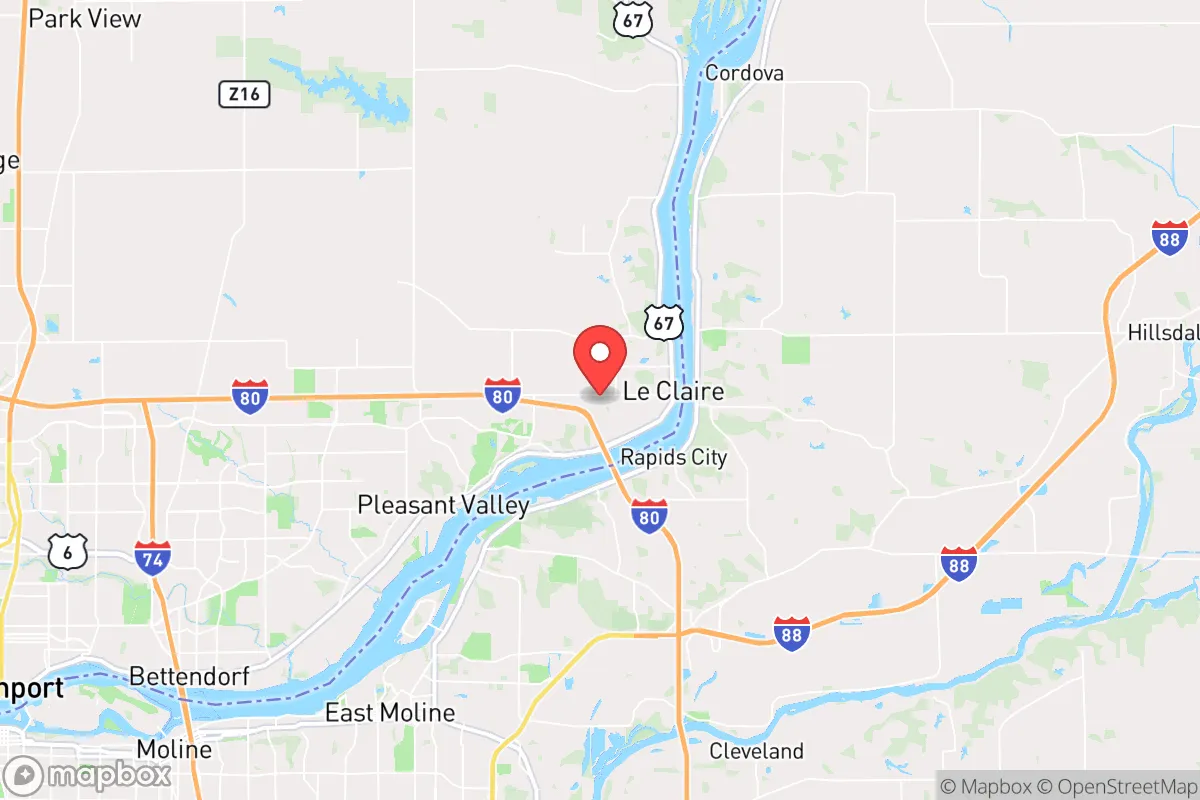
Photo: Wikipedia
Political ClimatePolitical Climate in Le Claire, IA
District shown is the primary district for this city’s centroid. Cities may span multiple districts.
Local Political AnalysisPolitical Analysis of Le Claire, IA
Le Claire leans Republican, but it’s a softer shade of red than much of Iowa. The area’s Cook Partisan Voting Index (PVI) of R+4 puts it two points to the left of the state’s overall R+6 rating, meaning you’ll find a noticeable number of independents and moderate Democrats here, especially compared to the deep-red rural precincts just a few miles west. That slight moderation has been a consistent feature for the last decade, driven by the town’s mix of riverfront tourism, a growing number of remote workers from the Quad Cities, and a local economy that’s less tied to agriculture than the rest of the state. If you’re looking for a place where the political temperature is a few degrees cooler than the surrounding countryside, Le Claire is it.
How it compares
Drive 15 minutes west to DeWitt or 20 minutes north to Maquoketa, and you’ll hit precincts that routinely vote 10 to 15 points more Republican than Le Claire. The contrast is even sharper with the Quad Cities metro area just across the Mississippi: Bettendorf and Davenport lean more Democratic, with Bettendorf’s PVI hovering around D+1 and Davenport’s closer to D+3. That riverfront proximity means Le Claire residents are exposed to a broader range of political views than most Iowans in towns of similar size. The local school board and city council races here tend to be decided by single-digit margins, whereas in nearby Scott County’s rural townships, Republican candidates often run unopposed. For a practical example: in the 2024 presidential primary, Le Claire’s precincts gave about 38% of the vote to Nikki Haley, significantly higher than the 22% she pulled in the county’s rural precincts—a sign that the town’s GOP voters are more willing to consider non-Trump candidates.
What this means for residents
For conservative residents, Le Claire offers a comfortable baseline: you’ll see plenty of yard signs for Republican candidates, the local gun club is active, and the county sheriff’s office is reliably conservative. But you won’t find the kind of hardline activism you might in more rural parts of the state. For liberal residents, the reality is that you’re in a minority, but not an isolated one. There’s a small but visible Democratic group that meets at the library, and the town’s annual Riverfront Festival draws a crowd that’s politically mixed enough that nobody feels the need to avoid certain topics. The practical upshot is that most policy debates here—whether about school funding, riverfront development, or zoning for new housing—tend to be pragmatic rather than ideological. The town council has approved both a new solar farm and a gun range expansion in the same year, which tells you something about the local appetite for compromise.
One cultural distinction worth noting: Le Claire’s identity as the home of the “American Pickers” TV show has brought in a steady stream of tourists and new residents from blue states, which has subtly nudged the local political culture toward a live-and-let-live attitude. You’ll see more “Coexist” bumper stickers here than in most of Scott County, but also more “Don’t Tread on Me” flags than in the Quad Cities. The trajectory over the next decade likely depends on how many more remote workers and retirees from Illinois decide to settle here—if that trend continues, Le Claire could drift toward a PVI of R+2 or even R+1, making it one of the most politically balanced small towns in eastern Iowa. For now, it’s a place where both sides can find enough common ground to get through a neighborhood block party without anyone storming off.

State Political ClimatePolitical Climate in Iowa
State Political AnalysisPolitical Environment in the State
Iowa has been a reliably Republican state in presidential elections for over a decade, carrying a Cook PVI of R+6, but its political identity is more nuanced than a simple red-state label. The state’s overall lean is driven by a deep rural-urban divide, with conservative voters concentrated in small towns and farming communities, while the state’s two major metros—Des Moines and Iowa City—anchor the Democratic coalition. Over the past 20 years, Iowa has shifted from a classic swing state (voting for Al Gore in 2000 and Barack Obama in 2008 and 2012) to a solidly Republican one, with Donald Trump winning it by 9 points in 2016 and 8 points in 2020. This trajectory reflects a broader realignment where cultural and economic anxieties have pulled rural voters rightward, even as suburban and urban areas have become more Democratic.
Urban vs. rural divide
The political map of Iowa is a textbook example of the urban-rural split. The Des Moines metro area, including Polk County and its suburbs like West Des Moines and Ankeny, is the state’s Democratic stronghold. Polk County voted for Joe Biden by 18 points in 2020, and its growing population—fueled by tech, insurance, and finance jobs—keeps the state competitive in down-ballot races. Iowa City, home to the University of Iowa, is another deep-blue hub, with Johnson County delivering a 35-point margin for Biden. In contrast, the vast rural expanse—counties like Sioux, Lyon, and Plymouth in the northwest, and Decatur, Wayne, and Appanoose in the south—routinely vote Republican by 30 to 50 points. The suburbs around Des Moines, such as Waukee and Urbandale, have become battlegrounds: they voted for Trump in 2016 but shifted toward Biden in 2020, reflecting a national trend of college-educated suburbanites moving left. Meanwhile, smaller cities like Cedar Rapids and Davenport are more evenly split, with their working-class and manufacturing bases leaning Republican in recent cycles. The key takeaway: if you move to a rural county, you’ll be in a deep-red environment; if you settle in Des Moines or Iowa City, you’ll find a liberal enclave.
Policy environment
Iowa’s policy environment is shaped by a Republican trifecta (governor, House, Senate) that has pursued a conservative agenda since 2017. The state has a flat income tax rate of 3.8% (phased down from a progressive structure), with a goal of reaching 3.5% by 2027, and no inheritance or estate tax. Property taxes are relatively low, averaging about 1.5% of home value, but vary by county. The regulatory posture is business-friendly, with right-to-work laws and limited zoning restrictions outside major cities. Education policy has been a flashpoint: Governor Kim Reynolds signed a school choice law in 2023 creating Education Savings Accounts (ESAs) worth about $7,600 per student, usable for private or homeschool expenses. This has drawn families from neighboring states like Illinois and Minnesota, where school choice is more restricted. Healthcare policy is mixed: Iowa expanded Medicaid under the Affordable Care Act, but the state has also imposed work requirements for able-bodied adults on the program. Election laws have tightened: the state now requires voter ID, limits early voting to 20 days, and closes polls at 8 p.m. on Election Day. For a conservative relocator, the policy environment is broadly aligned with limited government and fiscal restraint; for a liberal resident, it feels increasingly restrictive on social issues and voting access.
Recent policy direction
Iowa’s recent legislation signals a clear shift toward cultural conservatism and individual liberty in certain areas, with notable trade-offs. On gun and self-defense law, Iowa became a permitless carry state in 2021, allowing any legal adult to carry a concealed firearm without a permit. This aligns with the state’s strong hunting and sports shooting culture. On parental and education rights, the 2023 ESAs and a 2022 law banning instruction on sexual orientation and gender identity in K-6 classrooms (SF 496) reflect a push for parental control over curriculum. On speech and privacy, the state has not enacted broad surveillance laws, but a 2023 law restricts public library content that is “age-inappropriate,” which critics say chills free expression. On medical and bodily autonomy, Iowa passed a six-week abortion ban in 2023 (HF 732), which was blocked by courts but later upheld by the Iowa Supreme Court in 2024, making the state one of the most restrictive in the Midwest. On property rights, the state has strong eminent domain protections for landowners, but a 2022 law limited local governments’ ability to regulate agricultural land use, favoring farmers. On taxation, the flat tax and elimination of the inheritance tax are major draws for retirees and high earners. On voting and ballot access, the voter ID law and reduced early voting window have been criticized by Democrats as suppression, but Republicans argue they ensure election integrity. For a relocator, the bottom line is that Iowa is moving decisively toward conservative social policies, especially on abortion and education, while maintaining a light regulatory touch on the economy.
Civil unrest & political movements
Iowa has seen relatively low levels of civil unrest compared to coastal states, but political movements are active and visible. The Black Lives Matter protests in Des Moines and Iowa City in 2020 were largely peaceful, with some property damage in downtown Des Moines, but they didn’t escalate into the sustained violence seen in Portland or Seattle. On the right, the Iowa Freedom Riders and other groups have organized against COVID-19 mandates and school closures, with rallies at the state capitol in 2020-2021 drawing thousands. Immigration politics are less heated than in border states, but a 2024 law (SF 2340) makes it a state crime to be in Iowa illegally, mirroring Texas’s approach, and has sparked lawsuits from civil liberties groups. There is no serious secession or nullification movement, though some rural counties have passed symbolic “Second Amendment sanctuary” resolutions. Election integrity controversies flared after 2020, with Trump allies alleging fraud in counties like Linn and Polk, but no widespread irregularities were found. A new resident would notice the political divide mostly through yard signs and local news: in rural areas, you’ll see Trump flags and “Let’s Go Brandon” banners; in Des Moines, you’ll see “Science is Real” and “In This House We Believe” signs. The flashpoints are real but rarely boil over into daily life.
Projection
Over the next 5-10 years, Iowa is likely to remain Republican-leaning, but demographic shifts could narrow the gap. The Des Moines metro is growing steadily, attracting young professionals from Illinois and Minnesota who tend to vote Democratic, while rural counties continue to lose population. If this trend holds, the state could become more competitive in presidential races by 2032, similar to Arizona’s trajectory. However, the Republican legislature is likely to continue consolidating conservative policies—expect further tax cuts, expanded school choice, and additional restrictions on abortion and transgender rights. In-migration from blue states may accelerate, but many newcomers are conservative families drawn by the low taxes and school choice laws. For a relocator, the realistic expectation is that Iowa will be a solidly red state for the next decade, with the Des Moines area becoming a blue island. If you’re conservative, you’ll find a welcoming policy environment; if you’re liberal, you’ll need to accept that your vote may not carry statewide elections, but you’ll have strong local representation in urban areas.
Bottom line for a new resident: Iowa offers a stable, affordable, and safe environment with a conservative tilt that is likely to deepen. If you value low taxes, school choice, and a strong gun rights culture, you’ll feel at home. If you prioritize abortion access or progressive social policies, you’ll find the state increasingly restrictive, but the Des Moines and Iowa City areas provide a counterbalance. The practical takeaway is to choose your location carefully—your experience will differ dramatically between a rural county and an urban center.
* Values derived from national, state, county, city and local statistics and may differ in a specific area. Last updated: 2026-09-05T14:18:40.000Z
Narrative content on this page is AI-generated and may contain mistakes. Verify any details that matter before acting on them.
ReloMaps may earn a commission from affiliate links at no extra cost to you.

