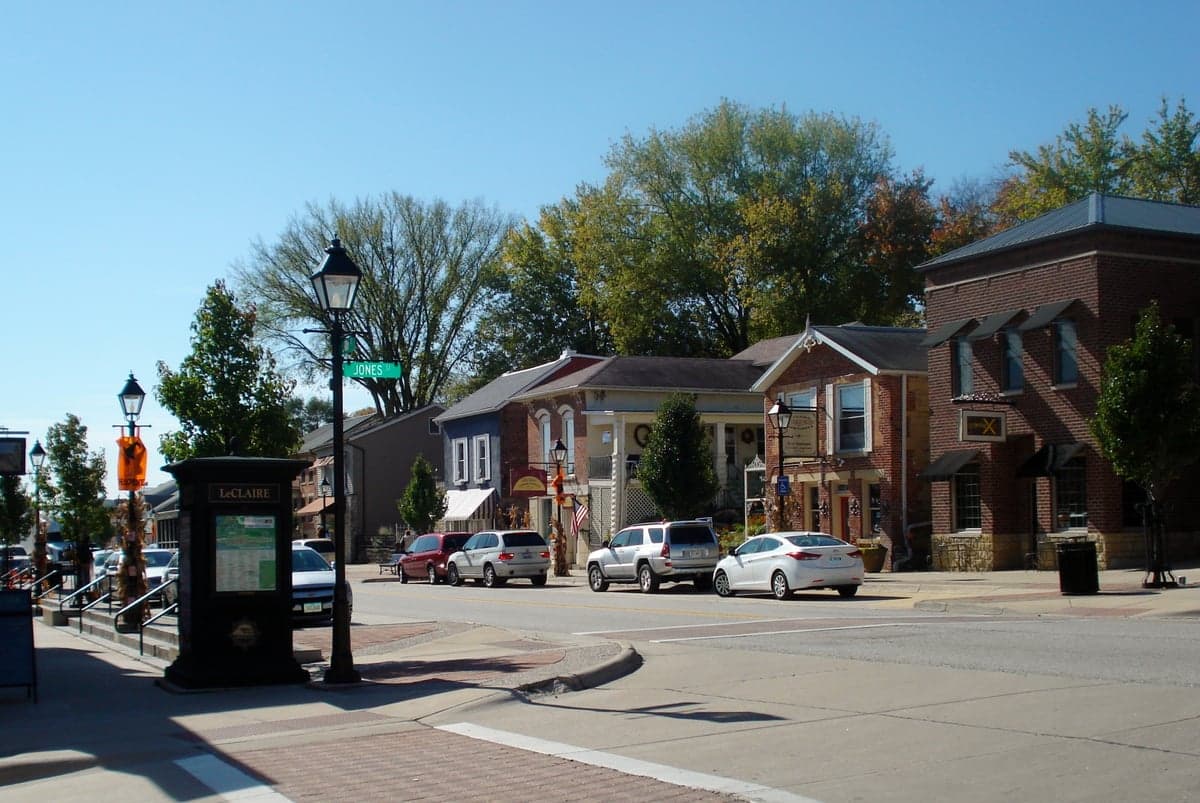
Photo: Wikipedia
Personal Sovereignty in Le Claire, IA
Viable for self-reliance. Generally workable, though some barriers may limit total independence.
What does Personal Sovereignty tell us?
Personal Sovereignty measures your capacity for self-reliance and independence with minimal government friction. Higher scores mean fewer barriers between you and the way you want to live... but it assumes you have the space you need and good neighbors.
What does this tell us?
Personal Sovereignty measures your capacity for self-reliance and independence with minimal government friction. Higher scores mean fewer barriers between you and the way you want to live... but it assumes you have the space you need and good neighbors.
State Policy
Energy independence: Importer (50% of energy produced in-state)
Personal Liberty
Homesteading

Personal Liberty Analysis
Le Claire, Iowa, offers a personal sovereignty environment that leans heavily on the state's strong preemption laws and a generally light-touch local governance structure, making it a compelling option for those prioritizing autonomy. As a small river town of roughly 4,000 residents in Scott County, the community benefits from Iowa's broad protections for gun rights, parental control in education, and a tax structure that avoids the high burdens found in neighboring Illinois. For a relocation researcher evaluating self-reliance, Le Claire presents a practical balance of low regulatory friction and access to the Quad Cities' economic base, though its proximity to more populous areas means some local ordinances warrant scrutiny.
Tax burden and regulatory posture in Le Claire
Iowa's state-level tax reforms, including a flat income tax rate of 3.8% (phasing down to 3.5% by 2026) and no inheritance tax, create a favorable baseline for personal financial sovereignty. Le Claire's local property tax rate is moderate for Scott County, with a 2025 levy of roughly $18.50 per $1,000 of assessed value, which is competitive compared to Bettendorf or Davenport but slightly higher than more rural townships. The city maintains a business-friendly approach with no local sales tax beyond the state's 6% rate, and Scott County's overall tax burden ranks in the lower half of Iowa counties. Regulatory posture is notably light: Le Claire has no rent control, no local minimum wage above the state's $7.25/hour, and no zoning overlay districts that restrict home-based businesses beyond basic nuisance ordinances. The city's planning department processes most permits within 10 business days, and there are no special use permits required for typical home occupations like consulting or online retail. However, the city does enforce a standard building code (2018 International Residential Code) and requires permits for structural changes, which is typical for a town of this size but worth noting for those seeking a completely unregulated environment.
Self-defense and gun law specifics in Le Claire
Iowa's firearm laws are among the most permissive in the Midwest, and Le Claire fully inherits this framework. The state is a constitutional carry jurisdiction, meaning no permit is required to carry a concealed handgun for anyone legally allowed to possess a firearm. Le Claire has no local ordinances restricting open carry, magazine capacity, or firearm storage, and the city does not maintain a gun registry or impose waiting periods. The Scott County Sheriff's Office issues permits to acquire handguns (still required for purchasing from a dealer) within 30 days, and the process is straightforward with no local restrictions beyond state law. Stand-your-ground laws apply statewide, with no duty to retreat in any place where a person is lawfully present. For those concerned about self-defense in the home, Iowa law explicitly protects the use of deadly force against unlawful entry. The closest gun ranges are the Izaak Walton League range in Davenport (15 minutes) and the Scott County Park range (20 minutes), both offering public access. Le Claire's police department is small (about 12 officers), and response times in the town proper average 4-6 minutes, though rural addresses on the outskirts may see 10-15 minute waits, reinforcing the practical need for personal defensive capability.
Self-reliance and homesteading viability in Le Claire
Le Claire's residential zoning allows for substantial self-reliance, particularly on larger lots. The city's minimum lot size in the R-1 (single-family) district is 8,000 square feet, but many properties along the Mississippi River bluffs and in the older sections of town sit on half-acre to one-acre parcels. Chickens are permitted without a special permit, with a limit of six hens (no roosters) on lots under one acre, and up to 12 on larger parcels. Beekeeping is allowed with registration and a setback of 10 feet from property lines. Rainwater collection is unrestricted at the state level, and Le Claire has no local ordinance prohibiting cisterns or rain barrels. Off-grid living is legally feasible: Iowa has no state-level mandate for grid connection, and Le Claire's building code does not require municipal water or sewer hookup if a private well and septic system are installed to county health standards. Solar panels are permitted by right, and net metering is available through MidAmerican Energy, the local utility, at a 1:1 credit rate for excess generation. However, the city does require a building permit for solar installations (typically $75-150), and homeowners' associations in newer subdivisions like the Canyons or River Ridge may impose aesthetic restrictions. For those seeking true homesteading, the unincorporated areas of Scott County just outside Le Claire offer even fewer restrictions, with no zoning and no building permits required for agricultural structures.
Personal liberties in Le Claire: parental rights, medical autonomy, speech, and property
Iowa's legal framework strongly supports parental rights in education. The state's "Parents Bill of Rights" (enacted 2021) requires school districts to notify parents of any medical or mental health services offered to students and to obtain parental consent for most non-emergency care. Le Claire is served by the Pleasant Valley Community School District, which has a reputation for conservative administration and transparent curriculum policies. The district posts all instructional materials online and allows parents to opt their children out of any sex education or health instruction. Homeschooling is deregulated: parents need only file a Form A with the local school board, and there are no required assessments, curriculum approvals, or home visits. Medical autonomy is similarly broad: Iowa has no state vaccine mandate for adults, and while school attendance requires standard immunizations, philosophical exemptions are available for all vaccines. The state's "Right to Try" law allows terminally ill patients access to experimental treatments, and there are no state-level restrictions on dietary supplements or alternative medicine providers. Free speech protections are robust, with Le Claire having no local noise ordinances that restrict amplified speech beyond reasonable hours (10 PM to 7 AM). Property rights are strengthened by Iowa's lack of statewide rent control and its "right to farm" law, which protects agricultural activities from nuisance lawsuits. Le Claire does not have a rental registry or inspection program, and there are no limits on short-term rentals like Airbnb, though the city requires a simple business license ($50 annually) for such operations.
Compared to the broader Quad Cities region, Le Claire offers a notably higher degree of personal sovereignty than its Illinois neighbors, where state income taxes are nearly double, firearm regulations are far stricter, and parental rights in education are more limited. Within Iowa, Le Claire sits in a middle ground: less restrictive than larger cities like Iowa City or Des Moines, which have local ordinances on rental inspections and noise, but slightly more regulated than truly rural townships where no zoning or building codes exist. For a relocation researcher advising a conservative-leaning individual or family, Le Claire represents a pragmatic choice — strong state-level protections for gun rights, parental control, and tax burden, combined with a local government that generally stays out of personal decisions, all within a community that values its small-town character and riverfront lifestyle. The key trade-off is proximity to urban amenities versus the complete regulatory freedom of deep rural areas, but for most autonomy-minded households, Le Claire's balance will feel like a clear win.

* Values derived from national, state, county, city and local statistics and may differ in a specific area. Last updated: 2026-09-05T14:18:40.000Z
Narrative content on this page is AI-generated and may contain mistakes. Verify any details that matter before acting on them.
ReloMaps may earn a commission from affiliate links at no extra cost to you.

