Photo: Wikipedia
Demographics of Le Claire, IA
Affluence Level in Le Claire, IA
A middle-class area roughly in line with national averages across income, home values, education, and employment.
People of Le Claire, IA
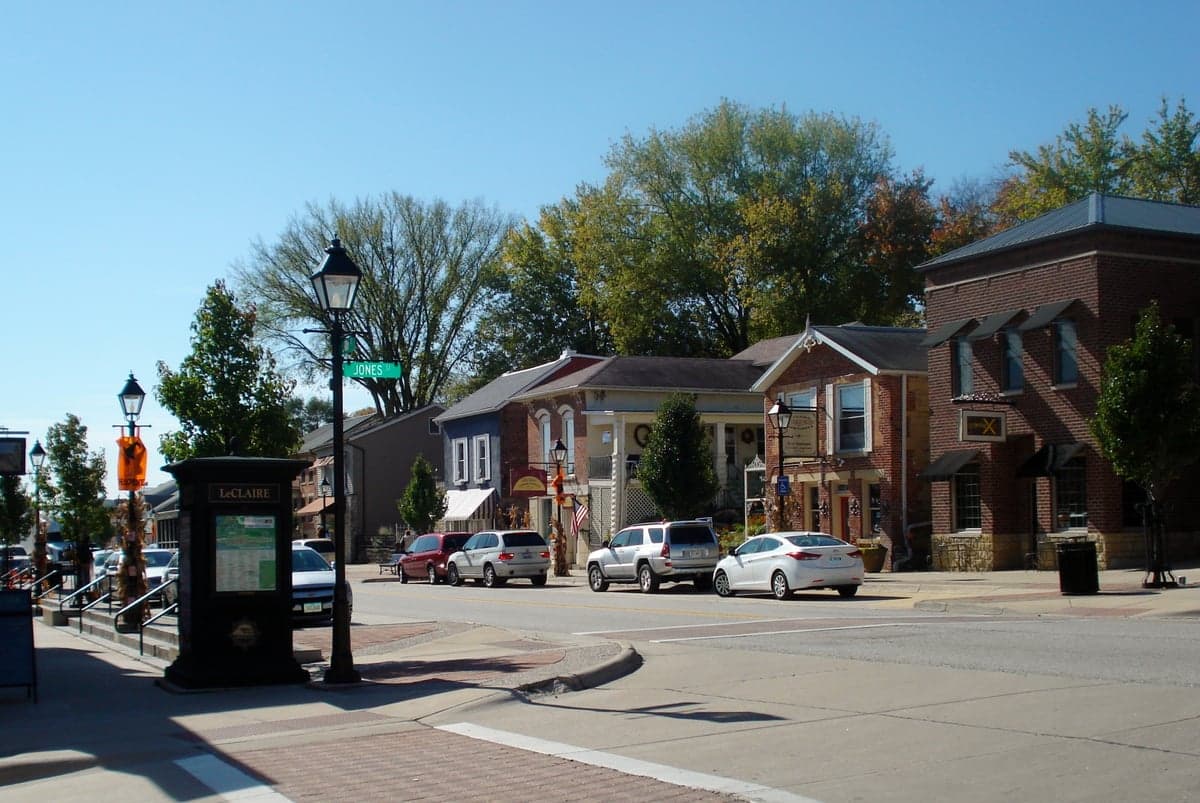
Le Claire, Iowa, is a predominantly white, family-oriented Mississippi River town of 4,718 residents, where 90.9% of the population identifies as white alone. The city’s character is shaped by its historic riverfront, a strong sense of local community, and a demographic profile that is notably less diverse than the national average, with a foreign-born population of just 0.1%. Residents are relatively well-educated, with 38.5% holding a college degree, and the community maintains a quiet, conservative-leaning atmosphere that appeals to those seeking a slower pace of life within commuting distance of the Quad Cities.
How the city was settled and grew
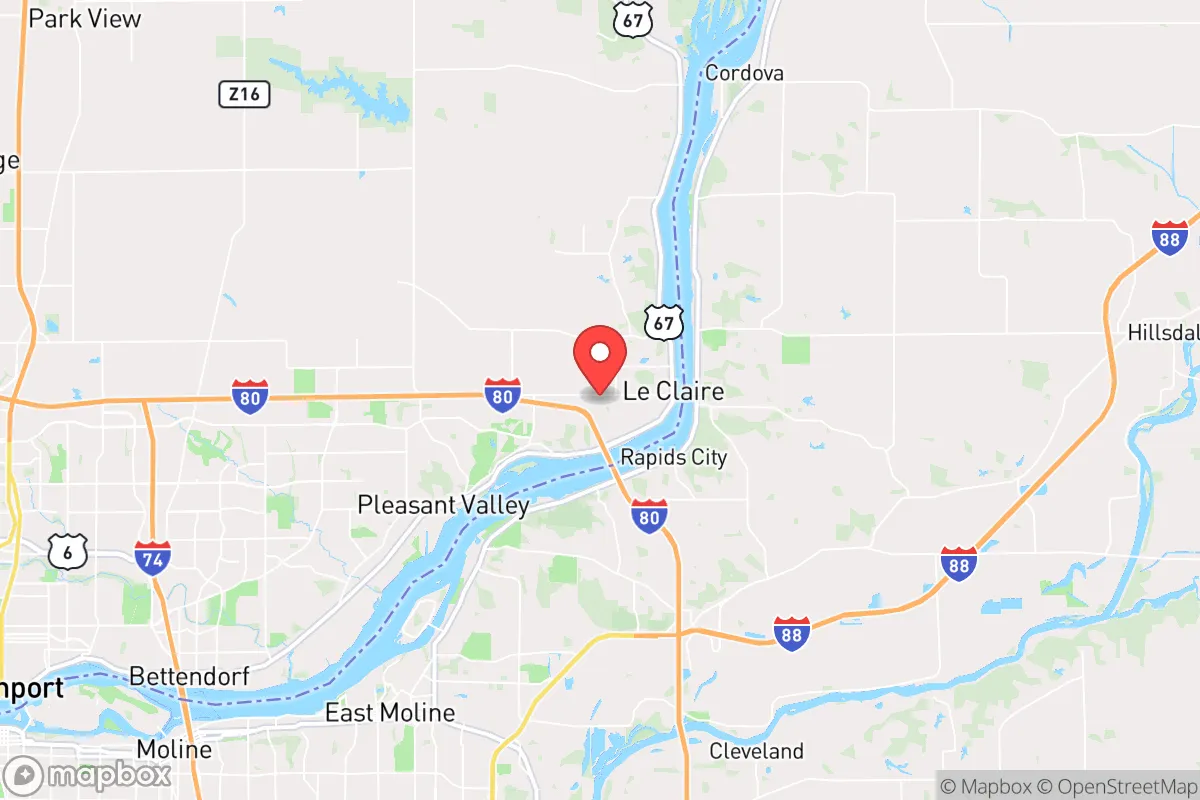
Le Claire’s human history begins with its strategic location on the Mississippi River. The area was originally inhabited by Sauk and Meskwaki tribes, but European-American settlement accelerated after the Black Hawk Purchase of 1832. The town was platted in 1836 and named after Antoine Le Claire, a Métis interpreter and trader who played a key role in early negotiations. The original population was drawn by river commerce and the promise of fertile farmland. Irish and German immigrants formed the backbone of the early workforce, building homes and businesses along the riverfront in what is now known as the Historic Cody Road district, named for Buffalo Bill Cody, who lived there as a boy. These early settlers established a tight-knit, Catholic and Lutheran community centered on river trade and small-scale agriculture. By the late 19th century, the arrival of the railroad solidified Le Claire’s role as a shipping point, attracting a second wave of German and Scandinavian families who settled in the North Le Claire area, near the rail yards and grain elevators. The town’s population remained small and overwhelmingly white through the mid-20th century, with little in-migration from outside the Midwest.
Modern era (post-1965)
Le Claire did not experience the major demographic shifts that transformed many American cities after the 1965 Immigration and Nationality Act. The city’s foreign-born population remains negligible at 0.1%, and its racial composition has stayed overwhelmingly white. The most significant change in the modern era has been domestic in-migration from the nearby Quad Cities metro area, particularly Bettendorf and Davenport, as families sought larger lots and a more rural feel. This suburbanization wave, beginning in the 1980s and accelerating through the 2000s, led to new residential development in the Eagle Ridge and Prairie Heights subdivisions on the city’s western edge. These neighborhoods attracted primarily white, middle-class families, many with ties to local employers like John Deere and the Rock Island Arsenal. The city’s small Hispanic population (1.8%) and Black population (1.3%) are dispersed throughout the community, with no single ethnic enclave forming. The East/Southeast Asian population (0.4%) and Indian subcontinent population (0.3%) are similarly scattered, reflecting the area’s limited draw for immigrant communities. The Riverfront District has seen some reinvestment, with historic homes converted to boutique shops and restaurants, but it remains a predominantly white, owner-occupied area.
The future
Le Claire’s population is projected to grow slowly, driven by continued spillover from the Quad Cities and the appeal of its riverfront lifestyle. The city is unlikely to become significantly more diverse in the near term. The foreign-born population is expected to remain very low, and the Hispanic and Asian shares are likely to increase only incrementally, if at all. New residential development is concentrated in the West Le Claire area, where large-lot subdivisions are being built to accommodate families seeking newer homes and good schools. The city’s cultural identity is likely to remain rooted in its historic, small-town character, with a strong emphasis on community events like the Tug Fest and the Buffalo Bill Cody Rodeo. For a new resident, this means moving into a place where the population is stable, the schools are well-regarded, and the social fabric is built on long-standing local ties rather than rapid demographic change.
Le Claire is becoming a carefully growing, family-oriented bedroom community that preserves its historic river town identity while accommodating modest suburban expansion. For someone moving in now, the city offers a safe, homogeneous environment with strong schools and a clear sense of place, but little racial or ethnic diversity. The population is stable, educated, and rooted in Midwestern values, making it a predictable choice for those seeking continuity over change.

* Values derived from national, state, county, city and local statistics and may differ in a specific area. Last updated: 2026-09-05T14:18:40.000Z
Narrative content on this page is AI-generated and may contain mistakes. Verify any details that matter before acting on them.
ReloMaps may earn a commission from affiliate links at no extra cost to you.

