
Photo: Wikipedia
Political ClimatePolitical Climate in Lake Ozark, MO
District shown is the primary district for this city’s centroid. Cities may span multiple districts.
Local Political AnalysisPolitical Analysis of Lake Ozark, MO
How it compares
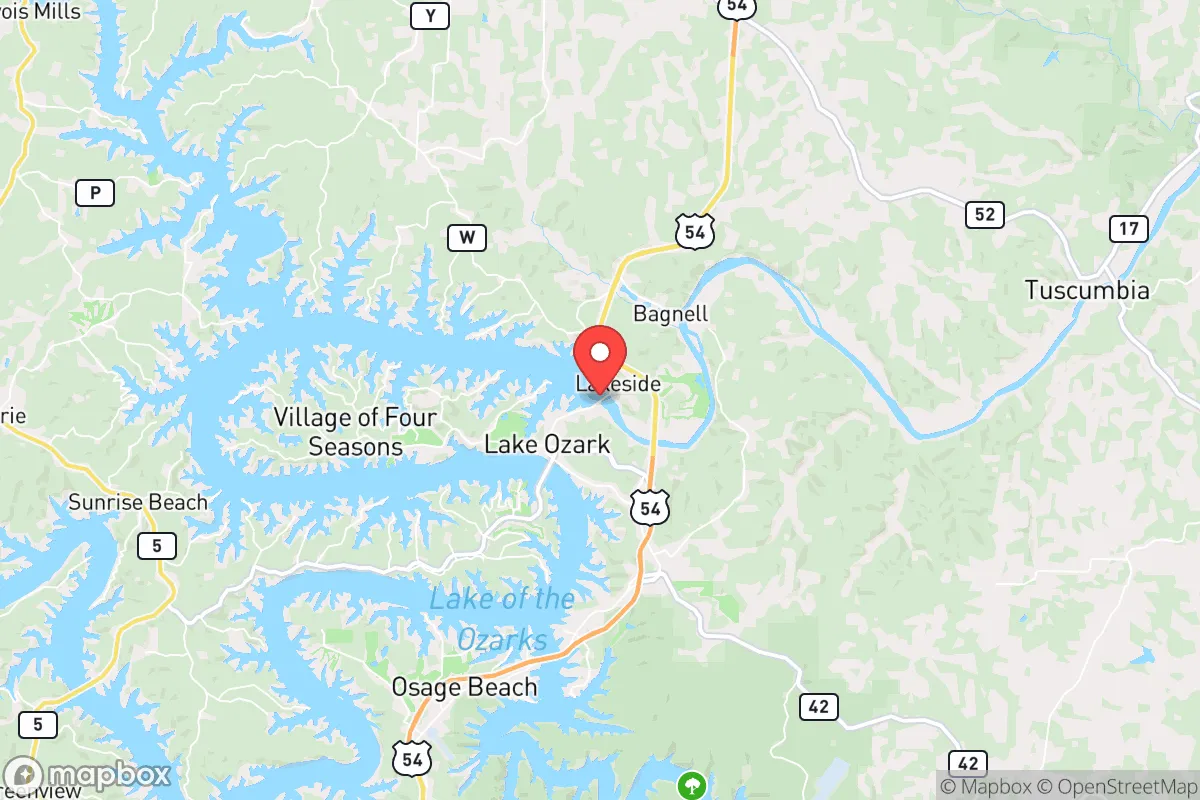
The contrast is sharpest at the county line. Lake Ozark straddles Miller and Camden counties, both of which vote heavily Republican — often 70 percent or better in presidential years — so the city's D+12 lean is a blue island inside deep-red territory. Drive 20 minutes to Osage Beach or Eldon and the politics shift noticeably conservative; Camdenton, the Camden County seat, is reliably Republican down the ballot. Compare that with Columbia (Boone County, genuinely blue) or Jefferson City, which is more purple than people assume. Lake Ozark is closer to Jefferson City's swing character than Columbia's, but its state-level representation is all Republican — the area sits in a GOP-held legislative district and a Republican congressional seat, so local Democrats are effectively a minority voice at every level above city hall.
What this means for residents
In practice, the city's Democratic lean shows up in local governance more than partisan labels: lake-related regulation, short-term rental rules, infrastructure spending, and tourism promotion tend to get pragmatic treatment rather than ideological treatment. For conservative residents, state and county government reliably reflects their views — gun policy, taxes, and school curriculum all run Republican — so the city's lean rarely overrides their priorities. For liberal residents, the reverse is true: they can win a city council seat or shape a local ordinance, but they have almost no leverage on state policy. The practical advice longtime residents give newcomers is to vote in city elections, where a few hundred votes decide things, and to treat state races as foregone conclusions.
The cultural distinction worth knowing: Lake Ozark politics is transactional and lake-centric. The Bagnell Dam, the Party Cove controversies, boating safety rules, and the seasonal economy dominate local debate far more than national culture-war issues. That pragmatism is the city's real political identity, and it's likely to survive the slow rightward drift — even as the D+12 margin shrinks toward toss-up territory over the next decade.

State Political ClimatePolitical Climate in Missouri
State Political AnalysisPolitical Environment in the State
Missouri has settled into a durable Republican lean that Cook Political Report rates at R+8, and the trajectory over the past two decades has been one-directional: a state that twice voted for Bill Clinton and was a genuine presidential bellwether through 2004 has since gone red by widening margins, with Donald Trump carrying it by roughly 15 points in 2016, 2020, and 2024. The coalition driving that shift is the same one reshaping most of the Midwest — rural and exurban voters, small-town Catholics and evangelicals, and working-class families in the Ozarks and Bootheel — while Democrats increasingly concentrate in St. Louis and Kansas City and lose ground almost everywhere else. Republicans hold the governorship, both U.S. Senate seats, supermajorities in the General Assembly, and every statewide office.
Urban vs. rural divide
The map is stark. St. Louis city and Kansas City are deep blue and elect progressive mayors and prosecutors; Jackson County and St. Louis County lean Democratic but have drifted rightward at the margins. Columbia, home to the University of Missouri, and Jefferson City (state government) are blue islands. Everything between them is reliably red. Springfield, the Ozarks hub, is the state's conservative anchor — a fast-growing metro that has become a magnet for transplants from California and the Pacific Northwest seeking lower taxes and a church-centered civic culture. St. Charles County, the sprawling suburban ring northwest of St. Louis, is the state's quintessential red suburb and one of its fastest-growing counties. Cape Girardeau in the southeast and Joplin in the southwest are solidly Republican small metros. The practical result: outside a handful of urban cores, a conservative newcomer will find like-minded neighbors almost anywhere; a liberal one should expect to be outnumbered outside St. Louis, Kansas City, and Columbia.
Policy environment
Missouri is a low-tax, light-regulation state by national standards. It has no state property tax, a relatively low corporate income tax (now being phased down toward 4%), and a personal income tax that has been cut repeatedly since 2014. It is one of the few states with a gas tax that voters raised in 2021 (Proposition D). Right-to-work failed at the ballot in 2018, but union density remains modest. Education policy has moved toward school choice: the 2021 Missouri Empowerment Scholarship Accounts program and later expansions created tax-credit scholarships and, in 2024, a broader open-enrollment framework. On healthcare, Missouri expanded Medicaid via 2020's Amendment 2, though the Republican legislature has repeatedly slow-walked implementation. Election law tightened after 2020: photo ID is now required to vote (2022's Amendment 3, upheld), and the state banned ranked-choice voting and most foreign funding of election administration.
Recent policy direction
The legislature has been busy. On guns, Missouri is among the most permissive states: constitutional carry since 2017, a Second Amendment Preservation Act (2021) that purported to nullify federal gun laws (later partially struck down in federal court), and a 2021 "stand your ground" expansion. On education and parental rights, the Parents' Bill of Rights (2022) and the SAFE Act-style curriculum restrictions on "critical race theory" and gender instruction in early grades have reshaped school districts. On speech and privacy, the state passed a data privacy law in 2024 and has been active on social-media age verification. On bodily autonomy, Missouri enacted one of the nation's strictest abortion bans after Dobbs — a near-total ban with no rape or incest exception — though 2024's Amendment 3, which enshrined abortion rights in the constitution, passed narrowly and is now the subject of ongoing litigation over conflicting statutes. On property rights, the state has leaned toward landowners in eminent-domain fights (notably against the Grain Belt Express transmission line) and passed restrictions on foreign ownership of agricultural land. On voting, the 2022 ID requirement and a 2024 measure barring noncitizen voting (already illegal) signaled the direction. The through-line: a state that trusts private gun ownership, parental authority, and low taxes, but is more restrictive on reproductive autonomy and increasingly willing to regulate tech platforms.
Civil unrest & political movements
Missouri has had visible flashpoints. The 2014 Ferguson unrest after Michael Brown's death put St. Louis County policing under a national microscope and spawned a durable reform movement (and a counter-movement). Black Lives Matter protests in 2020 were met with a strong law-and-order response from then-Governor Mike Parson. On the right, the state has an active Missouri First-style populist current, strong pro-life and gun-rights organizations, and a legislature that has flirted with "nullification" rhetoric on federal mandates — most visibly during COVID-19, when the state resisted mask and vaccine requirements. Immigration politics are live: several counties have passed symbolic "sanctuary-free" resolutions, and the state has cooperated closely with federal immigration enforcement. Election-integrity controversies have been persistent but largely rhetorical; audits have found no systemic fraud. A new resident will notice the culture-war signage, the church-based civic networks, and, in the cities, an organized progressive infrastructure.
Projection
Barring a national realignment, Missouri stays red and probably gets redder at the statewide level over the next decade. In-migration is concentrated in the conservative exurbs — St. Charles, Christian County near Springfield, and the Lake of the Ozarks retirement belt — which reinforces the lean. The cities will remain blue and may grow more so as young professionals cluster there. The real wild cards are the abortion-rights amendment litigation, which could keep reproductive policy in flux for years, and school-choice expansion, which is quietly reshaping suburban school districts. Expect continued tax cuts, further gun-rights expansion, and more parental-rights legislation.
Bottom line for a relocator: if low taxes, strong gun rights, school choice, and a church-friendly civic culture matter to you, Missouri delivers — especially in Springfield, St. Charles, or the Ozarks. If reproductive autonomy, robust public schools, or progressive politics are priorities, you'll want to be inside St. Louis, Kansas City, or Columbia, and even there you'll be in a blue island in a red state. The state is stable, affordable, and politically predictable — which, depending on your priorities, is either the appeal or the catch.
* Values derived from national, state, county, city and local statistics and may differ in a specific area. Last updated: 2026-11-03T04:17:38.000Z
Narrative content on this page is AI-generated and may contain mistakes. Verify any details that matter before acting on them.
ReloMaps may earn a commission from affiliate links at no extra cost to you.

