Photo: Wikipedia
Demographics of Lake Ozark, MO
Affluence Level in Lake Ozark, MO
A middle-class area roughly in line with national averages across income, home values, education, and employment.
People of Lake Ozark, MO
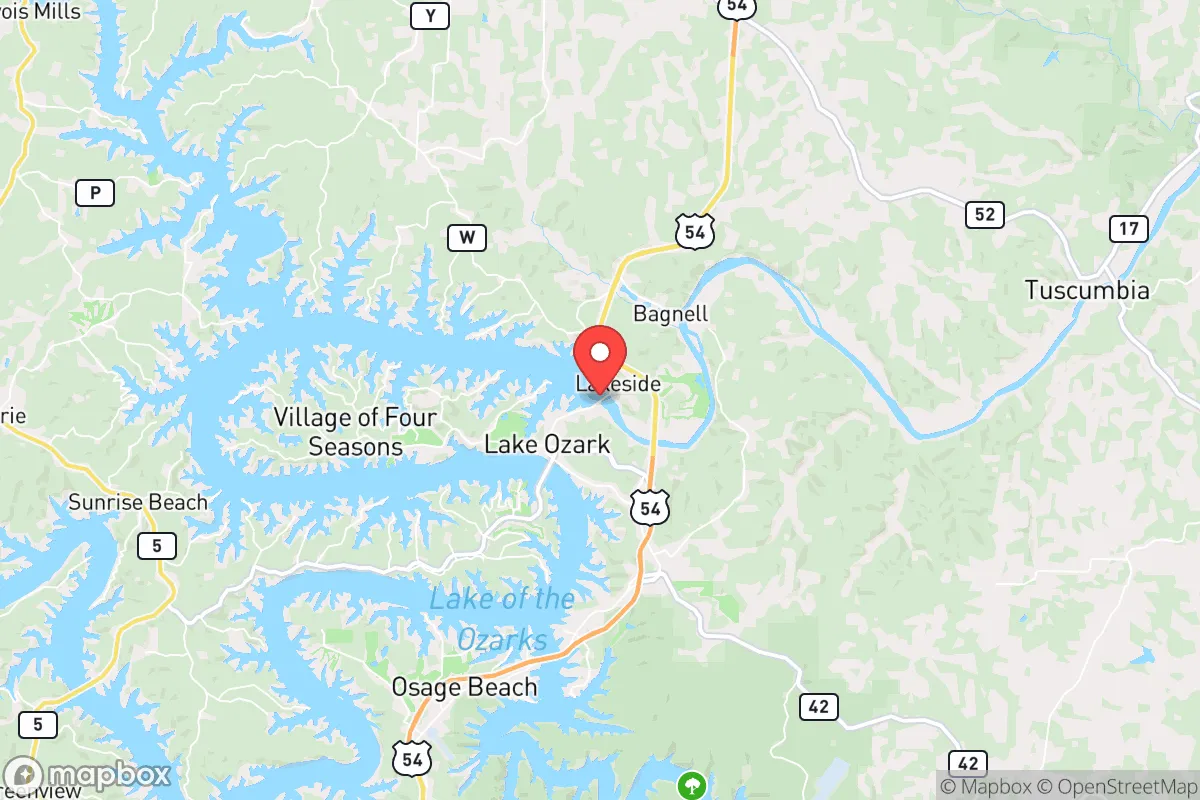
Lake Ozark is a small city of 2,451 residents strung along the Bagnell Dam strip and the bluffs above it, in Miller County on the north side of the Lake of the Ozarks. It is overwhelmingly white (90.7%), with a Black population of 6.1%, a Hispanic share of 0.9%, and a foreign-born share of just 0.3% — one of the lowest immigrant concentrations of any incorporated city in Missouri. The population is unusually well educated for a lake town (40.9% hold a college degree) and skews toward second-home owners, retirees, and service workers who keep the tourism economy running.
How the city was settled and grew
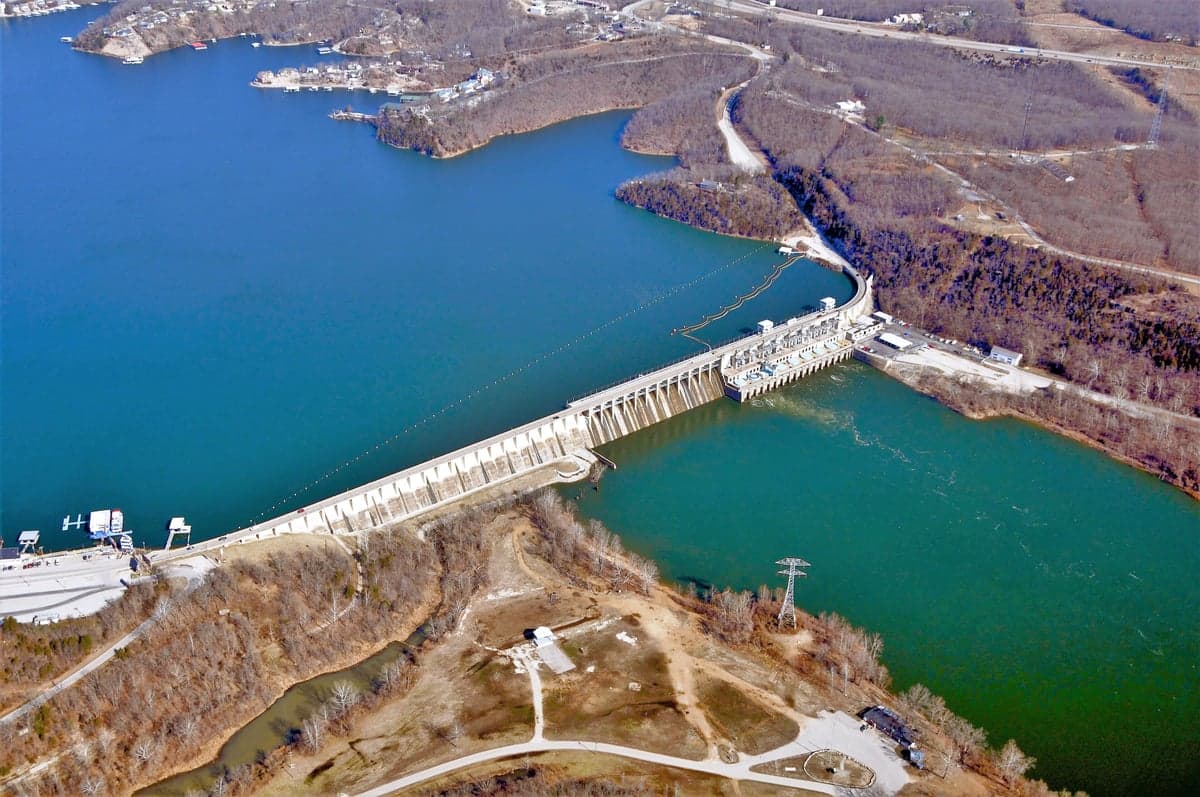
Lake Ozark is a genuinely twentieth-century place: it did not exist before the Bagnell Dam. The Union Electric Company broke ground on the dam in 1929 and finished it in 1931, flooding the Osage River valley to create the Lake of the Ozarks and permanently displacing the small farming hamlets — Bagnell, along the river bottom, was the largest — that had occupied the valley since the 1830s. The city of Lake Ozark was platted on the Miller County shore specifically to serve the construction workforce and then the tourists who followed. Early settlement clustered in three places: Bagnell Dam Strip, the commercial spine of souvenir shops, boat docks, and dance halls that ran from the dam along the water; Horseshoe Bend, the peninsula subdivision where dam engineers and Union Electric managers built the first permanent homes; and the hillside streets off Osage Hills Road, where tradesmen and dock builders settled within walking distance of the strip. Through the mid-20th century the population was almost entirely native-born white Missourians of German, Scotch-Irish, and Ozark yeoman stock, drawn by dam work, the resort trade, and later by the U.S. Highway 54 crossing that made the north shore reachable from Jefferson City and St. Louis.
Modern era (post-1965)
The 1965 Hart-Celler Act reshaped immigration nationally but barely touched Lake Ozark: the foreign-born share remains 0.3%, meaning roughly seven or eight residents in a city of 2,451. The modern era here has been defined instead by domestic in-migration — retirees from Kansas City, St. Louis, and the Kansas and Illinois suburbs buying condos on the water, and a growing workforce commuting to the lake's hospitality and construction trades. That inflow concentrated in Regatta Bay and the Lodge of Four Seasons corridor, where gated subdivisions and golf-course homes absorbed most of the 1990s and 2000s growth, while the older Bagnell Dam Strip and Osage Hills blocks became more rental-heavy and seasonal. The city's Black population (6.1%) is a notable outlier for a rural Missouri lake town and reflects a mix of year-round service workers and military-connected families tied to nearby Fort Leonard Wood and Whiteman AFB. The East/Southeast Asian and Indian-subcontinent populations are statistically negligible — both round to 0.0% — so there is no ethnic enclave of any kind in the city. The one genuinely diverse pocket is the rental stock along the strip, which draws a younger, more transient, and more racially mixed population than the gated subdivisions above it.
The future
Lake Ozark is likely to stay small, white, and native-born through 2045. The city's growth constraint is geography and sewer capacity, not demand; the buildable shoreline is largely developed, and new construction is pushing outward along Highway 54 toward Osage Beach and the Community Bridge approach rather than densifying inside city limits. Demographically, expect the college-educated share to keep climbing as remote workers and early retirees discover the lake, the median age to rise, and the Hispanic and foreign-born shares to remain in the low single digits — this is not a gateway community and shows no sign of becoming one. The Black share may tick up modestly as Fort Leonard Wood and lake-hospital employment draw more families, but the city's cultural identity will continue to be defined by Ozark-rooted families, second-home owners, and the tourism calendar rather than by immigration. The likeliest change is class rather than race: a widening gap between the gated subdivisions at Regatta Bay and the Lodge and the aging, rental-heavy strip below.
For a family or individual moving in now, Lake Ozark is a homogeneous, low-diversity, high-education lake town where the population is stable rather than transforming — you will find an established white middle-class base, a small but real Black community, essentially no immigrant infrastructure, and a housing market split between resort-grade waterfront and older working housing on the strip. Anyone expecting a diversifying Sun Belt suburb will be surprised; anyone looking for a settled, low-turnover Ozark community with a tourism economy will find exactly that.

* Values derived from national, state, county, city and local statistics and may differ in a specific area. Last updated: 2026-11-03T04:17:38.000Z
Narrative content on this page is AI-generated and may contain mistakes. Verify any details that matter before acting on them.
ReloMaps may earn a commission from affiliate links at no extra cost to you.

