Photo: Wikipedia
Personal Sovereignty in Lake Ozark, MO
Strong independent fundamentals that actively favor personal liberty and low regulation.
What does Personal Sovereignty tell us?
Personal Sovereignty measures your capacity for self-reliance and independence with minimal government friction. Higher scores mean fewer barriers between you and the way you want to live... but it assumes you have the space you need and good neighbors.
What does this tell us?
Personal Sovereignty measures your capacity for self-reliance and independence with minimal government friction. Higher scores mean fewer barriers between you and the way you want to live... but it assumes you have the space you need and good neighbors.
State Policy
Energy independence: Importer (14% of energy produced in-state)
Personal Liberty
Homesteading

Personal Liberty Analysis
Lake Ozark sits in Miller County on the north side of the Lake of the Ozarks, and for a reader who ranks personal autonomy near the top of the relocation checklist, the honest summary is this: Missouri is a comparatively light-touch state on taxes, gun law, and property rights, and Lake Ozark inherits most of that posture — but the city itself is a tourism-and-waterfront municipality with its own code, short-term rental rules, and shoreline regulation layered on top. The result is a place where you can keep a lot of what you earn and defend your household with few legal obstacles, but where building, subdividing, and going fully off-grid run into practical and regulatory friction. Below is how that breaks down by category.
How heavy is the tax and regulatory burden in Lake Ozark?
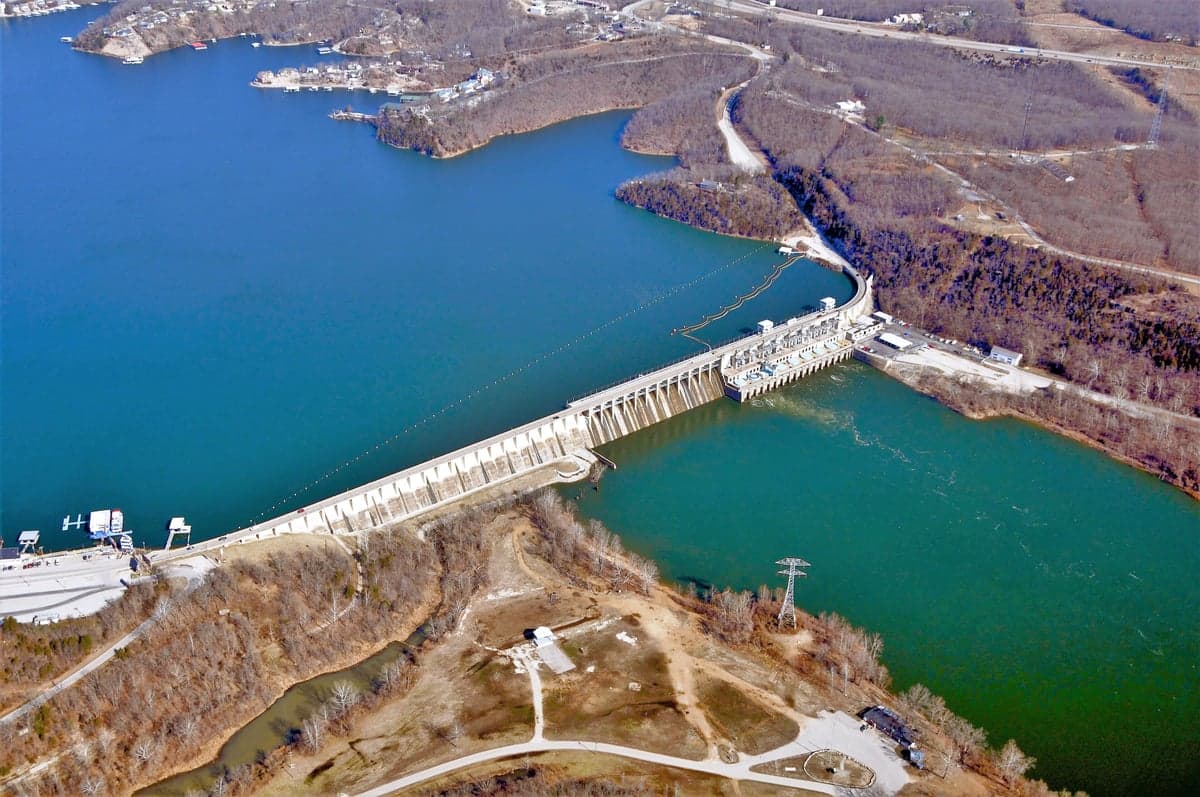
Missouri is one of the more tax-friendly states in the country, and that shows up directly in a Lake Ozark budget. The state income tax has been phasing down under a 2022 law and sits at 3.5% for 2025, with further triggers tied to revenue growth. The state sales tax is a low 4.225%, though Miller County and Lake Ozark add local increments that push the combined rate into roughly the 7–9% range depending on the zone. Property taxes are assessed on a fractional basis — residential property at 19% of market value — and Miller County's levies are modest by national standards, so a typical lake-area home carries a far lighter annual property tax bill than a comparable house in Illinois or Kansas. Missouri also exempts most retirement income and Social Security from state tax, which matters for older relocators. The regulatory side is where the friction lives: Lake Ozark has a planning and zoning department, a building permit process, and — critically for waterfront owners — shoreline and dock permitting that runs through both the city and Ameren Missouri's federal license for the Osage hydroelectric project. If your definition of freedom includes "build whatever I want on my lot," the lakefront is not the place for it. If it means "keep more of my money and deal with a normal small-city permit desk," it's a reasonable fit.
What Missouri's self-defense and gun laws mean for Lake Ozark residents
Missouri is one of the strongest self-defense states in the country, and Lake Ozark residents operate under that framework. The state adopted constitutional carry in 2017, meaning any law-abiding adult 19 or older can carry a concealed firearm without a permit; a concealed carry permit is still available for reciprocity purposes if you travel. Missouri's Stand Your Ground law removes any duty to retreat before using deadly force in a place you have a right to be, and the state's Castle Doctrine extends strong protection to your home and vehicle. The Missouri Supreme Court has also treated the right to keep and bear arms as fundamental under the state constitution, which insulates it from some of the legislative churn seen elsewhere. Practically, that means a Lake Ozark homeowner has wide latitude on firearms storage, carry, and defensive use, with the usual caveats about federal law, prohibited persons, and the fact that any defensive incident will still be scrutinized. For families who want their kids trained in firearm safety and hunting — the lake area has active deer and turkey seasons and plenty of nearby public land — the legal environment is permissive and the local culture is broadly aligned.
Can you homestead or go off-grid on a Lake Ozark lot?
This is the category where expectations need calibrating. Lake Ozark proper is a small city of roughly 2,000 full-time residents wrapped around a heavily developed waterfront, and its platted lots are often small, steep, and served by city water and sewer. Homesteading-scale acreage — think 5 to 40 acres with room for a garden, livestock, a shop, and a well — is generally found outside city limits in unincorporated Miller County, in places like the Eldon, Kaiser, and Brumley areas. There, Missouri's right-to-farm protections and relatively permissive county zoning give you real room to operate: chickens, goats, and small-scale agriculture are workable, and Missouri has no statewide zoning outside municipalities. Off-grid feasibility is mixed. Solar works but the Ozarks' tree cover and winter cloud cover mean you should size a system conservatively; wells are common and generally productive in the region; septic systems are standard where sewer isn't available. What you should not expect is a no-rules environment — Missouri requires permitted septic systems, the county enforces health and building codes in many contexts, and any structure near the lake triggers shoreline regulation. The realistic play is buying acreage a few miles off the water, not trying to homestead a lakefront lot.
How personal liberties play out in daily life around Lake Ozark
On the liberties that drive a lot of relocation decisions, Missouri leans toward parental and property rights. The state's school choice landscape is among the broadest in the country, with charter expansion and a tax-credit scholarship program giving families alternatives to the local district, and homeschooling is lightly regulated — Missouri requires roughly 1,000 hours of instruction and record-keeping but no state approval or testing. On medical autonomy, Missouri has been more active than some states: it was among the first to prohibit vaccine mandates in most public settings and has pushed back on federal mandates, though the picture is a patchwork that changes with each legislative session. Speech and property rights follow the general Missouri pattern — strong constitutional protections, with the usual municipal levers on signage, short-term rentals, and nuisance. Lake Ozark's short-term rental rules are the one area where a property owner may feel the city's hand more than expected, since the tourism economy has driven regulation of vacation rentals. For a family prioritizing independence, the practical takeaway is that state law gives you wide latitude, and the city's main impositions are land-use and rental-related rather than ideological.
Weighed against other lake and exurban markets, Lake Ozark lands in the "moderately free, with strings attached" bucket. It beats Illinois, California, and most of the Northeast decisively on taxes, gun law, and property rights, and it holds its own against most of the South on self-defense and school choice. It trails the most permissive rural counties in the Mountain West and parts of the Ozarks' own unincorporated backcountry, where you can buy acreage with almost no code overhead. The strategic read: if your priority is keeping earnings, carrying without a permit, defending your home, and homeschooling without interference, Lake Ozark delivers — provided you accept that the waterfront comes with a permit desk, and that true homesteading means looking a few miles inland.

* Values derived from national, state, county, city and local statistics and may differ in a specific area. Last updated: 2026-11-03T04:17:38.000Z
Narrative content on this page is AI-generated and may contain mistakes. Verify any details that matter before acting on them.
ReloMaps may earn a commission from affiliate links at no extra cost to you.

